QUESTION IMAGE
Question
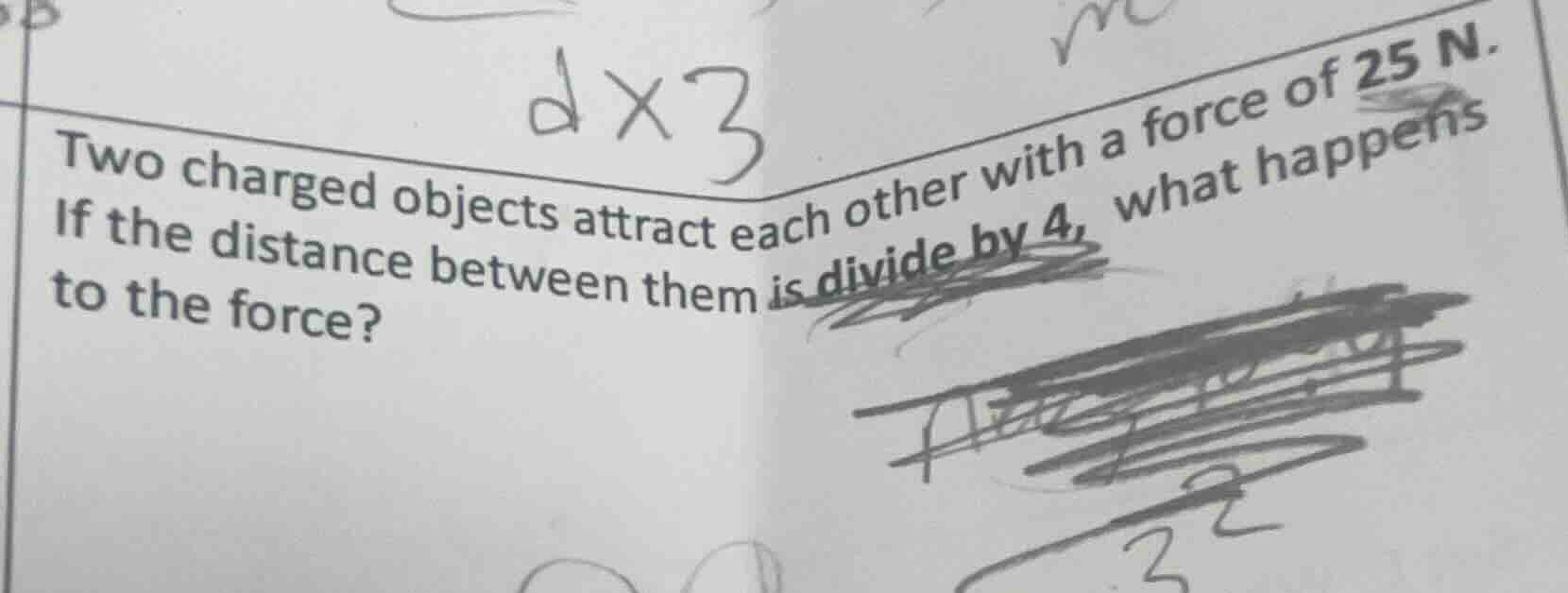
two charged objects attract each other with a force of 25 n. if the distance between them is divide by 4, what happens to the force?
Step1: Recall Coulomb's Law
The electrostatic force between two charged objects is given by $$F = k\frac{q_1q_2}{r^2}$$ where $k$ is Coulomb's constant, $q_1,q_2$ are the charges, and $r$ is the distance between them.
Step2: Define initial force
Let initial force $F_1 = 25\ \text{N}$, initial distance $r_1 = r$. So $$25 = k\frac{q_1q_2}{r^2}$$
Step3: Calculate new distance
New distance $r_2 = \frac{r}{4}$.
Step4: Compute new force $F_2$
Substitute $r_2$ into Coulomb's Law:
$$F_2 = k\frac{q_1q_2}{(\frac{r}{4})^2} = k\frac{q_1q_2}{\frac{r^2}{16}} = 16k\frac{q_1q_2}{r^2}$$
From Step2, $k\frac{q_1q_2}{r^2}=25\ \text{N}$, so $$F_2 = 16\times25$$
Step5: Solve for $F_2$
$$F_2 = 400\ \text{N}$$

Snap & solve any problem in the app
Get step-by-step solutions on Sovi AI
Photo-based solutions with guided steps
Explore more problems and detailed explanations
The electrostatic force increases to 400 N (it becomes 16 times the original force).