QUESTION IMAGE
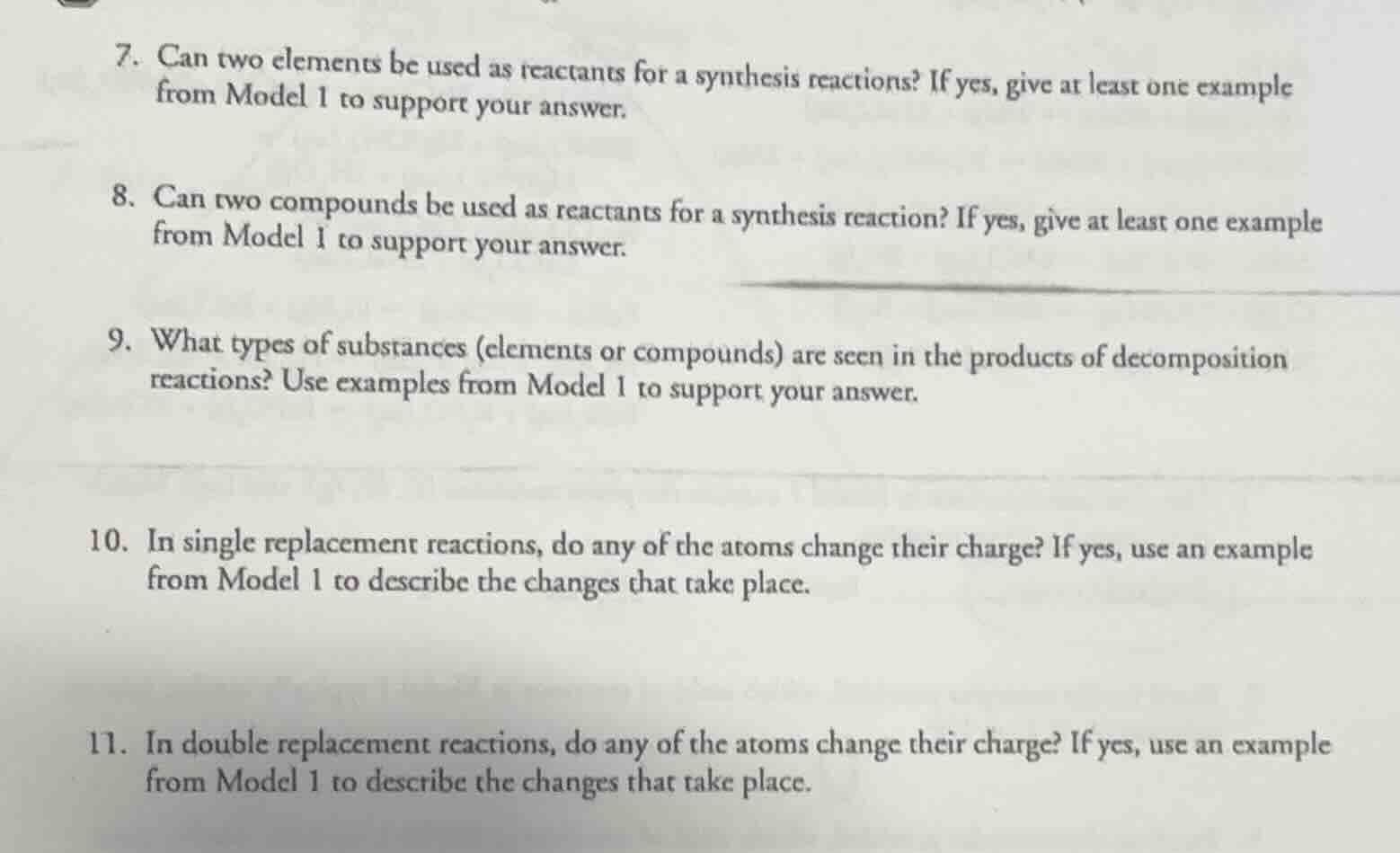
Question
- can two elements be used as reactants for a synthesis reactions? if yes, give at least one example from model 1 to support your answer.
- can two compounds be used as reactants for a synthesis reaction? if yes, give at least one example from model 1 to support your answer.
- what types of substances (elements or compounds) are seen in the products of decomposition reactions? use examples from model 1 to support your answer.
- in single replacement reactions, do any of the atoms change their charge? if yes, use an example from model 1 to describe the changes that take place.
- in double replacement reactions, do any of the atoms change their charge? if yes, use an example from model 1 to describe the changes that take place.
Question 7
A synthesis reaction combines reactants to form a single product. Two elements can react: e.g., \( \ce{2H_2 + O_2 -> 2H_2O} \) (hydrogen and oxygen, both elements, form water).
Synthesis can use two compounds. E.g., \( \ce{CaO + CO_2 -> CaCO_3} \) (calcium oxide and carbon dioxide, both compounds, form calcium carbonate).
Decomposition breaks a compound into simpler substances. Products can be elements (e.g., \( \ce{2H_2O -> 2H_2 + O_2} \), products \( \ce{H_2} \) and \( \ce{O_2} \) are elements) or compounds (e.g., \( \ce{CaCO_3 -> CaO + CO_2} \), products \( \ce{CaO} \) and \( \ce{CO_2} \) are compounds).

Snap & solve any problem in the app
Get step-by-step solutions on Sovi AI
Photo-based solutions with guided steps
Explore more problems and detailed explanations
Yes. Example: \( \ce{2H_2 + O_2 -> 2H_2O} \) (hydrogen and oxygen, elements, synthesize water).