QUESTION IMAGE
Question
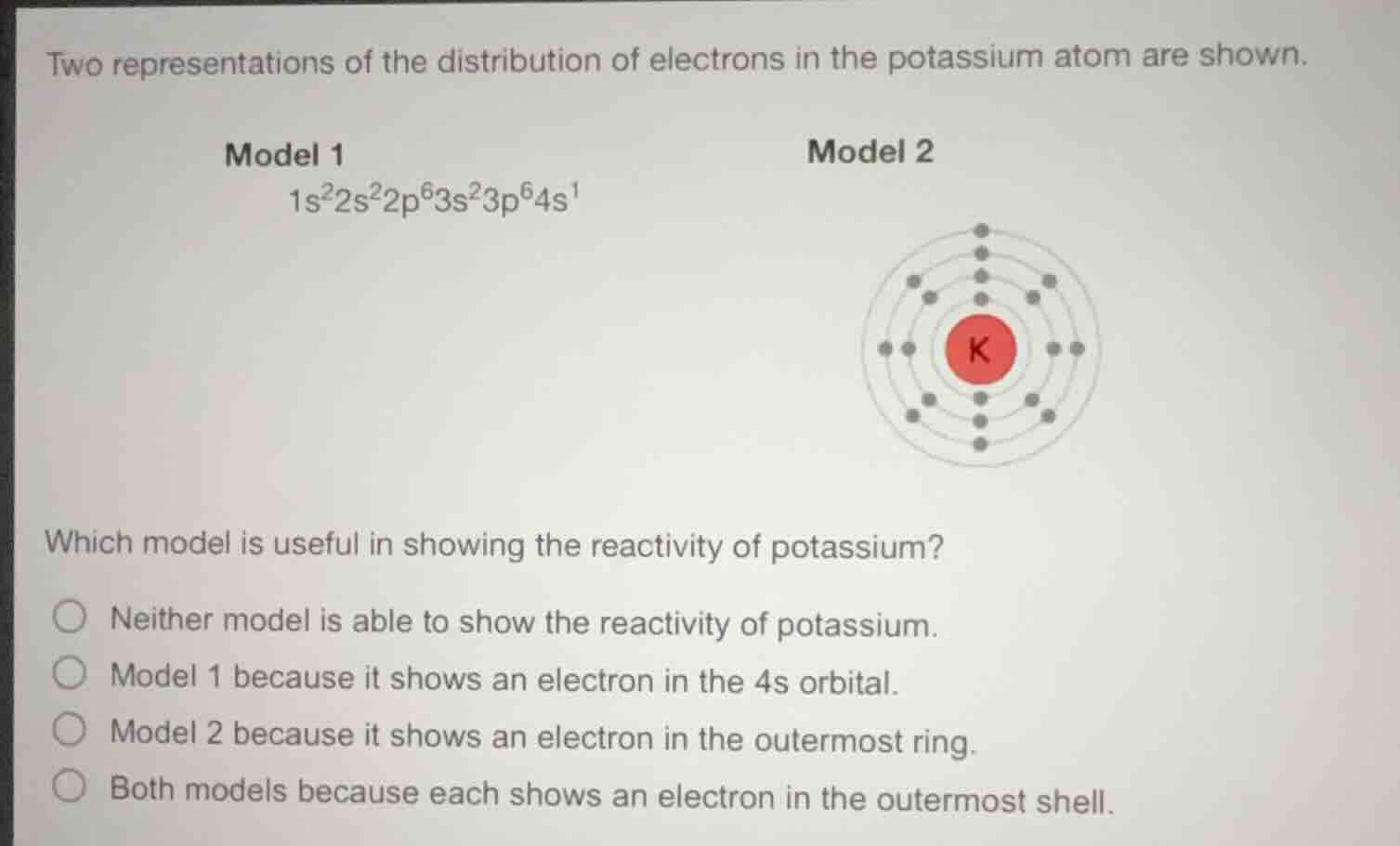
two representations of the distribution of electrons in the potassium atom are shown.
model 1
$1s^2 2s^2 2p^6 3s^2 3p^6 4s^1$
model 2
which model is useful in showing the reactivity of potassium?
neither model is able to show the reactivity of potassium.
model 1 because it shows an electron in the 4s orbital.
model 2 because it shows an electron in the outermost ring.
both models because each shows an electron in the outermost shell.
The reactivity of an atom is mainly determined by the number of electrons in its outermost shell (valence electrons). Model 2 is a Bohr - like model that shows the electrons in different energy levels (rings), and it clearly displays the outermost ring with its electron. Model 1 is an electron - configuration notation, which is more about the orbital - based arrangement. To determine reactivity, the outermost shell (or ring) electrons are key. Model 2 shows the outermost ring's electron, which is crucial for reactivity as potassium (a metal) tends to lose its outermost electron. The first option is wrong as at least Model 2 can help. Model 1's focus on the 4s orbital is not as direct for showing reactivity as Model 2's display of the outermost ring. The “both models” option is wrong because Model 1's notation doesn't as clearly show the outermost shell in a way that's intuitive for reactivity (compared to the ring - based Model 2).

Snap & solve any problem in the app
Get step-by-step solutions on Sovi AI
Photo-based solutions with guided steps
Explore more problems and detailed explanations
Model 2 because it shows an electron in the outermost ring.