QUESTION IMAGE
Question
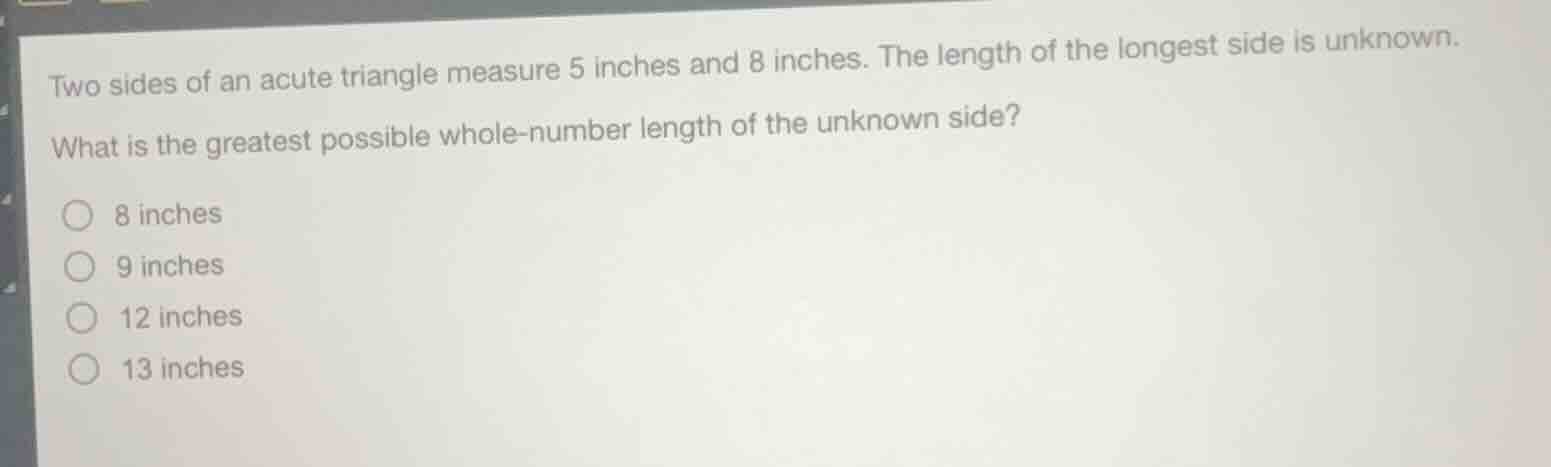
two sides of an acute triangle measure 5 inches and 8 inches. the length of the longest side is unknown. what is the greatest possible whole - number length of the unknown side? 8 inches 9 inches 12 inches 13 inches
Step1: Recall triangle inequality and acute triangle condition
For a triangle with sides \(a\), \(b\), \(c\) (where \(c\) is the longest side), the triangle inequality is \(a + b>c\). For an acute triangle, the Pythagorean inequality for the longest side \(c\) (opposite the largest angle) is \(a^{2}+b^{2}>c^{2}\) (since the triangle is acute, the square of the longest side must be less than the sum of the squares of the other two sides). Here, \(a = 5\), \(b = 8\), and \(c\) is the unknown longest side.
First, from the triangle inequality: \(5 + 8>c\) i.e., \(c < 13\).
Second, from the acute triangle condition: \(c^{2}<5^{2}+8^{2}\)
Calculate \(5^{2}+8^{2}=25 + 64=89\)
So \(c^{2}<89\), then \(c<\sqrt{89}\approx9.43\)
Since \(c\) is a whole number and the longest side (so \(c\geq8\) as 8 is one of the given sides and it could be the longest or \(c\) is longer than 8), we find the greatest whole number \(c\) such that \(c < 9.43\) and \(c\geq8\) and \(c < 13\). The possible values for \(c\) (longest side) are 8, 9 (since 9 < 9.43). We need the greatest possible whole - number length, so we check 9:
Check triangle inequality: \(5 + 8>9\) (13>9, true)
Check acute condition: \(9^{2}=81<89\) (true)
Check 10: \(10^{2}=100>89\) (not acute)
Check 12: \(12^{2}=144>89\) (not acute)
Check 13: \(13^{2}=169>89\) and \(5 + 8 = 13\) (not a triangle as \(c\) must be less than 13 for triangle inequality)
Step2: Determine the greatest whole - number length
From the above analysis, the greatest whole - number length of the unknown side (longest side) is 9 inches.

Snap & solve any problem in the app
Get step-by-step solutions on Sovi AI
Photo-based solutions with guided steps
Explore more problems and detailed explanations
B. 9 inches