QUESTION IMAGE
Question
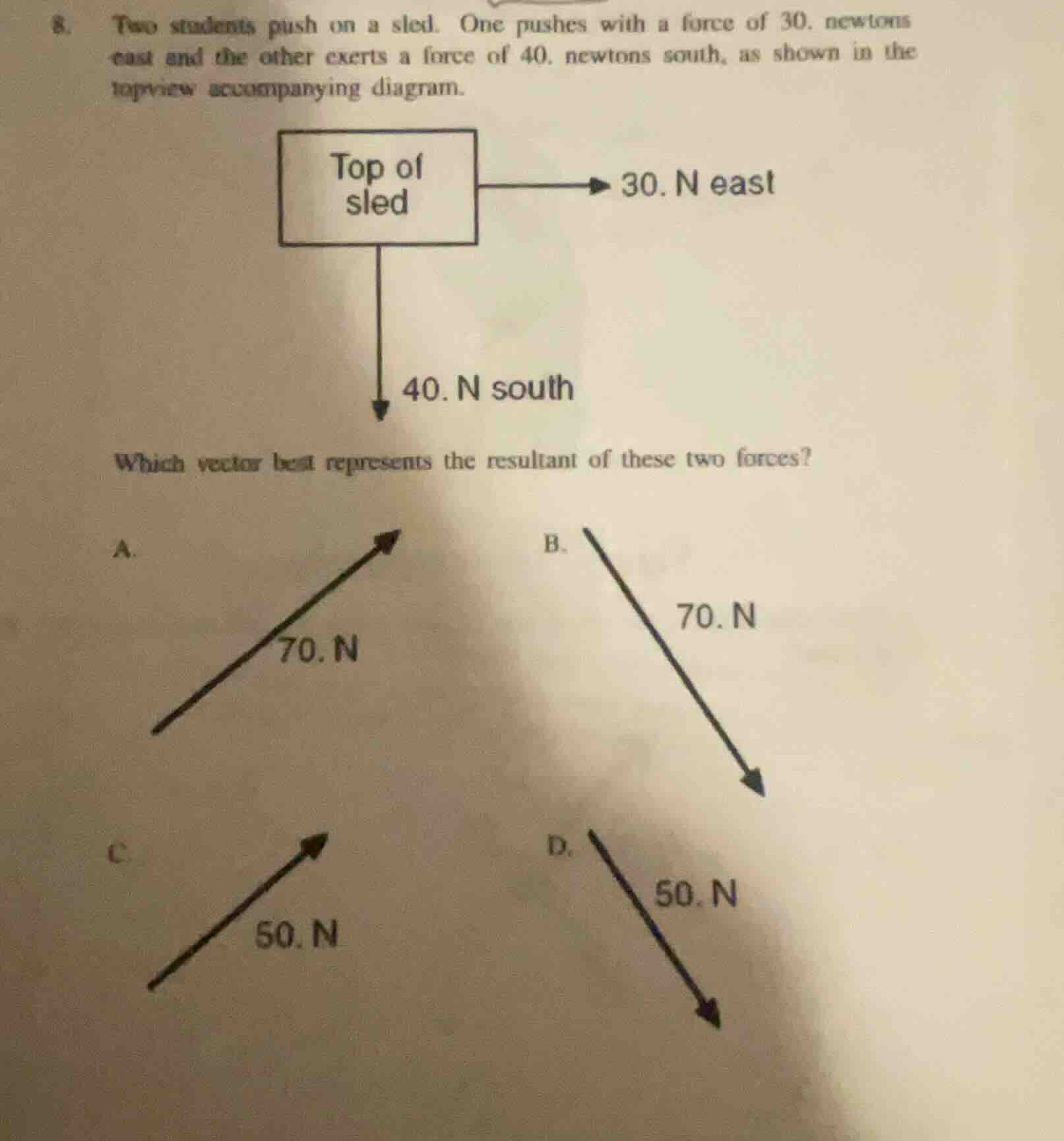
- two students push on a sled. one pushes with a force of 30. newtons east and the other exerts a force of 40. newtons south, as shown in the topview accompanying diagram.
diagram: top of sled with arrow → 30. n east and arrow ↓ 40. n south
which vector best represents the resultant of these two forces?
a. arrow with 70. n
b. arrow with 70. n
c. arrow with 50. n
d. arrow with 50. n
Step1: Recognize the forces as perpendicular vectors.
The two forces (30 N east and 40 N south) are perpendicular to each other (east - west and north - south are perpendicular directions). So we can use the Pythagorean theorem to find the magnitude of the resultant force. The Pythagorean theorem for two perpendicular vectors \(\vec{F}_1\) and \(\vec{F}_2\) with magnitudes \(F_1\) and \(F_2\) is \(F_{resultant}=\sqrt{F_1^{2}+F_2^{2}}\).
Step2: Substitute the values into the formula.
Here, \(F_1 = 30\space N\) and \(F_2=40\space N\). So, \(F_{resultant}=\sqrt{(30)^{2}+(40)^{2}}\)
First, calculate the squares: \((30)^{2}=900\) and \((40)^{2} = 1600\)
Then, add them: \(900 + 1600=2500\)
Now, take the square root: \(\sqrt{2500} = 50\space N\)
Step3: Determine the direction of the resultant.
The force of 30 N is east and 40 N is south. So the resultant force should be in the direction of southeast (between east and south). Now, looking at the options:
- Option A: Magnitude is 70 N, which is wrong (we calculated 50 N).
- Option B: Magnitude is 70 N, wrong.
- Option C: Direction is northeast (upwards and to the right), but our resultant should be southeast (downwards and to the right? Wait, no: east is right, south is down. So the resultant should be in the fourth quadrant (if we consider east as positive x and north as positive y, then south is negative y). Wait, maybe the diagram for options: Let's re - check. The two forces: east (right) and south (down). So the resultant should be a vector going from the tail of the first vector (or the origin) to the head of the second vector when we place them tip - to - tail. So if we draw 30 N east (right) and then 40 N south (down) from the tip of the first vector, the resultant is from the tail of the first to the head of the second. So the direction is southeast. Now, option D has magnitude 50 N and direction towards southeast (the vector is going down and to the right? Wait, the options: Let's see the vectors. Option D: the vector is going in a direction that is south - east (since it's a combination of south and east components). Option C is north - east. So since our forces are east and south, the resultant is south - east, and magnitude 50 N. So option D.

Snap & solve any problem in the app
Get step-by-step solutions on Sovi AI
Photo-based solutions with guided steps
Explore more problems and detailed explanations
D. 50. N (with the vector direction representing the resultant of 30 N east and 40 N south)