QUESTION IMAGE
Question
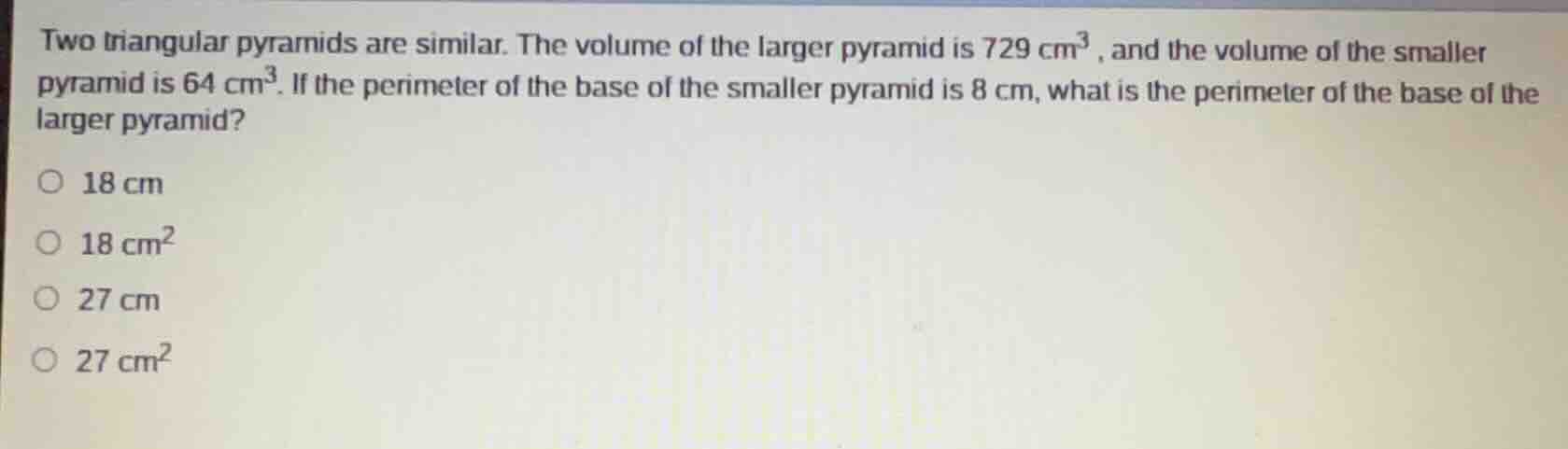
two triangular pyramids are similar. the volume of the larger pyramid is $729\\ \mathrm{cm}^3$, and the volume of the smaller pyramid is $64\\ \mathrm{cm}^3$. if the perimeter of the base of the smaller pyramid is $8\\ \mathrm{cm}$, what is the perimeter of the base of the larger pyramid?\
\\(\bigcirc\\) $18\\ \mathrm{cm}$\
\\(\bigcirc\\) $18\\ \mathrm{cm}^2$\
\\(\bigcirc\\) $27\\ \mathrm{cm}$\
\\(\bigcirc\\) $27\\ \mathrm{cm}^2$
Step1: Recall the ratio of volumes for similar solids
For similar solids, the ratio of their volumes is the cube of the ratio of their corresponding linear dimensions (like perimeter, side length, etc.). Let the ratio of the linear dimensions (perimeter here) of the larger pyramid to the smaller one be \( k \). So, \( \frac{V_{larger}}{V_{smaller}} = k^3 \).
Given \( V_{larger} = 729 \, \text{cm}^3 \) and \( V_{smaller} = 64 \, \text{cm}^3 \), we have \( \frac{729}{64} = k^3 \).
Step2: Find the value of \( k \)
Taking the cube root of both sides, \( k = \sqrt[3]{\frac{729}{64}} \). Since \( 729 = 9^3 \) and \( 64 = 4^3 \), \( k = \frac{9}{4} \).
Step3: Relate the perimeters using the ratio \( k \)
Let \( P_{smaller} = 8 \, \text{cm} \) (perimeter of smaller base) and \( P_{larger} \) be the perimeter of the larger base. Since \( k = \frac{P_{larger}}{P_{smaller}} \), we can solve for \( P_{larger} \).
Substituting the values, \( P_{larger} = k \times P_{smaller} = \frac{9}{4} \times 8 \).
Calculating \( \frac{9}{4} \times 8 = 9 \times 2 = 18 \, \text{cm} \). Also, perimeter is a linear measure, so the unit is cm, not \( \text{cm}^2 \) (which is for area).

Snap & solve any problem in the app
Get step-by-step solutions on Sovi AI
Photo-based solutions with guided steps
Explore more problems and detailed explanations
18 cm