QUESTION IMAGE
Question
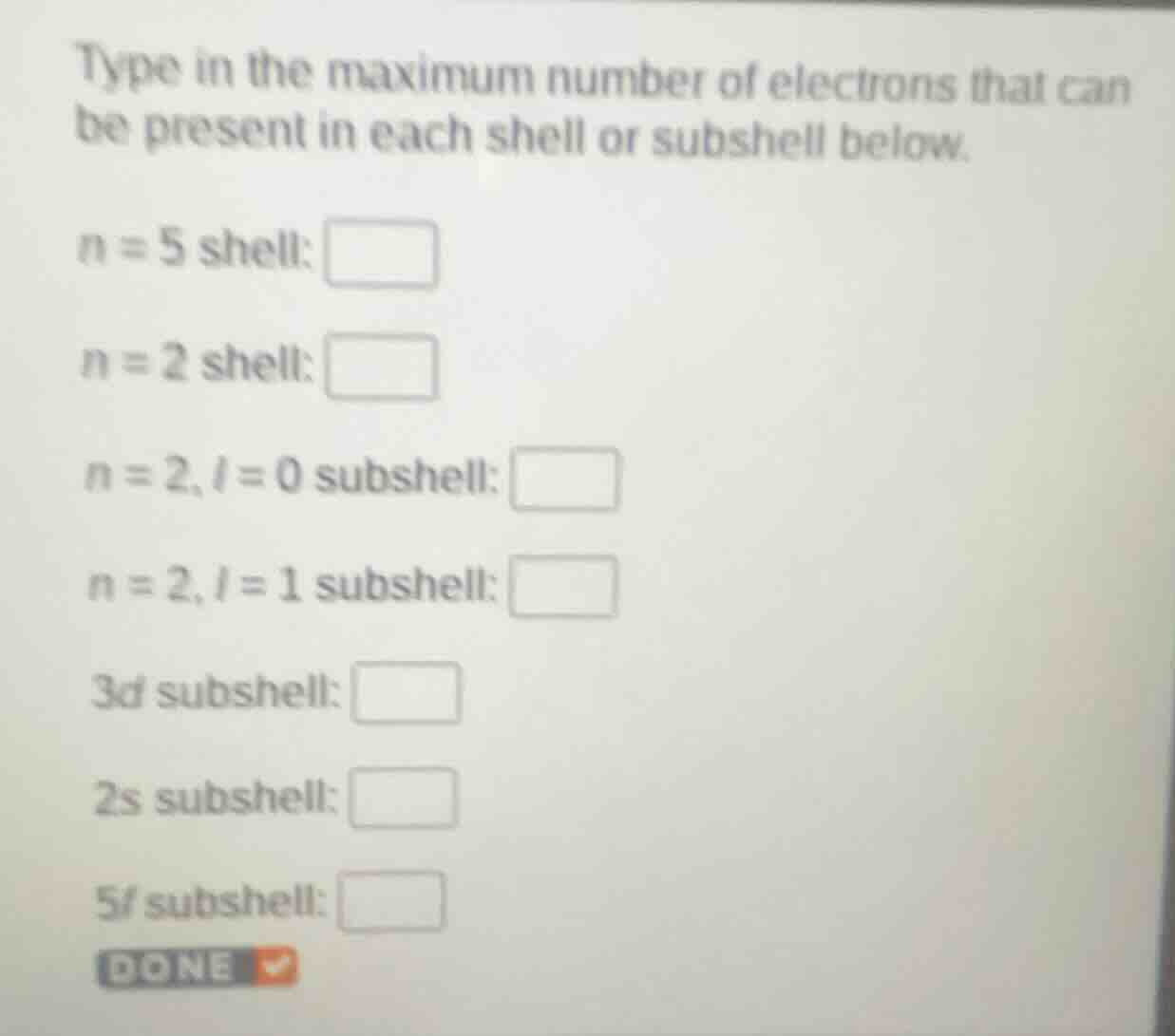
type in the maximum number of electrons that can be present in each shell or subshell below.
n = 5 shell:
n = 2 shell:
n = 2, l = 0 subshell:
n = 2, l = 1 subshell:
3d subshell:
2s subshell:
5f subshell:
done
Step1: For \( n = 5 \) shell
The formula for the maximum number of electrons in a shell with principal quantum number \( n \) is \( 2n^2 \). For \( n = 5 \), we calculate \( 2\times5^2 = 2\times25 = 50 \).
Step2: For \( n = 2 \) shell
Using the formula \( 2n^2 \), with \( n = 2 \), we get \( 2\times2^2 = 2\times4 = 8 \).
Step3: For \( n = 2, l = 0 \) subshell (which is the \( 2s \) subshell)
A subshell with \( l = 0 \) (s - subshell) can hold a maximum of \( 2(2l + 1) \) electrons. For \( l = 0 \), this is \( 2(2\times0 + 1)=2\times1 = 2 \).
Step4: For \( n = 2, l = 1 \) subshell (which is the \( 2p \) subshell)
For \( l = 1 \) (p - subshell), using \( 2(2l + 1) \), we have \( 2(2\times1+ 1)=2\times3 = 6 \).
Step5: For \( 3d \) subshell
For a d - subshell, \( l = 2 \). Using \( 2(2l + 1) \), we get \( 2(2\times2 + 1)=2\times5 = 10 \).
Step6: For \( 2s \) subshell
As \( l = 0 \) (s - subshell), using \( 2(2l + 1) \), we have \( 2(2\times0+ 1)=2 \).
Step7: For \( 5f \) subshell
For an f - subshell, \( l = 3 \). Using \( 2(2l + 1) \), we get \( 2(2\times3+ 1)=2\times7 = 14 \).

Snap & solve any problem in the app
Get step-by-step solutions on Sovi AI
Photo-based solutions with guided steps
Explore more problems and detailed explanations
\( n = 5 \) shell: \( 50 \)
\( n = 2 \) shell: \( 8 \)
\( n = 2, l = 0 \) subshell: \( 2 \)
\( n = 2, l = 1 \) subshell: \( 6 \)
\( 3d \) subshell: \( 10 \)
\( 2s \) subshell: \( 2 \)
\( 5f \) subshell: \( 14 \)