QUESTION IMAGE
Question
types of contact forces are tension, normal force, and friction
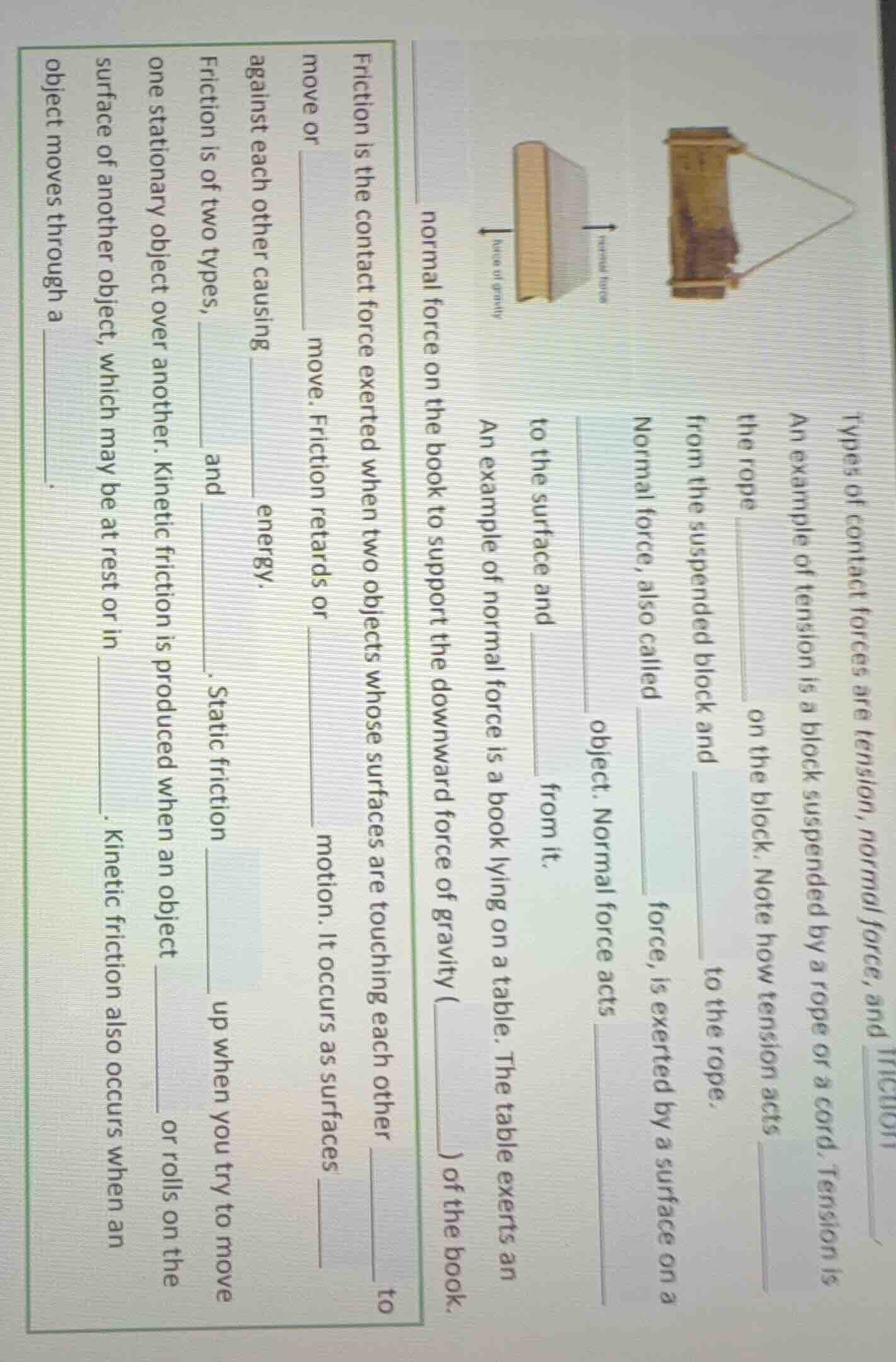
an example of tension is a block suspended by a rope or a cord. tension is the rope
on the block. note how tension acts
from the suspended block and
to the rope.
normal force, also called
force, is exerted by a surface on a
object. normal force acts
to the surface and
from it.
an example of normal force is a book lying on a table. the table exerts an normal force on the book to support the downward force of gravity (
) of the book.
friction is the contact force exerted when two objects whose surfaces are touching each other
to move or
move. friction retards or
motion. it occurs as surfaces
against each other causing
energy.
friction is of two types,
and
. static friction
up when you try to move one stationary object over another. kinetic friction is produced when an object
or rolls on the surface of another object, which may be at rest or in
. kinetic friction also occurs when an object moves through a
.
Filling the Blanks (Contact Forces and Friction)
1. Types of contact forces:
Types of contact forces are tension, normal force, and friction.
2. Tension:
An example of tension is a block suspended by a rope or a cord. Tension is the force exerted by the rope on the block. Note how tension acts along the rope, from the suspended block and opposite to the direction of gravity (or the pulling force).
3. Normal Force:
Normal force, also called the support force, is exerted by a surface on a contacting object. Normal force acts perpendicular to the surface and opposes the force pressing into it (e.g., gravity). An example of normal force is a book lying on a table. The table exerts an upward normal force on the book to support the downward force of gravity ($F_g = mg$) of the book.
4. Friction:
Friction is the contact force exerted when two objects whose surfaces are touching each other tend to move or are moving. Friction retards or opposes motion. It occurs as surfaces rub against each other, causing heat (or thermal) energy.
Friction is of two types: static friction and kinetic friction.
- Static friction holds (or resists) when you try to move one stationary object over another.
- Kinetic friction is produced when an object slides or rolls on the surface of another object, which may be at rest or in motion. Kinetic friction also occurs when an object moves through a fluid (like air or water).
Final Filled Text (Key Blanks):
- Types of contact forces: tension, normal force, and $\boldsymbol{\text{friction}}$.
- Tension: The rope $\boldsymbol{\text{exerts}}$ force on the block. Tension acts $\boldsymbol{\text{along}}$ the rope, from the block and $\boldsymbol{\text{opposite}}$ to gravity.
- Normal force: Also called $\boldsymbol{\text{support}}$ force, exerted by a surface on a $\boldsymbol{\text{contacting}}$ object. Acts $\boldsymbol{\text{perpendicular}}$ to the surface and $\boldsymbol{\text{opposes}}$ the pressing force.
- Friction: Occurs when surfaces touch and $\boldsymbol{\text{tend}}$ to move or $\boldsymbol{\text{are moving}}$. Retards motion, causes $\boldsymbol{\text{heat}}$ energy. Types: $\boldsymbol{\text{static friction}}$ and $\boldsymbol{\text{kinetic friction}}$. Static friction $\boldsymbol{\text{holds}}$; kinetic friction occurs when an object $\boldsymbol{\text{slides}}$ or moves through a $\boldsymbol{\text{fluid}}$.

Snap & solve any problem in the app
Get step-by-step solutions on Sovi AI
Photo-based solutions with guided steps
Explore more problems and detailed explanations
Filling the Blanks (Contact Forces and Friction)
1. Types of contact forces:
Types of contact forces are tension, normal force, and friction.
2. Tension:
An example of tension is a block suspended by a rope or a cord. Tension is the force exerted by the rope on the block. Note how tension acts along the rope, from the suspended block and opposite to the direction of gravity (or the pulling force).
3. Normal Force:
Normal force, also called the support force, is exerted by a surface on a contacting object. Normal force acts perpendicular to the surface and opposes the force pressing into it (e.g., gravity). An example of normal force is a book lying on a table. The table exerts an upward normal force on the book to support the downward force of gravity ($F_g = mg$) of the book.
4. Friction:
Friction is the contact force exerted when two objects whose surfaces are touching each other tend to move or are moving. Friction retards or opposes motion. It occurs as surfaces rub against each other, causing heat (or thermal) energy.
Friction is of two types: static friction and kinetic friction.
- Static friction holds (or resists) when you try to move one stationary object over another.
- Kinetic friction is produced when an object slides or rolls on the surface of another object, which may be at rest or in motion. Kinetic friction also occurs when an object moves through a fluid (like air or water).
Final Filled Text (Key Blanks):
- Types of contact forces: tension, normal force, and $\boldsymbol{\text{friction}}$.
- Tension: The rope $\boldsymbol{\text{exerts}}$ force on the block. Tension acts $\boldsymbol{\text{along}}$ the rope, from the block and $\boldsymbol{\text{opposite}}$ to gravity.
- Normal force: Also called $\boldsymbol{\text{support}}$ force, exerted by a surface on a $\boldsymbol{\text{contacting}}$ object. Acts $\boldsymbol{\text{perpendicular}}$ to the surface and $\boldsymbol{\text{opposes}}$ the pressing force.
- Friction: Occurs when surfaces touch and $\boldsymbol{\text{tend}}$ to move or $\boldsymbol{\text{are moving}}$. Retards motion, causes $\boldsymbol{\text{heat}}$ energy. Types: $\boldsymbol{\text{static friction}}$ and $\boldsymbol{\text{kinetic friction}}$. Static friction $\boldsymbol{\text{holds}}$; kinetic friction occurs when an object $\boldsymbol{\text{slides}}$ or moves through a $\boldsymbol{\text{fluid}}$.