QUESTION IMAGE
Question
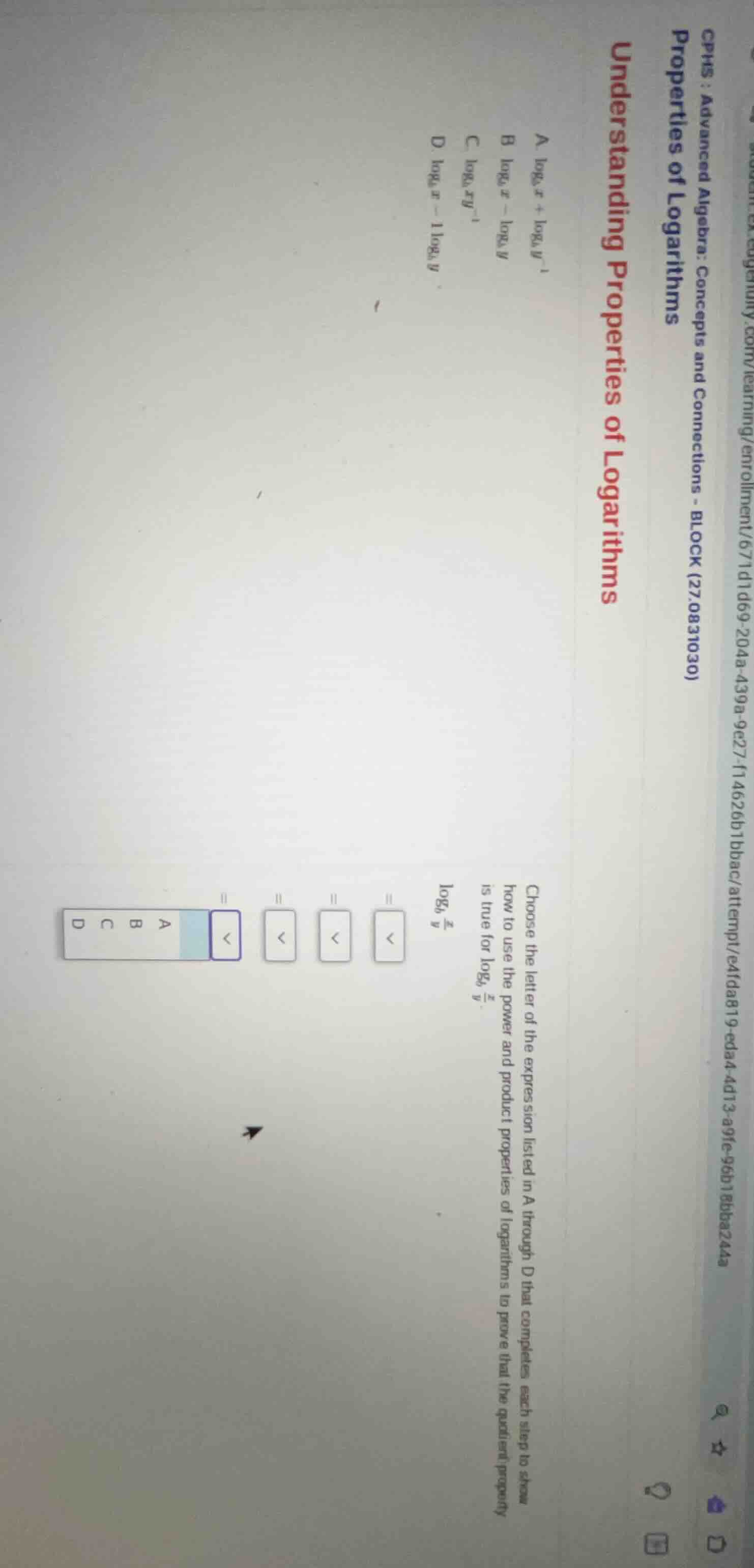
understanding properties of logarithms choose the letter of the expression listed in a through d that completes each step to show how to use the power and product properties of logarithms to prove that the quotient property is true for \\(\log_b \frac{x}{y}\\). \\(\log_b \frac{x}{y}\\) = = = = a \\(\log_b x + \log_b y^{-1}\\) b \\(\log_b x - \log_b y\\) c \\(\log_b xy^{-1}\\) d \\(\log_b x - 1\log_b y\\)
To solve the problem of showing \(\log_b \frac{x}{y}\) using logarithmic properties, we analyze each step:
Step 1: Recall the Quotient Property of Logarithms
The quotient property states \(\log_b \frac{x}{y} = \log_b x - \log_b y\). However, we can also derive this using the power property (\(\log_b a^n = n\log_b a\)) and product property (\(\log_b (ab) = \log_b a + \log_b b\)).
First, rewrite \(\frac{x}{y}\) as \(x \cdot y^{-1}\) (since \(\frac{1}{y} = y^{-1}\)).
Step 2: Apply the Product Property
The product property of logarithms is \(\log_b (ab) = \log_b a + \log_b b\). For \(x \cdot y^{-1}\), this gives:
\[
\log_b (x \cdot y^{-1}) = \log_b x + \log_b y^{-1}
\]
This matches option A: \(\log_b x + \log_b y^{-1}\).
Step 3: Apply the Power Property
The power property states \(\log_b a^n = n\log_b a\). For \(\log_b y^{-1}\), this becomes:
\[
\log_b y^{-1} = -1 \cdot \log_b y = -\log_b y
\]
Substituting back, we get:
\[
\log_b x + \log_b y^{-1} = \log_b x - \log_b y
\]
This matches option B: \(\log_b x - \log_b y\).
Step 4: Verify the Final Form
The quotient property of logarithms confirms \(\log_b x - \log_b y = \log_b \frac{x}{y}\), which is the target expression.
Final Answer
To show \(\log_b \frac{x}{y}\), the steps use:
- \(\boldsymbol{\log_b x + \log_b y^{-1}}\) (Option A)
- \(\boldsymbol{\log_b x - \log_b y}\) (Option B)
(Note: The problem likely asks for the sequence of options to derive \(\log_b \frac{x}{y}\). The first step uses Option A, then simplifies to Option B, and so on.)
If selecting the first step (rewriting \(\frac{x}{y}\) as \(x \cdot y^{-1}\) and applying the product property), the answer is:
\(\boldsymbol{A. \log_b x + \log_b y^{-1}}\)

Snap & solve any problem in the app
Get step-by-step solutions on Sovi AI
Photo-based solutions with guided steps
Explore more problems and detailed explanations
To solve the problem of showing \(\log_b \frac{x}{y}\) using logarithmic properties, we analyze each step:
Step 1: Recall the Quotient Property of Logarithms
The quotient property states \(\log_b \frac{x}{y} = \log_b x - \log_b y\). However, we can also derive this using the power property (\(\log_b a^n = n\log_b a\)) and product property (\(\log_b (ab) = \log_b a + \log_b b\)).
First, rewrite \(\frac{x}{y}\) as \(x \cdot y^{-1}\) (since \(\frac{1}{y} = y^{-1}\)).
Step 2: Apply the Product Property
The product property of logarithms is \(\log_b (ab) = \log_b a + \log_b b\). For \(x \cdot y^{-1}\), this gives:
\[
\log_b (x \cdot y^{-1}) = \log_b x + \log_b y^{-1}
\]
This matches option A: \(\log_b x + \log_b y^{-1}\).
Step 3: Apply the Power Property
The power property states \(\log_b a^n = n\log_b a\). For \(\log_b y^{-1}\), this becomes:
\[
\log_b y^{-1} = -1 \cdot \log_b y = -\log_b y
\]
Substituting back, we get:
\[
\log_b x + \log_b y^{-1} = \log_b x - \log_b y
\]
This matches option B: \(\log_b x - \log_b y\).
Step 4: Verify the Final Form
The quotient property of logarithms confirms \(\log_b x - \log_b y = \log_b \frac{x}{y}\), which is the target expression.
Final Answer
To show \(\log_b \frac{x}{y}\), the steps use:
- \(\boldsymbol{\log_b x + \log_b y^{-1}}\) (Option A)
- \(\boldsymbol{\log_b x - \log_b y}\) (Option B)
(Note: The problem likely asks for the sequence of options to derive \(\log_b \frac{x}{y}\). The first step uses Option A, then simplifies to Option B, and so on.)
If selecting the first step (rewriting \(\frac{x}{y}\) as \(x \cdot y^{-1}\) and applying the product property), the answer is:
\(\boldsymbol{A. \log_b x + \log_b y^{-1}}\)