QUESTION IMAGE
Question
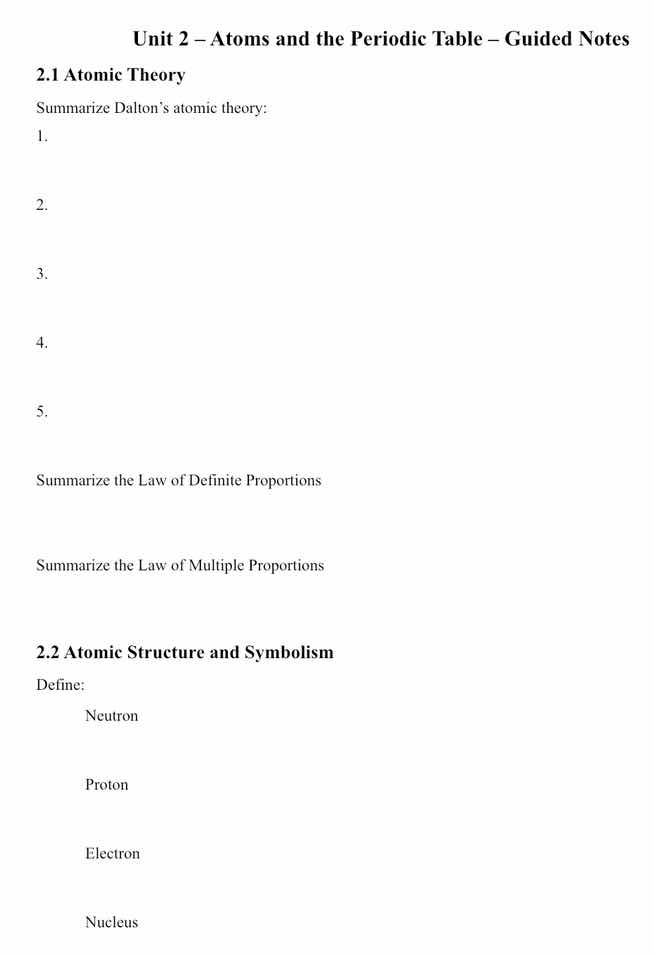
unit 2 – atoms and the periodic table – guided notes
2.1 atomic theory
summarize dalton’s atomic theory:
1.
2.
3.
4.
5.
summarize the law of definite proportions
summarize the law of multiple proportions
2.2 atomic structure and symbolism
define:
neutron
proton
electron
nucleus
Dalton's Atomic Theory
- All matter is made of indivisible atoms.
- Atoms of the same element are identical in mass and properties.
- Atoms of different elements have unique masses and properties.
- Atoms combine in fixed whole-number ratios to form compounds.
- Atoms are rearranged, not created/destroyed, in chemical reactions.
Law of Definite Proportions
A given compound always contains the same elements in the exact same mass proportion, regardless of its source or amount.
Law of Multiple Proportions
When two elements form multiple compounds, the masses of one element that combine with a fixed mass of the second element are in a ratio of small whole numbers.
Atomic Structure Definitions
- Neutron: A neutral subatomic particle found in an atom's nucleus, with a mass ~1 atomic mass unit (amu).
- Proton: A positively charged subatomic particle found in an atom's nucleus, with a mass ~1 amu; its charge equals +1 elementary charge.
- Electron: A negatively charged subatomic particle that orbits the atom's nucleus, with a mass ~1/1836 amu; its charge equals -1 elementary charge.
- Nucleus: The dense, central core of an atom that contains protons and neutrons, holding most of the atom's mass.

Snap & solve any problem in the app
Get step-by-step solutions on Sovi AI
Photo-based solutions with guided steps
Explore more problems and detailed explanations
Dalton's Atomic Theory
- All matter consists of indivisible atoms.
- Same-element atoms are identical.
- Different elements have unique atoms.
- Atoms combine in fixed whole-number ratios.
- Atoms are rearranged, not created/destroyed, in reactions.
Law of Definite Proportions
A compound has fixed element mass ratios, regardless of source/amount.
Law of Multiple Proportions
For two elements forming multiple compounds, fixed mass ratios of one element to the other are small whole numbers.
Atomic Structure Definitions
- Neutron: Neutral nucleus particle, ~1 amu.
- Proton: Positive nucleus particle, ~1 amu, +1 charge.
- Electron: Negative orbital particle, ~1/1836 amu, -1 charge.
- Nucleus: Dense central core holding protons/neutrons.