QUESTION IMAGE
Question
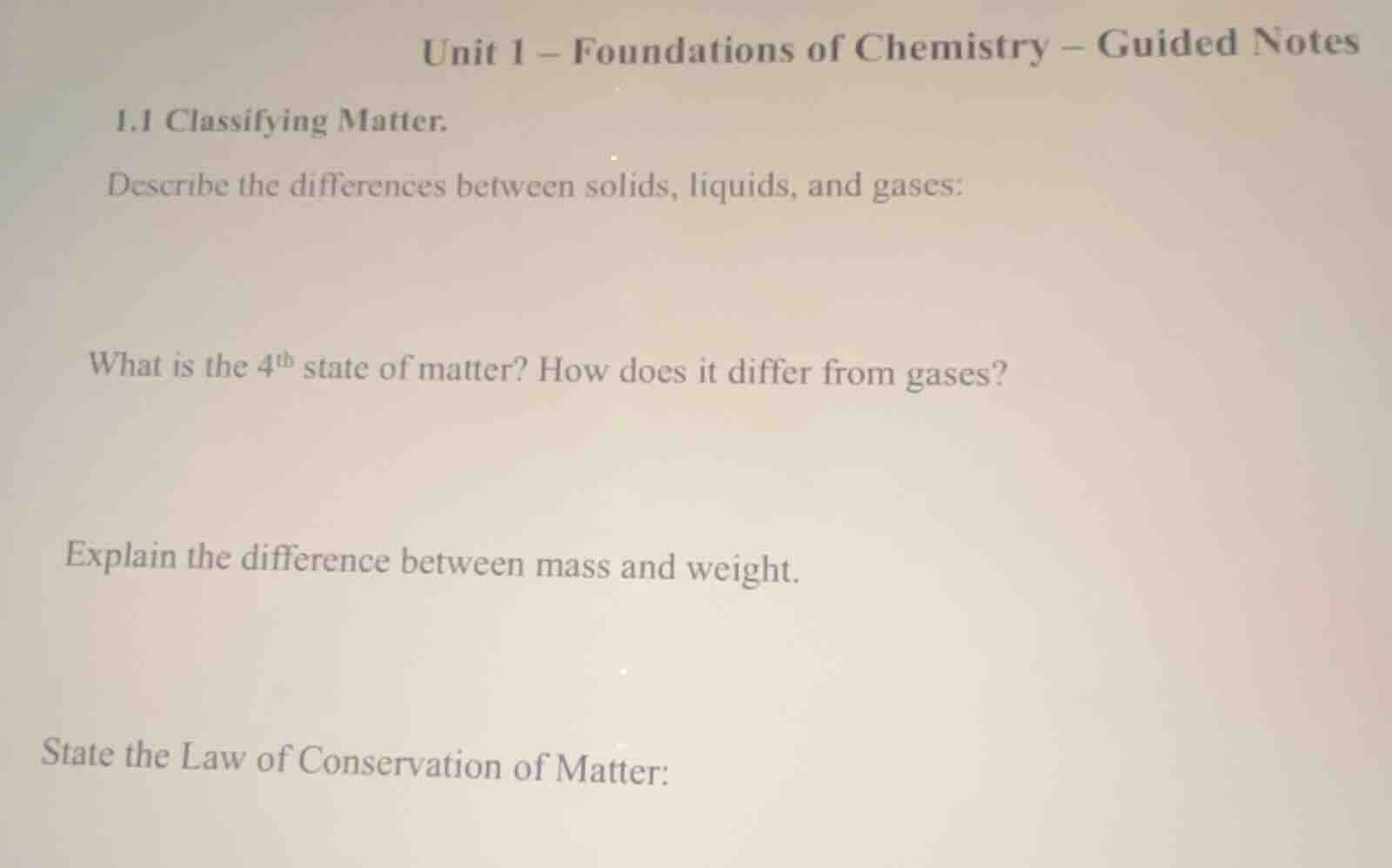
unit 1 – foundations of chemistry – guided notes
1.1 classifying matter.
describe the differences between solids, liquids, and gases:
what is the 4$^{th}$ state of matter? how does it differ from gases?
explain the difference between mass and weight.
state the law of conservation of matter:
- For solids, liquids, gases: Differences are based on particle arrangement, shape/volume fixedness, and particle motion.
- 4th state of matter is plasma; it differs from gases in ionization.
- Mass is amount of matter; weight depends on gravity.
- Law of Conservation of Matter covers matter behavior in reactions.

Snap & solve any problem in the app
Get step-by-step solutions on Sovi AI
Photo-based solutions with guided steps
Explore more problems and detailed explanations
- Differences between solids, liquids, and gases:
- Solids: Have a fixed shape and fixed volume; particles are tightly packed in a regular arrangement, with only vibrational motion.
- Liquids: Have a fixed volume but no fixed shape (takes shape of container); particles are close together but can slide past one another, allowing flow.
- Gases: Have no fixed shape or volume (expands to fill container); particles are far apart and move freely at high speeds.
- 4th state of matter and difference from gases:
The 4th state of matter is plasma. Unlike gases, plasma is made up of charged particles (ions and free electrons) due to high temperatures or electrical ionization, and it is conductive and responds to magnetic fields, while most neutral gases do not.
- Difference between mass and weight:
Mass is a measure of the total amount of matter in an object, and it is constant regardless of location. Weight is a measure of the force of gravity acting on an object's mass, so it changes with gravitational pull (e.g., an object weighs less on the Moon than on Earth, but its mass stays the same).
- Law of Conservation of Matter:
In a closed system, matter cannot be created or destroyed; it can only be rearranged or transformed from one form to another. The total mass of substances before a physical or chemical change equals the total mass of substances after the change.