QUESTION IMAGE
Question
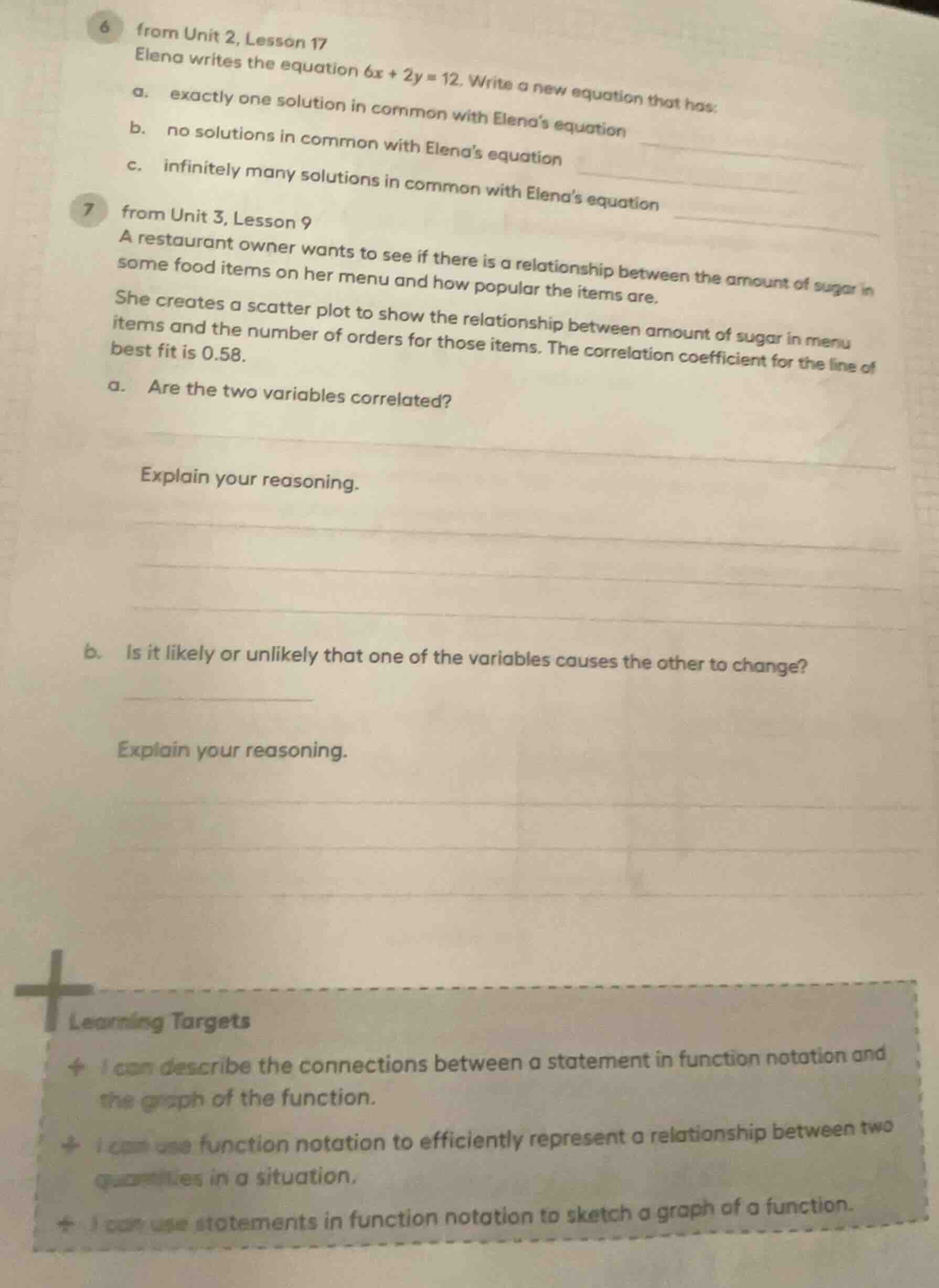
6 from unit 2, lesson 17
elena writes the equation $6x + 2y = 12$. write a new equation that has:
a. exactly one solution in common with elena’s equation
b. no solutions in common with elena’s equation
c. infinitely many solutions in common with elena’s equation
7 from unit 3, lesson 9
a restaurant owner wants to see if there is a relationship between the amount of sugar in some food items on her menu and how popular the items are.
she creates a scatter plot to show the relationship between amount of sugar in menu items and the number of orders for those items. the correlation coefficient for the line of best fit is 0.58.
a. are the two variables correlated?
explain your reasoning.
b. is it likely or unlikely that one of the variables causes the other to change?
explain your reasoning.
learning targets
- i can describe the connections between a statement in function notation and the graph of the function.
- i can use function notation to efficiently represent a relationship between two quantities in a situation.
- i can use statements in function notation to sketch a graph of a function.
Problem 6
Part a
Step 1: Analyze Elena's equation
Elena's equation is \(6x + 2y = 12\). We can simplify it by dividing by 2: \(3x + y = 6\), or \(y=-3x + 6\). To have exactly one solution in common, we need a linear equation with a different slope (so it's not parallel) and different y - intercept (so it's not the same line). Let's choose a line with a different slope, say \(y = x+1\) (rewritten in standard form: \(x - y=- 1\)).
Step 2: Verify the intersection
The first line has slope \(m_1=-3\) and the second line \(y = x + 1\) has slope \(m_2 = 1\). Since \(m_1
eq m_2\), the two lines will intersect at exactly one point, so they have exactly one solution in common.
Step 1: Recall the condition for no solution
For two linear equations \(a_1x + b_1y=c_1\) and \(a_2x + b_2y=c_2\) to have no solution, \(\frac{a_1}{a_2}=\frac{b_1}{b_2}
eq\frac{c_1}{c_2}\). From Elena's equation \(6x + 2y = 12\) (or \(3x + y=6\)), we can create a line with the same slope but different y - intercept. Let's multiply the left - hand side of \(3x + y = 6\) by a non - zero number, say 2, to get \(6x+2y\), and then set the right - hand side to a number different from 12, say 10. So the equation is \(6x + 2y=10\).
Step 2: Check the ratios
For \(6x + 2y = 12\) and \(6x + 2y=10\), \(\frac{6}{6}=\frac{2}{2}=1\) and \(\frac{12}{10}=\frac{6}{5}
eq1\). So the two lines are parallel and have no solution in common.
Step 1: Recall the condition for infinitely many solutions
For two linear equations \(a_1x + b_1y=c_1\) and \(a_2x + b_2y=c_2\) to have infinitely many solutions, \(\frac{a_1}{a_2}=\frac{b_1}{b_2}=\frac{c_1}{c_2}\). We can multiply Elena's equation \(6x + 2y = 12\) by a non - zero constant, say 2.
Step 2: Create the equation
Multiplying \(6x + 2y = 12\) by 2 gives \(12x+4y = 24\). Now, \(\frac{6}{12}=\frac{2}{4}=\frac{12}{24}=\frac{1}{2}\), so the two equations represent the same line, and thus have infinitely many solutions in common.

Snap & solve any problem in the app
Get step-by-step solutions on Sovi AI
Photo-based solutions with guided steps
Explore more problems and detailed explanations
\(x - y=-1\) (or any linear equation with a different slope from \(y=-3x + 6\))