QUESTION IMAGE
Question
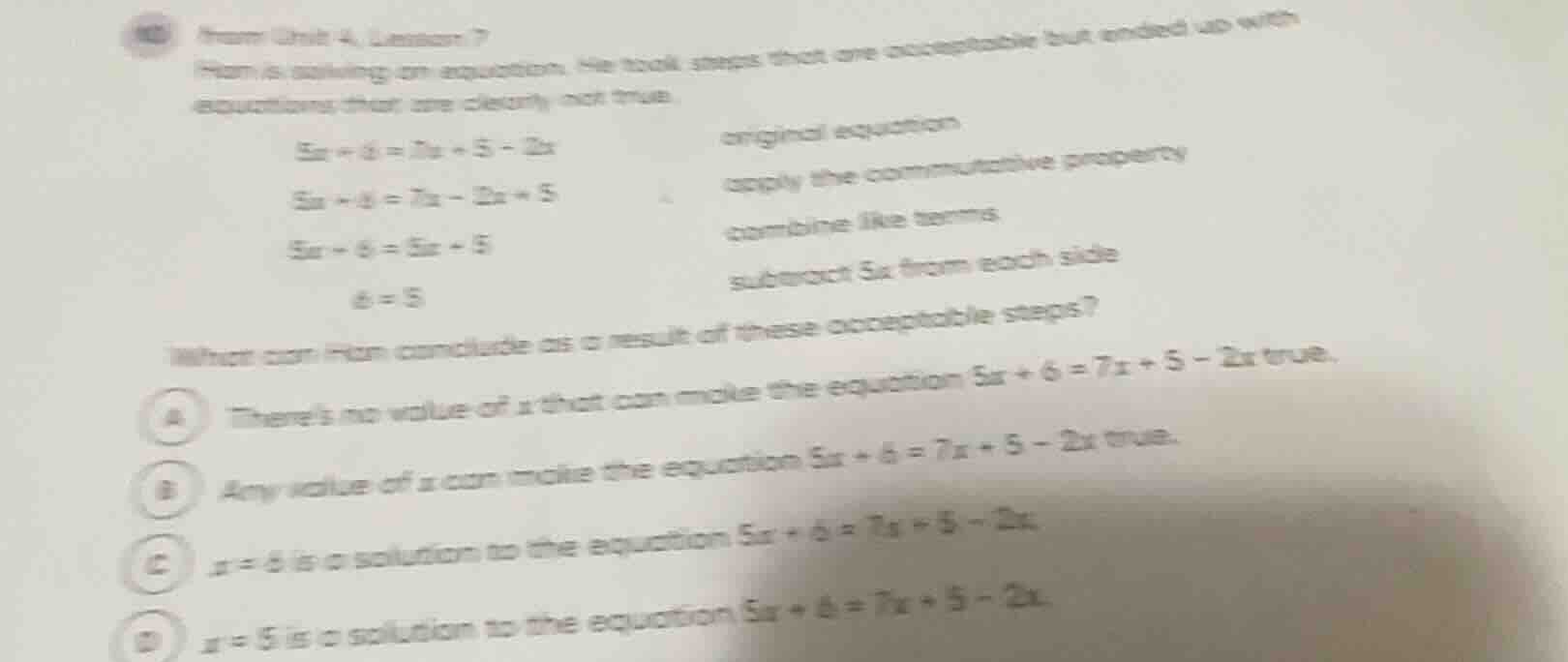
from unit 4, lesson 7 ham is solving an equation. he took steps that are acceptable but ended up with equations that are clearly not true. \\(5x + 6 = 7x + 5 - 2x\\) original equation \\(5x + 6 = 7x - 2x + 5\\) apply the commutative property \\(5x + 6 = 5x + 5\\) combine like terms \\(6 = 5\\) subtract \\(5x\\) from each side what can ham conclude as a result of these acceptable steps? a theres no value of \\(x\\) that can make the equation \\(5x + 6 = 7x + 5 - 2x\\) true. b any value of \\(x\\) can make the equation \\(5x + 6 = 7x + 5 - 2x\\) true. c \\(x = 6\\) is a solution to the equation \\(5x + 6 = 7x + 5 - 2x\\). d \\(x = 5\\) is a solution to the equation \\(5x + 6 = 7x + 5 - 2x\\).
Step1: Analyze simplified equation
After simplifying the original equation, we get $6=5$, which is a false statement with no variable $x$ remaining.
Step2: Interpret false identity
When solving an equation leads to a false statement with no variables left, it means there is no value of the variable that can satisfy the original equation.

Snap & solve any problem in the app
Get step-by-step solutions on Sovi AI
Photo-based solutions with guided steps
Explore more problems and detailed explanations
A. There's no value of $x$ that can make the equation $5x + 6 = 7x + 5 - 2x$ true.