QUESTION IMAGE
Question
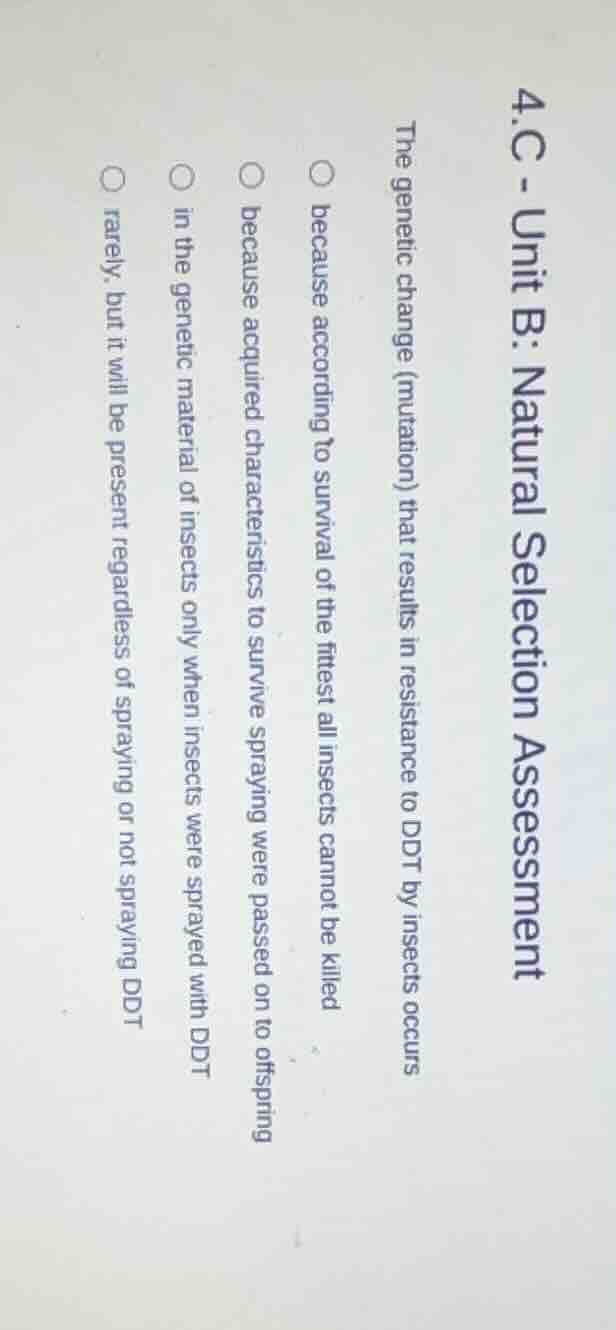
4.c - unit b: natural selection assessment
the genetic change (mutation) that results in resistance to ddt by insects occurs
○ because according to survival of the fittest all insects cannot be killed
○ because acquired characteristics to survive spraying were passed on to offspring
○ in the genetic material of insects only when insects were sprayed with ddt
○ rarely, but it will be present regardless of spraying or not spraying ddt
To determine the correct answer, we analyze each option:
- Option 1: "because according to survival of the fittest all insects cannot be killed" is incorrect. Natural selection doesn't mean all non - resistant insects can't be killed; DDT can kill non - resistant ones.
- Option 2: "because acquired characteristics to survive spraying were passed on to offspring" is wrong. Acquired characteristics (like changes from environmental exposure, not genetic) aren't passed to offspring. Natural selection works on genetic variations.
- Option 3: "in the genetic material of insects only when insects were sprayed with DDT" is incorrect. Mutations (genetic changes) that lead to DDT resistance can occur spontaneously, not just because of DDT spraying.
- Option 4: "rarely, but it will be present regardless of spraying or not spraying DDT" is correct. Mutations (genetic changes) are random. A mutation for DDT resistance can occur at any time, and then if DDT is present, natural selection will favor the resistant insects. Even without spraying, the mutation (though rare) can exist in the insect population's genetic material.

Snap & solve any problem in the app
Get step-by-step solutions on Sovi AI
Photo-based solutions with guided steps
Explore more problems and detailed explanations
The correct option is the one with the text "rarely, but it will be present regardless of spraying or not spraying DDT". (Since the options are not labeled with A, B, C, D in the provided image, we identify it by the text. If we assume the options are in order from top to bottom as Option 1, Option 2, Option 3, Option 4, then the answer is Option 4: rarely, but it will be present regardless of spraying or not spraying DDT)