QUESTION IMAGE
Question
5.f - unit c photosynthesis and cellular respiration formative
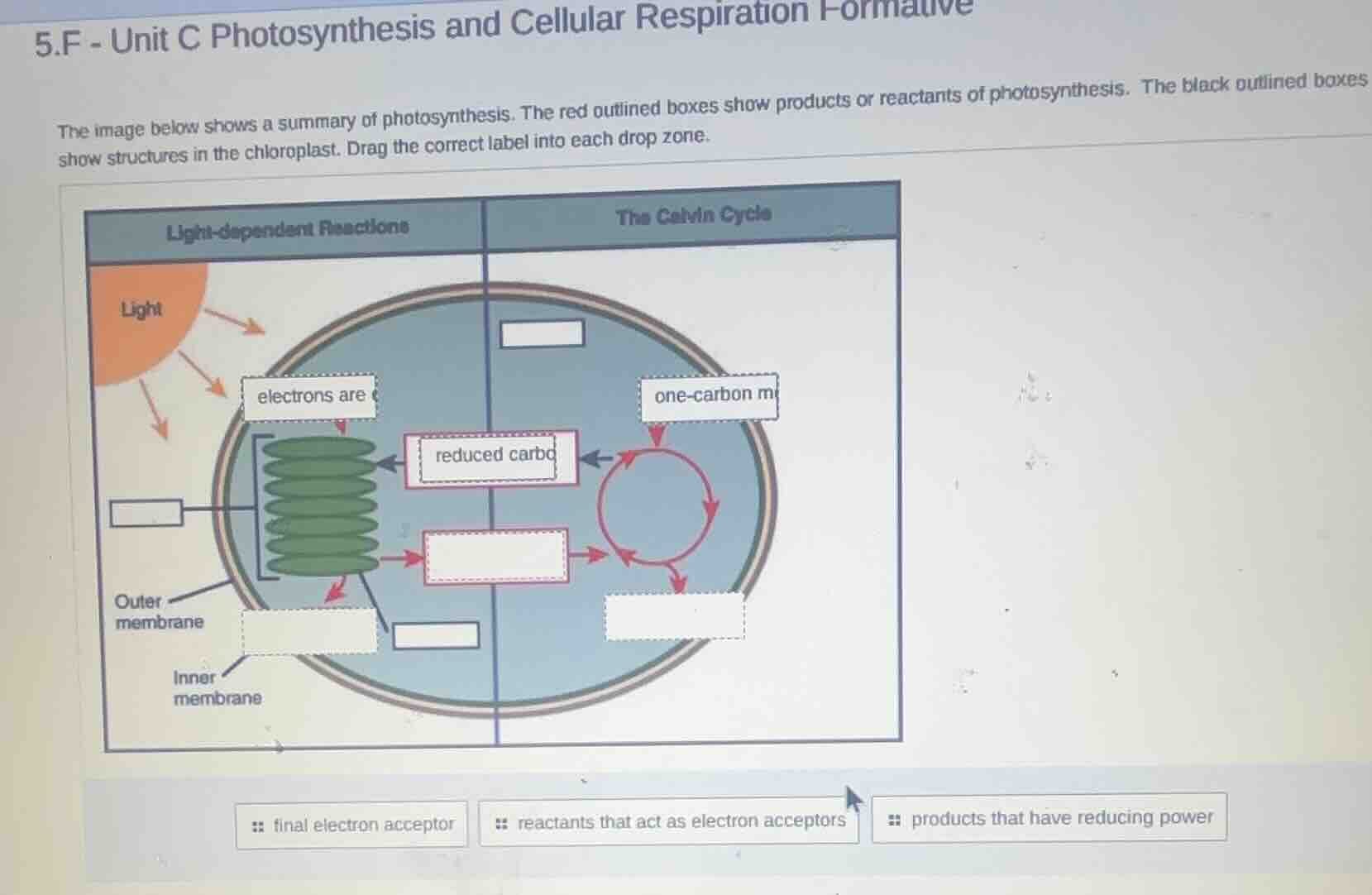
the image below shows a summary of photosynthesis. the red outlined boxes show products or reactants of photosynthesis. the black outlined boxes show structures in the chloroplast. drag the correct label into each drop zone.
light-dependent reactions the calvin cycle
light
electrons are one-carbon m
reduced carbo
outer
membrane
inner
membrane
final electron acceptor reactants that act as electron acceptors products that have reducing power
To solve this photosynthesis - related labeling problem, we analyze the components of light - dependent reactions and the Calvin cycle:
Step 1: Analyze the light - dependent reactions
- In the light - dependent reactions, water ($H_2O$) is split. The electrons from water need an acceptor. The "reactants that act as electron acceptors" label should be associated with the molecule that accepts electrons from the split water. In the light - dependent reactions, $NADP^+$ (nicotinamide adenine dinucleotide phosphate) acts as an electron acceptor. But in the context of the reactants for the light - dependent reactions, water is split and the electrons are passed along, with the initial electron acceptors being part of the photosystem. However, looking at the labels, the "reactants that act as electron acceptors" should be placed where the reactant (like $NADP^+$ or another electron - accepting reactant) is involved in the light - dependent reactions. The area near the thylakoid (the green stacks, which are thylakoids) where the electron flow starts from the split water, the "reactants that act as electron acceptors" label fits the region where the electron - accepting reactant is utilized.
- The "final electron acceptor" in the light - dependent reactions is $NADP^+$, which is reduced to $NADPH$. $NADPH$ has reducing power, so the "products that have reducing power" label is for $NADPH$. The "final electron acceptor" label is for the molecule that finally accepts the electrons, which is $NADP^+$, and then the product $NADPH$ (with reducing power) is formed.
Step 2: Analyze the Calvin cycle
- In the Calvin cycle, carbon dioxide ($CO_2$) is fixed. The "one - carbon molecule" is likely $CO_2$ (since it has one carbon atom in the context of carbon fixation). The Calvin cycle uses the products of the light - dependent reactions (ATP and $NADPH$) to fix carbon. The "reduced carbon" is the end product of the Calvin cycle, like glyceraldehyde - 3 - phosphate (G3P) or glucose - related molecules. The "reactants that act as electron acceptors" in the Calvin cycle would be the molecules that accept electrons during the reduction of carbon, but more accurately, the light - dependent reactions produce $NADPH$ (with reducing power) which is used in the Calvin cycle.
Label Placement (Summary of correct placements)
- For the light - dependent reactions (left side, near the thylakoid and the electron flow):
- The "reactants that act as electron acceptors" label goes to the region where the electron - accepting reactant (e.g., $NADP^+$ as a reactant in the light - dependent reactions to accept electrons and become $NADPH$) is involved.
- The "final electron acceptor" label is for the molecule that finally accepts the electrons, which is $NADP^+$, and the product $NADPH$ (with reducing power) is formed, so the "products that have reducing power" label is for the $NADPH$ - producing region.
- For the Calvin cycle (right side):
- The "one - carbon molecule" is $CO_2$, which is a reactant in the Calvin cycle. The "reduced carbon" is the product of the Calvin cycle (like G3P). The "products that have reducing power" (from the light - dependent reactions, $NADPH$) is used in the Calvin cycle to reduce carbon, so the $NADPH$ (product with reducing power) is used in the Calvin cycle, but the label "products that have reducing power" should be placed where the product from the light - dependent reactions (with reducing power) is input into the Calvin cycle.
Since this is a drag - and - drop problem, the correct placements (in general term…

Snap & solve any problem in the app
Get step-by-step solutions on Sovi AI
Photo-based solutions with guided steps
Explore more problems and detailed explanations
- Light - dependent reactions (near thylakoid, electron flow start): reactants that act as electron acceptors
- Light - dependent reactions (near $NADPH$ production): final electron acceptor
- Light - dependent reactions (output to Calvin cycle): products that have reducing power
- Calvin cycle (carbon input): one - carbon molecule (e.g., $CO_2$)
- Calvin cycle (carbon output): reduced carbon
(The exact placement depends on the diagram's drop zones, but the above is the correct association of labels with the components of photosynthesis.)