QUESTION IMAGE
Question
unit 2 - physical science
science standards and concepts: ps.8.1, ps.8.3
what are some reasons why people might not want to rely on solar energy?
_____________________________________________________
_____________________________________________________
_____________________________________________________
magnetism
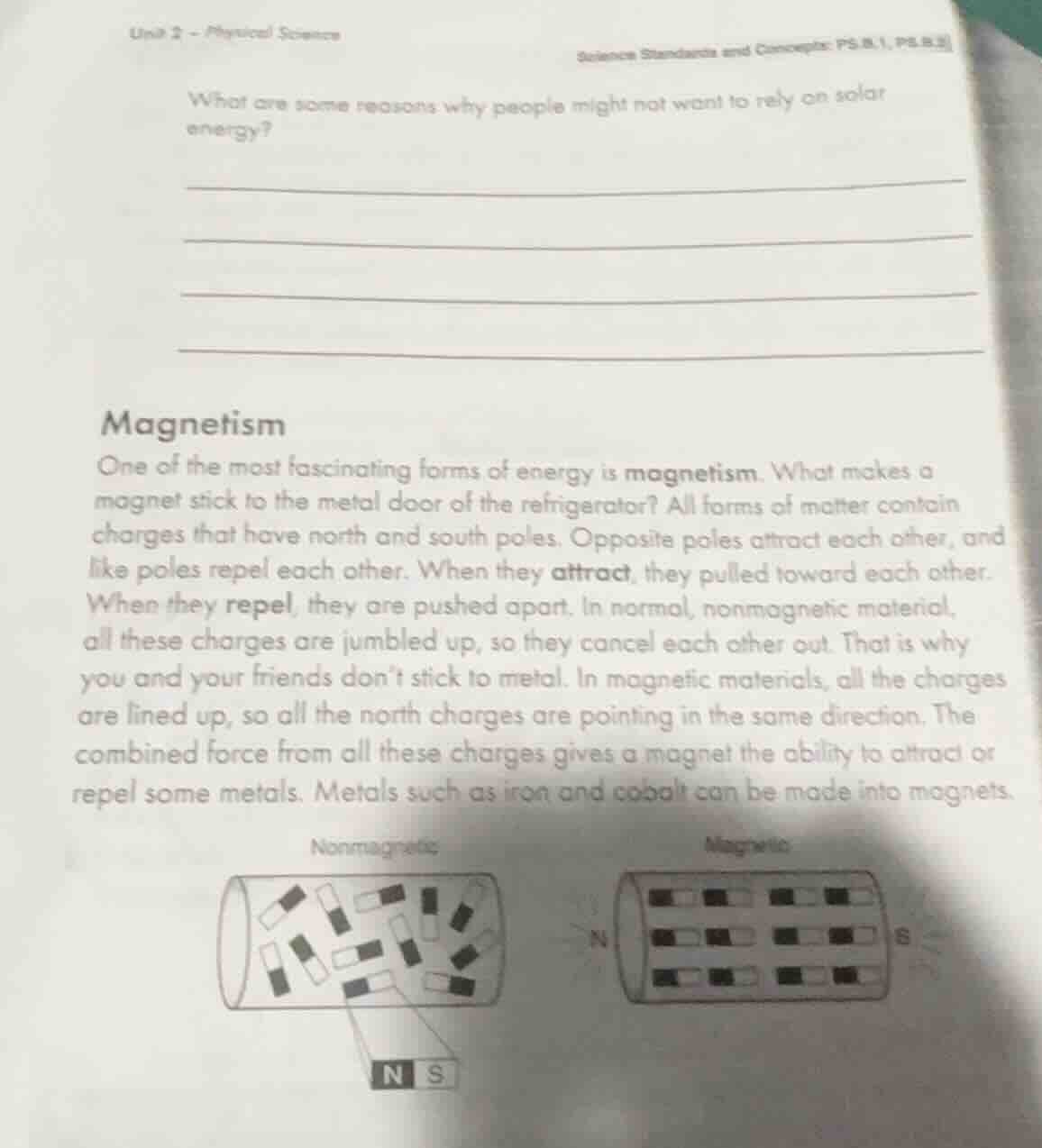
one of the most fascinating forms of energy is magnetism. what makes a magnet stick to the metal door of the refrigerator? all forms of matter contain charges that have north and south poles. opposite poles attract each other, and like poles repel each other. when they attract, they pulled toward each other. when they repel, they are pushed apart. in normal, nonmagnetic material, all these charges are jumbled up, so they cancel each other out. that is why you and your friends don’t stick to metal. in magnetic materials, all the charges are lined up, so all the north charges are pointing in the same direction. the combined force from all these charges gives a magnet the ability to attract or repel some metals. metals such as iron and cobalt can be made into magnets.
image of nonmagnetic and magnetic material charge arrangements
To determine why people might not rely on solar energy, we analyze factors like weather dependence (cloudy days, night reduce output), high initial costs (solar panels, installation), energy storage challenges (batteries are expensive and have limited capacity), and land/space requirements (large areas needed for solar farms or sufficient rooftop space). These factors make solar energy less reliable or accessible for some.

Snap & solve any problem in the app
Get step-by-step solutions on Sovi AI
Photo-based solutions with guided steps
Explore more problems and detailed explanations
Some reasons people might not want to rely on solar energy include: 1. Weather dependence: Solar panels produce less energy on cloudy days, rainy days, and at night, so they can't consistently meet energy needs. 2. High initial costs: Purchasing and installing solar panels, along with related equipment (like batteries for storage), requires a large upfront investment. 3. Energy storage challenges: Storing excess solar energy for use when the sun isn’t shining (e.g., at night) is difficult and expensive, as batteries have limited capacity and degrade over time. 4. Land/space requirements: Solar farms need large, open areas, and rooftop solar requires sufficient roof space and orientation, which not all homes or businesses have. 5. Intermittency: The inconsistent nature of solar energy production makes it hard to rely on as a sole or primary energy source without backup power (e.g., from the grid or fossil fuels).