QUESTION IMAGE
Question
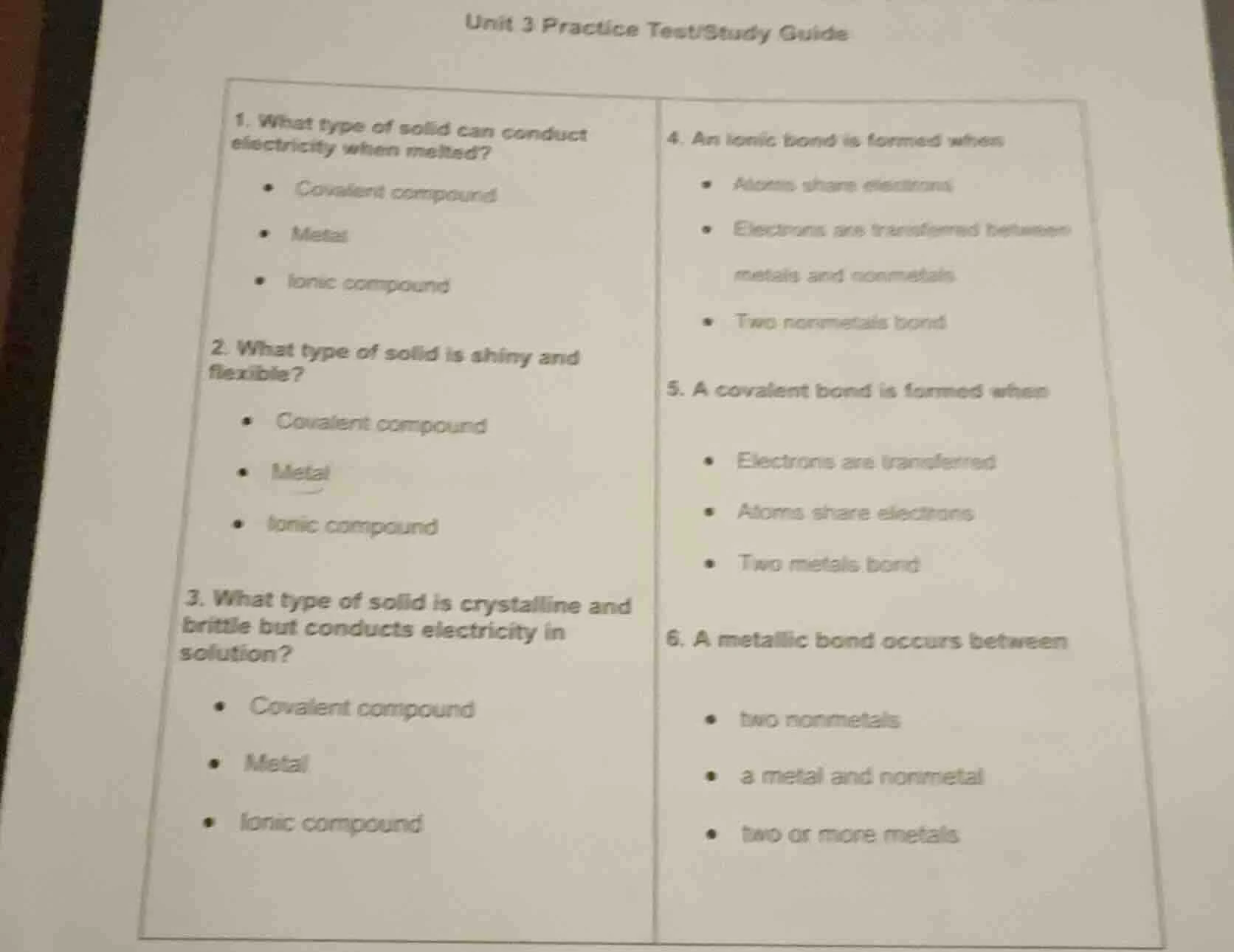
unit 3 practice test/study guide
- what type of solid can conduct electricity when melted?
- covalent compound
- metal
- ionic compound
- what type of solid is shiny and flexible?
- covalent compound
- metal
- ionic compound
- what type of solid is crystalline and brittle but conducts electricity in solution?
- covalent compound
- metal
- ionic compound
- an ionic bond is formed when
- atoms share electrons
- electrons are transferred between metals and nonmetals
- two nonmetals bond
- a covalent bond is formed when
- electrons are transferred
- atoms share electrons
- two metals bond
- a metallic bond occurs between
- two nonmetals
- a metal and nonmetal
- two or more metals
Brief Explanations
- Ionic compounds have locked ions in solid form, but when melted, ions are free to move and conduct electricity. Metals conduct in solid state, covalent compounds do not conduct when melted.
- Metals have a metallic lattice structure that gives them shiny appearance and flexibility; ionic compounds are brittle, covalent compounds are not shiny/flexible.
- Ionic compounds form crystalline structures, are brittle, and when dissolved in solution, their dissociated ions allow electrical conduction. Metals conduct in solid state, covalent compounds do not conduct in solution.
- Ionic bonds form when metals (low electronegativity) transfer electrons to nonmetals (high electronegativity), creating charged ions that attract. Electron sharing is covalent, two nonmetals form covalent bonds.
- Covalent bonds form when nonmetals share electrons to achieve stable electron configurations; electron transfer is ionic, two metals form metallic bonds.
- Metallic bonds involve a sea of delocalized electrons shared between two or more metal atoms, holding the metal lattice together. Ionic bonds are metal-nonmetal, covalent are nonmetal-nonmetal.

Snap & solve any problem in the app
Get step-by-step solutions on Sovi AI
Photo-based solutions with guided steps
Explore more problems and detailed explanations
- Ionic compound
- Metal
- Ionic compound
- Electrons are transferred between metals and nonmetals.
- Atoms share electrons
- two or more metals