QUESTION IMAGE
Question
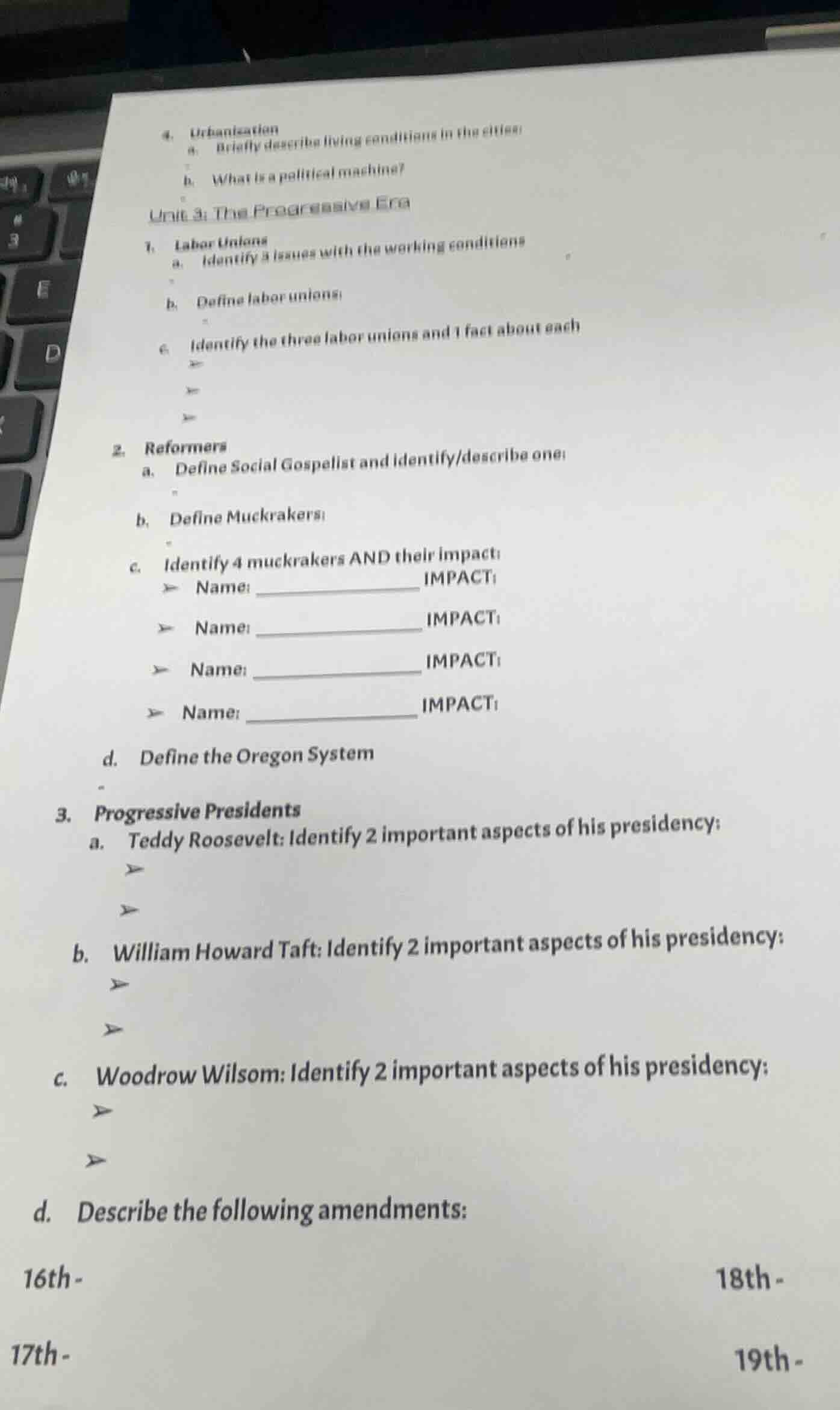
- urbanization
a. briefly describe living conditions in the cities
b. what is a political machine?
unit 3: the progressive era
- labor unions
a. identify 3 issues with the working conditions
b. define labor unions;
c. identify the three labor unions and 1 fact about each
- reformers
a. define social gospelist and identify/describe one;
b. define muckrakers;
c. identify 4 muckrakers and their impact;
name: _______________ impact;
name: _______________ impact;
name: _______________ impact;
name: _______________ impact;
d. define the oregon system
- progressive presidents
a. teddy roosevelt: identify 2 important aspects of his presidency;
b. william howard taft: identify 2 important aspects of his presidency;
c. woodrow wilson: identify 2 important aspects of his presidency;
d. describe the following amendments:
16th - \t\t\t18th -
17th - \t\t\t19th -
4. Urbanisation
a. Explains overcrowded, unsanitary urban living spaces.
b. Defines a corrupt urban political organization.
1. Labor Unions
a. Lists key workplace problems of the era.
b. Defines organized worker advocacy groups.
c. Details major 19th/20th century unions.
2. Reformers
a. Defines and gives an example of Social Gospel advocates.
b. Defines investigative progressive journalists.
c. Highlights key muckrakers and their reforms.
d. Defines a set of progressive electoral reforms.
3. Progressive Presidents
a. Covers Teddy Roosevelt's core progressive actions.
b. Covers William Howard Taft's key policies.
c. Covers Woodrow Wilson's progressive agenda.
d. Summarizes constitutional amendments of the Progressive Era.

Snap & solve any problem in the app
Get step-by-step solutions on Sovi AI
Photo-based solutions with guided steps
Explore more problems and detailed explanations
4. Urbanisation
a. City living conditions were overcrowded (tenement housing with multiple families per small space), unsanitary (lack of clean water, sewage systems, leading to disease outbreaks like cholera), and unsafe (fire hazards in unregulated buildings).
b. A political machine was a corrupt urban political organization that used patronage, bribes, and voter fraud to maintain power, providing basic services to immigrant and poor communities in exchange for political support.
1. Labor Unions
a. 1. Extremely long workdays (10-16 hours, 6-7 days a week) with no overtime pay; 2. Dangerous work environments (unregulated factories, no safety standards, high risk of injury/death); 3. Very low wages, especially for women and child workers who were paid a fraction of men's salaries.
b. Labor unions are organized groups of workers that advocate for better wages, safer working conditions, and fair employment practices through collective bargaining, strikes, and protests.
c. 1. Knights of Labor: Accepted all workers (skilled, unskilled, women, Black workers) and pushed for an 8-hour workday, but declined after the 1886 Haymarket Riot.
- American Federation of Labor (AFL): Focused on skilled workers, used collective bargaining to win higher wages and shorter hours, led by Samuel Gompers.
- Industrial Workers of the World (IWW): Founded in 1905, organized unskilled industrial workers (miners, lumber workers) and advocated for radical unionism, including the overthrow of capitalism.
2. Reformers
a. Social Gospelists were Protestant ministers and activists who applied Christian ethics to solve social problems like poverty, inequality, and labor exploitation. One example is Walter Rauschenbusch, who argued that churches should work to fix systemic societal issues rather than just focus on individual salvation.
b. Muckrakers were investigative journalists and writers who exposed corruption, social injustice, and corporate greed in the early 1900s, aiming to inspire progressive reform.
c. 1. Name: Upton Sinclair | IMPACT: His novel The Jungle exposed unsanitary conditions in the meatpacking industry, leading to the 1906 Pure Food and Drug Act and Meat Inspection Act.
- Name: Ida Tarbell | IMPACT: Her series The History of the Standard Oil Company exposed the monopolistic practices of John D. Rockefeller, leading to the breakup of Standard Oil under the Sherman Antitrust Act.
- Name: Jacob Riis | IMPACT: His photojournalism book How the Other Half Lives documented tenement poverty in New York City, spurring housing reform and improved urban sanitation laws.
- Name: Lincoln Steffens | IMPACT: His articles The Shame of the Cities exposed political corruption in major U.S. cities, pushing for municipal reform and anti-corruption laws.
d. The Oregon System was a set of progressive electoral reforms adopted in Oregon in the early 1900s, including the initiative (voters can propose laws), referendum (voters can approve/repeal laws), and recall (voters can remove elected officials from office early).
3. Progressive Presidents
a. Teddy Roosevelt:
- Trust-busting: He used the Sherman Antitrust Act to break up major monopolies like Northern Securities and Standard Oil, earning the nickname "Trust Buster."
- Conservation: He established the U.S. Forest Service, protected over 230 million acres of public land (national parks, forests, and wildlife refuges), and promoted sustainable resource management.
b. William Howard Taft:
- Trust-busting: He broke up more monopolies than Roosevelt, including the U.S. Steel Corporation, and strengthened antitrust laws.
- Tariff reform: He signed the Payne-Aldrich Tariff, which reduced some tariffs but was criticized by progressives for not going far enough, and supported a constitutional amendment for a federal income tax.
c. Woodrow Wilson:
- New Freedom agenda: He pushed for antitrust laws, banking reform (creating the Federal Reserve System in 1913), and tariff reduction (Underwood-Simmons Tariff) to promote competition and consumer protection.
- Women's suffrage: He eventually supported the 19th Amendment, which granted women the right to vote, after initially opposing it.
d.
16th Amendment (1913): Granted the federal government the power to levy a progressive income tax, allowing the government to raise revenue based on a person's income level.
17th Amendment (1913): Established the direct election of U.S. Senators by the people, replacing the previous system where senators were appointed by state legislatures.
18th Amendment (1919): Prohibited the manufacture, sale, and transportation of alcoholic beverages in the United States, leading to the era of Prohibition.
19th Amendment (1920): Granted women the right to vote nationwide, prohibiting the denial of suffrage based on sex.