QUESTION IMAGE
Question
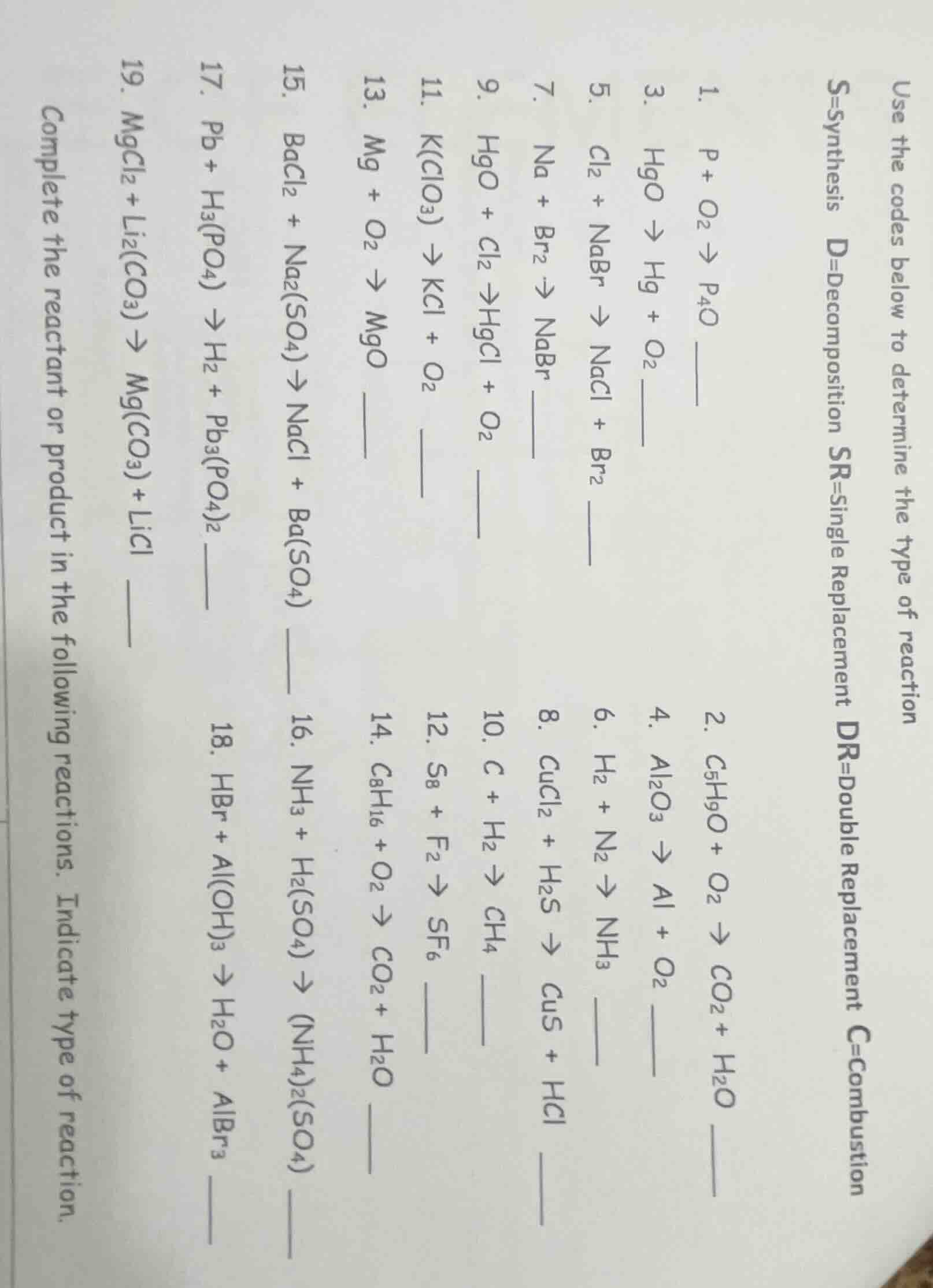
use the codes below to determine the type of reaction
s=synthesis d=decomposition sr=single replacement dr=double replacement c=combustion
- \\( \ce{p + o2 -> p4o} \\)
- \\( \ce{c5h9o + o2 -> co2 + h2o} \\)
- \\( \ce{hgo -> hg + o2} \\)
- \\( \ce{al2o3 -> al + o2} \\)
- \\( \ce{cl2 + nabr -> nacl + br2} \\)
- \\( \ce{h2 + n2 -> nh3} \\)
- \\( \ce{na + br2 -> nabr} \\)
- \\( \ce{cucl2 + h2s -> cus + hcl} \\)
- \\( \ce{hgo + cl2 -> hgcl + o2} \\)
- \\( \ce{c + h2 -> ch4} \\)
- \\( \ce{k(clo3) -> kcl + o2} \\)
- \\( \ce{s8 + f2 -> sf6} \\)
- \\( \ce{mg + o2 -> mgo} \\)
- \\( \ce{c8h16 + o2 -> co2 + h2o} \\)
- \\( \ce{bacl2 + na2(so4) -> nacl + ba(so4)} \\)
- \\( \ce{nh3 + h2(so4) -> (nh4)2(so4)} \\)
- \\( \ce{pb + h3(po4) -> h2 + pb3(po4)2} \\)
- \\( \ce{hbr + al(oh)3 -> h2o + albr3} \\)
- \\( \ce{mgcl2 + li2(co3) -> mg(co3) + licl} \\)
complete the reactant or product in the following reactions. indicate type of reaction.
Let's solve problem 1: \( \text{P} + \text{O}_2
ightarrow \text{P}_4\text{O}_{10} \) (first, balance the equation) and determine the reaction type.
Step 1: Balance the chemical equation
- Reactants: P (1 atom), \( \text{O}_2 \) (2 O atoms)
- Products: \( \text{P}_4\text{O}_{10} \) (4 P atoms, 10 O atoms)
- Balance P: Multiply P by 4: \( 4\text{P} + \text{O}_2
ightarrow \text{P}_4\text{O}_{10} \)
- Balance O: \( \text{O}_2 \) has 2 O, \( \text{P}_4\text{O}_{10} \) has 10 O. Multiply \( \text{O}_2 \) by 5: \( 4\text{P} + 5\text{O}_2
ightarrow \text{P}_4\text{O}_{10} \)
Step 2: Determine reaction type
- Synthesis reaction (S) is when two or more substances combine to form a single product. Here, P and \( \text{O}_2 \) combine to form \( \text{P}_4\text{O}_{10} \), so it's a synthesis reaction.
Step 1: Balance the chemical equation
- Reactants: \( \text{HgO} \) (1 Hg, 1 O)
- Products: Hg (1 Hg), \( \text{O}_2 \) (2 O)
- Balance O: Multiply \( \text{HgO} \) by 2: \( 2\text{HgO}
ightarrow \text{Hg} + \text{O}_2 \)
- Balance Hg: Multiply Hg by 2: \( 2\text{HgO}
ightarrow 2\text{Hg} + \text{O}_2 \)
Step 2: Determine reaction type
- Decomposition reaction (D) is when a single compound breaks down into two or more simpler substances. Here, \( \text{HgO} \) decomposes into Hg and \( \text{O}_2 \), so it's a decomposition reaction.
Step 1: Balance the chemical equation
- Reactants: \( \text{Cl}_2 \) (2 Cl), \( \text{NaBr} \) (1 Na, 1 Br)
- Products: \( \text{NaCl} \) (1 Na, 1 Cl), \( \text{Br}_2 \) (2 Br)
- Balance Br: Multiply \( \text{NaBr} \) by 2: \( \text{Cl}_2 + 2\text{NaBr}
ightarrow \text{NaCl} + \text{Br}_2 \)
- Balance Na and Cl: Multiply \( \text{NaCl} \) by 2: \( \text{Cl}_2 + 2\text{NaBr}
ightarrow 2\text{NaCl} + \text{Br}_2 \)
Step 2: Determine reaction type
- Single Replacement (SR) reaction: A more reactive element replaces a less reactive element in a compound. Cl (more reactive than Br) replaces Br in \( \text{NaBr} \), so it's a single replacement reaction.

Snap & solve any problem in the app
Get step-by-step solutions on Sovi AI
Photo-based solutions with guided steps
Explore more problems and detailed explanations
Balanced equation: \( 4\text{P} + 5\text{O}_2
ightarrow \text{P}_4\text{O}_{10} \), Reaction type: S (Synthesis)
---
Let's solve problem 3: \( \text{HgO}
ightarrow \text{Hg} + \text{O}_2 \) (balance and determine type)