QUESTION IMAGE
Question
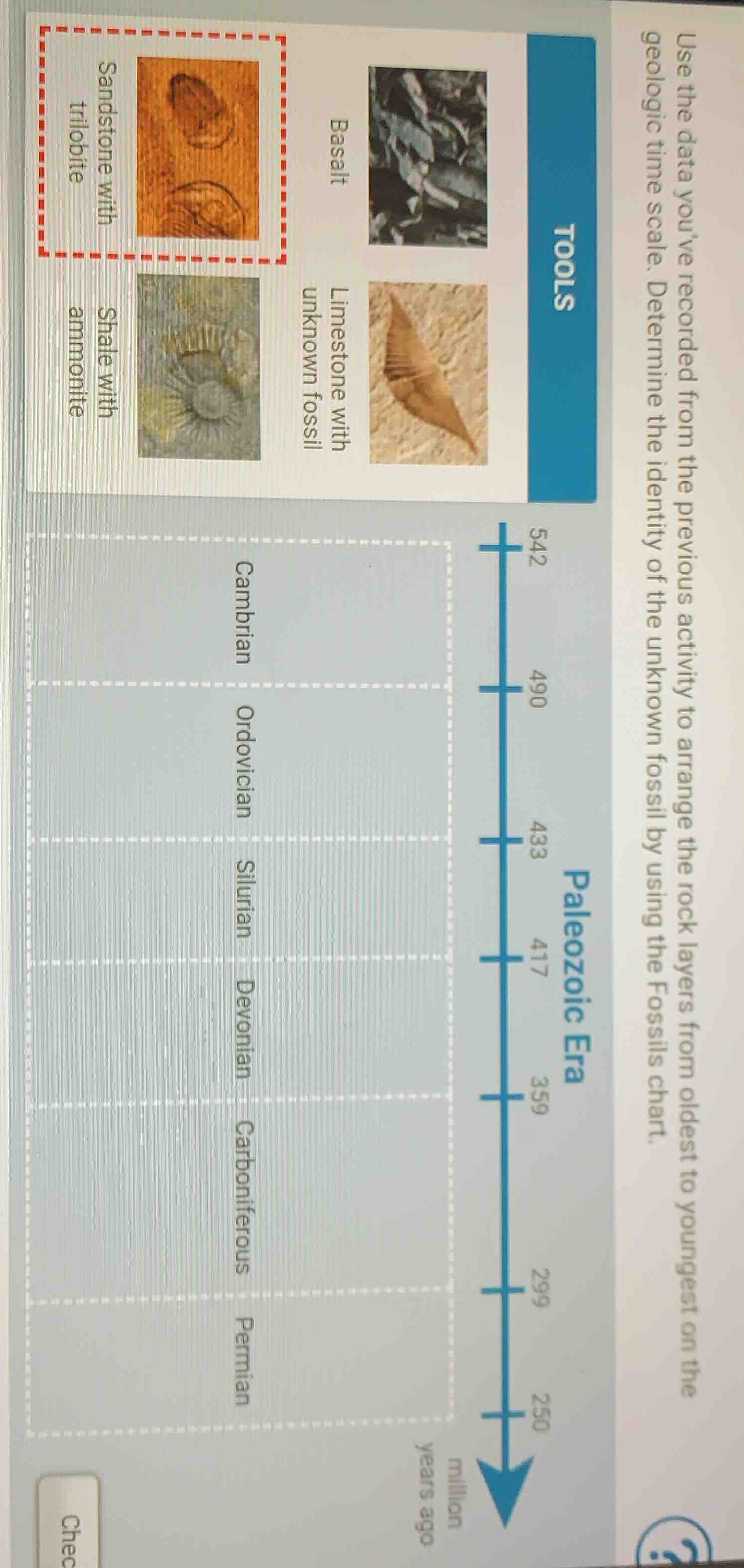
use the data you’ve recorded from the previous activity to arrange the rock layers from oldest to youngest on the geologic time scale. determine the identity of the unknown fossil by using the fossils chart. tools basalt sandstone with trilobite limestone with unknown fossil shale with ammonite paleozoic era 542 490 433 417 359 299 250 million years ago cambrian ordovician silurian devonian carboniferous permian chec
To determine the identity of the unknown fossil (in limestone), we analyze the fossil record and geologic time scale:
- Trilobite (sandstone): Trilobites are common in Cambrian - Ordovician periods (oldest Paleozoic, ~542–443 mya).
- Ammonite (shale): Ammonites appear later (e.g., Devonian - Mesozoic, ~419 mya onward).
- Unknown fossil (limestone): The limestone - associated fossil’s morphology (e.g., conical, cephalopod - like) and rock type suggest it aligns with Ordovician - Silurian periods (between trilobites’ early Paleozoic and ammonites’ later appearance). Comparing to index fossils, this fossil likely represents a graptolite (common in Ordovician - Silurian limestone, used for relative dating).

Snap & solve any problem in the app
Get step-by-step solutions on Sovi AI
Photo-based solutions with guided steps
Explore more problems and detailed explanations
The unknown fossil (in limestone) is likely a graptolite (or an Ordovician - Silurian index fossil, consistent with the geologic time scale and rock - fossil associations).