QUESTION IMAGE
Question
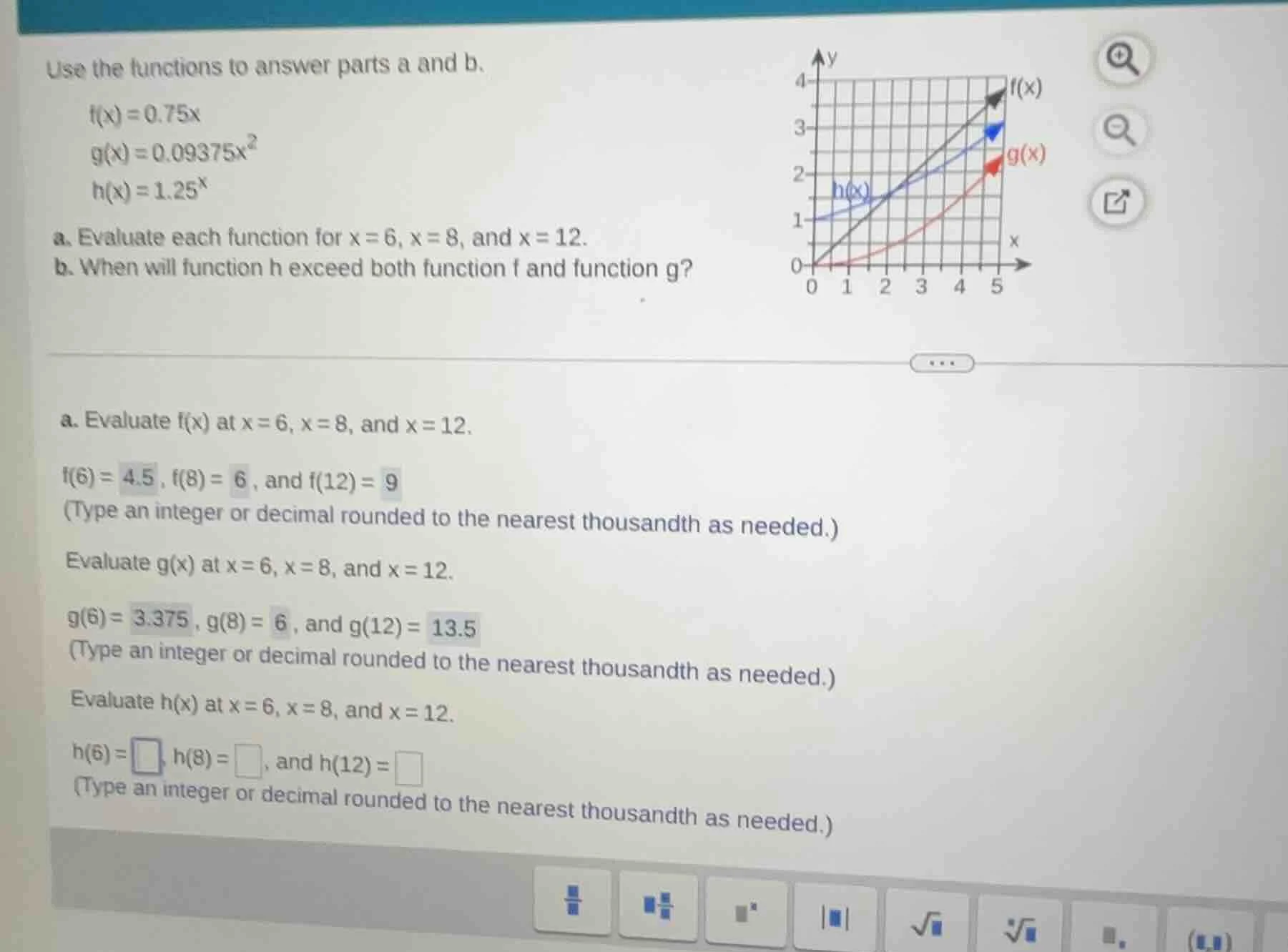
use the functions to answer parts a and b.$f(x)=0.75xLXB0h(x)=1.25^{x}$a. evaluate each function for $x=6$, $x=8$, and $x=12$.b. when will function h exceed both function f and function g?a. evaluate $f(x)$ at $x=6$, $x=8$, and $x=12$.$f(6)=4.5$, $f(8)=6$, and $f(12)=9$(type an integer or decimal rounded to the nearest thousandth as needed.)evaluate $g(x)$ at $x=6$, $x=8$, and $x=12$.$g(6)=3.375$, $g(8)=6$, and $g(12)=13.5$(type an integer or decimal rounded to the nearest thousandth as needed.)evaluate $h(x)$ at $x=6$, $x=8$, and $x=12$.$h(6)=\square$, $h(8)=\square$, and $h(12)=\square$(type an integer or decimal rounded to the nearest thousandth as needed.)
Step1: Calculate h(6)
$h(6)=1.25^6 = 3.814697265625 \approx 3.815$
Step2: Calculate h(8)
$h(8)=1.25^8 = 5.9604644775390625 \approx 5.960$
Step3: Calculate h(12)
$h(12)=1.25^{12} = 14.551915228366822 \approx 14.552$
Step4: Find x where h(x) > f(x) and h(x) > g(x)
Test x=13: $h(13)=1.25^{13}\approx18.1899$, $f(13)=0.75*13=9.75$, $g(13)=0.09375*13^2=0.09375*169=15.84375$. All $h(x) > f(x), g(x)$.
Test x=12: $h(12)\approx14.552$, $f(12)=9$, $g(12)=13.5$. $h(x) > f(x)$ but $h(x) < g(x)$.
So x=13 is the first integer where h(x) exceeds both.

Snap & solve any problem in the app
Get step-by-step solutions on Sovi AI
Photo-based solutions with guided steps
Explore more problems and detailed explanations
Part a:
$h(6)=3.815$, $h(8)=5.960$, and $h(12)=14.552$
Part b:
Function h exceeds both function f and function g when $x=13$ (the smallest integer value; for real numbers, $x\approx12.1$ but the practical integer solution is 13)