QUESTION IMAGE
Question
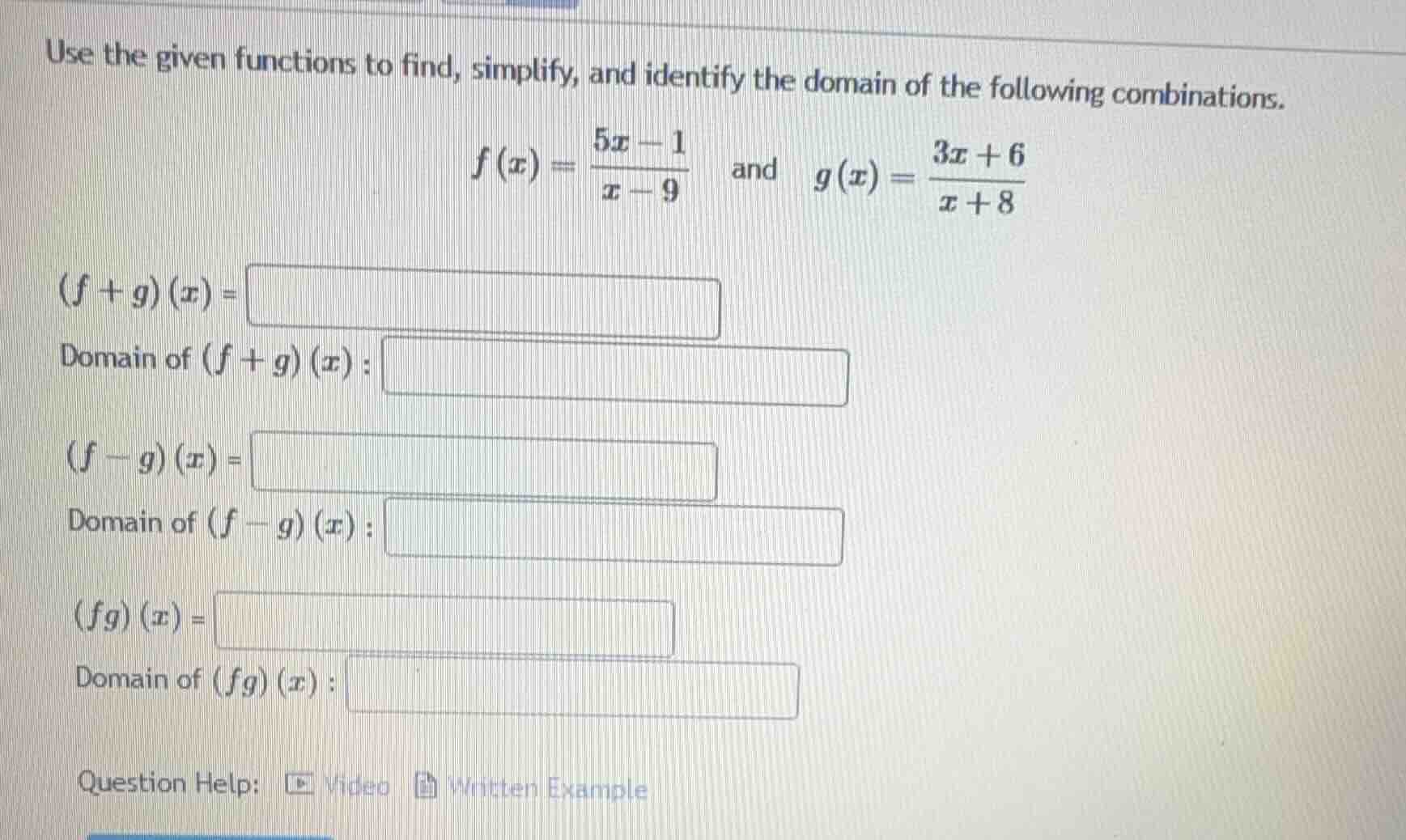
use the given functions to find, simplify, and identify the domain of the following combinations.
$f(x) = \frac{5x - 1}{x - 9}$ and $g(x) = \frac{3x + 6}{x + 8}$
$(f + g)(x) = \square$
domain of $(f + g)(x)$: $\square$
$(f - g)(x) = \square$
domain of $(f - g)(x)$: $\square$
$(fg)(x) = \square$
domain of $(fg)(x)$: $\square$
question help: \\(\boldsymbol{\text{video}}\\) \\(\boldsymbol{\text{written example}}\\)
For \((f + g)(x)\)
Step1: Add the two functions
To find \((f + g)(x)\), we add \(f(x)\) and \(g(x)\):
\[
(f + g)(x)=f(x)+g(x)=\frac{5x - 1}{x - 9}+\frac{3x + 6}{x + 8}
\]
Step2: Find a common denominator
The common denominator of \(x - 9\) and \(x + 8\) is \((x - 9)(x + 8)\). We rewrite each fraction with this common denominator:
\[
\frac{(5x - 1)(x + 8)}{(x - 9)(x + 8)}+\frac{(3x + 6)(x - 9)}{(x - 9)(x + 8)}
\]
Step3: Expand the numerators
Expand \((5x - 1)(x + 8)\) and \((3x + 6)(x - 9)\):
\[
(5x - 1)(x + 8)=5x^2+40x - x - 8 = 5x^2+39x - 8
\]
\[
(3x + 6)(x - 9)=3x^2-27x + 6x - 54 = 3x^2-21x - 54
\]
Step4: Add the numerators
Add the expanded numerators:
\[
\frac{5x^2+39x - 8+3x^2-21x - 54}{(x - 9)(x + 8)}=\frac{8x^2+18x - 62}{(x - 9)(x + 8)}
\]
We can factor the numerator: \(8x^2 + 18x-62 = 2(4x^2 + 9x - 31)\) (you can also leave it as \(8x^2+18x - 62\) for simplicity). So, \((f + g)(x)=\frac{8x^2+18x - 62}{(x - 9)(x + 8)}\) (or \(\frac{2(4x^2 + 9x - 31)}{(x - 9)(x + 8)}\)).
Step5: Find the domain
The domain of a rational function is all real numbers except where the denominator is zero. So we set the denominator \((x - 9)(x + 8)=0\). Solving \(x - 9 = 0\) gives \(x = 9\), and solving \(x + 8 = 0\) gives \(x=-8\). So the domain is all real numbers except \(x=-8\) and \(x = 9\), which can be written in interval notation as \((-\infty,-8)\cup(-8,9)\cup(9,\infty)\).
Step1: Subtract the two functions
To find \((f - g)(x)\), we subtract \(g(x)\) from \(f(x)\):
\[
(f - g)(x)=f(x)-g(x)=\frac{5x - 1}{x - 9}-\frac{3x + 6}{x + 8}
\]
Step2: Find a common denominator
The common denominator of \(x - 9\) and \(x + 8\) is \((x - 9)(x + 8)\). We rewrite each fraction with this common denominator:
\[
\frac{(5x - 1)(x + 8)}{(x - 9)(x + 8)}-\frac{(3x + 6)(x - 9)}{(x - 9)(x + 8)}
\]
Step3: Expand the numerators
Expand \((5x - 1)(x + 8)\) and \((3x + 6)(x - 9)\) (we already did this in the previous part):
\[
(5x - 1)(x + 8)=5x^2+39x - 8
\]
\[
(3x + 6)(x - 9)=3x^2-21x - 54
\]
Step4: Subtract the numerators
Subtract the expanded numerators:
\[
\frac{5x^2+39x - 8-(3x^2-21x - 54)}{(x - 9)(x + 8)}=\frac{5x^2+39x - 8 - 3x^2+21x + 54}{(x - 9)(x + 8)}=\frac{2x^2+60x + 46}{(x - 9)(x + 8)}
\]
We can factor the numerator: \(2x^2+60x + 46 = 2(x^2+30x + 23)\) (or leave it as \(2x^2+60x + 46\)). So, \((f - g)(x)=\frac{2x^2+60x + 46}{(x - 9)(x + 8)}\) (or \(\frac{2(x^2+30x + 23)}{(x - 9)(x + 8)}\)).
Step5: Find the domain
The domain is determined by the denominator \((x - 9)(x + 8)
eq0\). So \(x
eq9\) and \(x
eq - 8\). The domain is \((-\infty,-8)\cup(-8,9)\cup(9,\infty)\).
Step1: Multiply the two functions
To find \((fg)(x)\), we multiply \(f(x)\) and \(g(x)\):
\[
(fg)(x)=f(x)\cdot g(x)=\frac{5x - 1}{x - 9}\cdot\frac{3x + 6}{x + 8}
\]
Step2: Multiply the numerators and denominators
Multiply the numerators \((5x - 1)\) and \((3x + 6)\), and the denominators \((x - 9)\) and \((x + 8)\):
\[
\frac{(5x - 1)(3x + 6)}{(x - 9)(x + 8)}
\]
Step3: Simplify the numerator
Factor \(3x + 6 = 3(x + 2)\), so the numerator becomes \((5x - 1)\cdot3(x + 2)=3(5x - 1)(x + 2)\). Expand \(3(5x - 1)(x + 2)\):
\[
3(5x^2+10x - x - 2)=3(5x^2+9x - 2)=15x^2+27x - 6
\]
So, \((fg)(x)=\frac{15x^2+27x - 6}{(x - 9)(x + 8)}\) (or we can leave it as \(\frac{3(5x - 1)(x + 2)}{(x - 9)(x + 8)}\)).
Step4: Find the domain
The domain is determined by the denominator \((x - 9)(x + 8)
eq0\). So \(x
eq9\) and \(x
eq - 8\). The domain is \((-\infty,-8)\cup(-8,9)\cup(9,\infty)\).

Snap & solve any problem in the app
Get step-by-step solutions on Sovi AI
Photo-based solutions with guided steps
Explore more problems and detailed explanations
for \((f + g)(x)\): \(\frac{8x^2 + 18x-62}{(x - 9)(x + 8)}\) (or \(\frac{2(4x^2 + 9x - 31)}{(x - 9)(x + 8)}\))