QUESTION IMAGE
Question
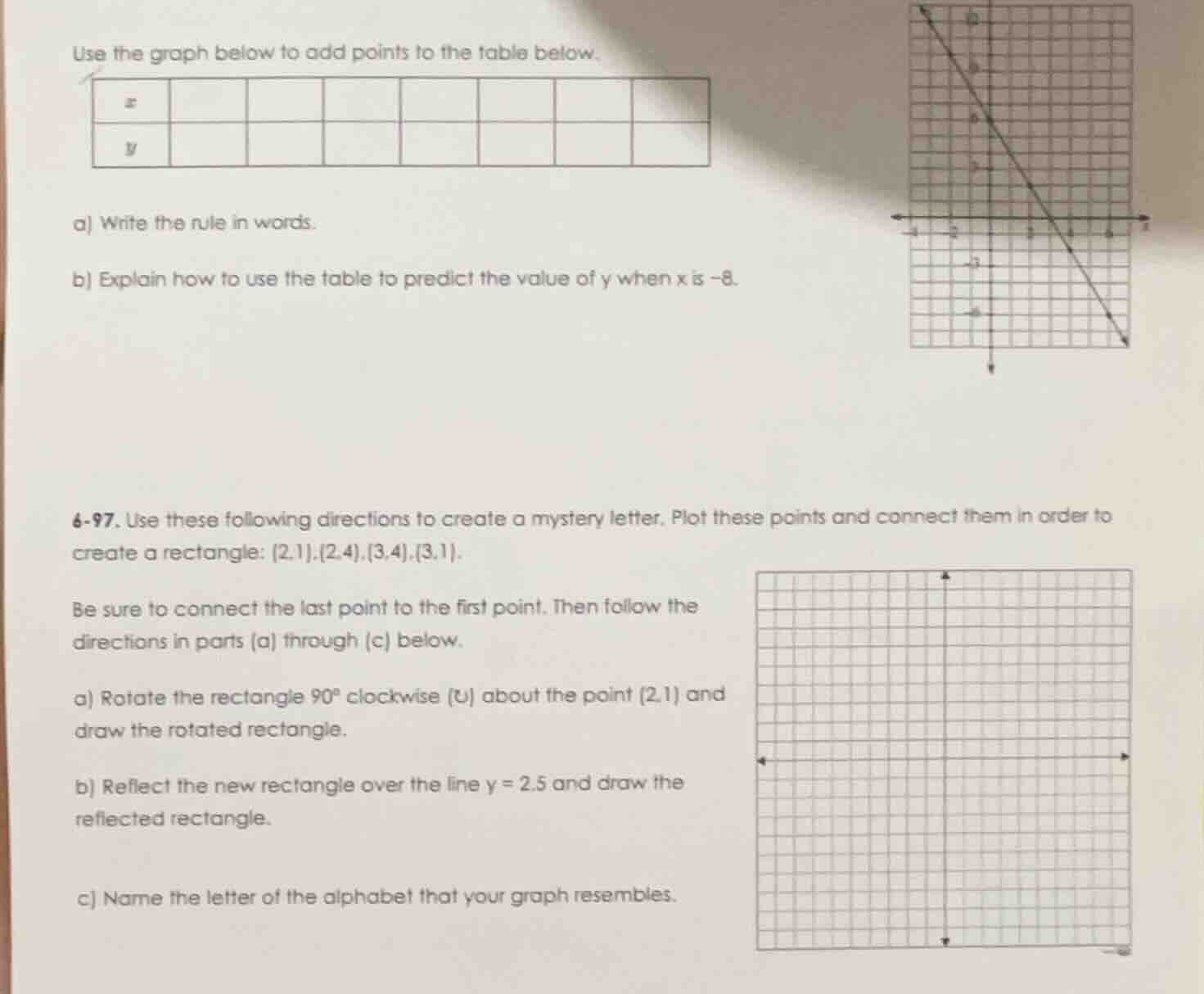
use the graph below to add points to the table below.
| x | |||||||
| y |
a) write the rule in words.
b) explain how to use the table to predict the value of y when x is -8.
6-97. use these following directions to create a mystery letter. plot these points and connect them in order to create a rectangle: (2,1),(2,4),(3,4),(3,1).
be sure to connect the last point to the first point. then follow the directions in parts (a) through (c) below.
a) rotate the rectangle 90° clockwise (↻) about the point (2,1) and draw the rotated rectangle.
b) reflect the new rectangle over the line y = 2.5 and draw the reflected rectangle.
c) name the letter of the alphabet that your graph resembles.
Part 6-97:
a) Rotating the Rectangle 90° Clockwise about (2,1)
To rotate a point \((x,y)\) 90° clockwise about a center \((h,k)\), we use the transformation:
New \(x = h + (y - k)\)
New \(y = k - (x - h)\)
- For point (2,1) (center):
Since it's the center, it remains \((2,1)\).
- For point (2,4):
\(h = 2\), \(k = 1\), \(x = 2\), \(y = 4\)
New \(x = 2 + (4 - 1) = 5\)
New \(y = 1 - (2 - 2) = 1\)
Rotated point: \((5,1)\)
- For point (3,4):
\(x = 3\), \(y = 4\)
New \(x = 2 + (4 - 1) = 5\)
New \(y = 1 - (3 - 2) = 0\)
Rotated point: \((5,0)\)
- For point (3,1):
\(x = 3\), \(y = 1\)
New \(x = 2 + (1 - 1) = 2\)
New \(y = 1 - (3 - 2) = 0\)
Rotated point: \((2,0)\)
The rotated rectangle has vertices: \((2,1)\), \((5,1)\), \((5,0)\), \((2,0)\).
b) Reflecting Over \(y = 2.5\)
To reflect a point \((x,y)\) over \(y = c\), the new \(y\)-coordinate is \(2c - y\), and \(x\) remains. Here, \(c = 2.5\).
- For (2,1):
New \(y = 2(2.5) - 1 = 4\)
Reflected point: \((2,4)\)
- For (5,1):
New \(y = 2(2.5) - 1 = 4\)
Reflected point: \((5,4)\)
- For (5,0):
New \(y = 2(2.5) - 0 = 5\)
Reflected point: \((5,5)\)
- For (2,0):
New \(y = 2(2.5) - 0 = 5\)
Reflected point: \((2,5)\)
The reflected rectangle has vertices: \((2,4)\), \((5,4)\), \((5,5)\), \((2,5)\).
c) Naming the Letter
After plotting the original rectangle, rotating, reflecting, and connecting, the combined shape (original + transformed) resembles the letter "H" (or may form a vertical/horizontal bar structure typical of "H").
For the Graph and Table (Top Section):
Step 1: Identify Points on the Line
From the graph, we can pick \(x\)-values and find corresponding \(y\)-values. For example:
- When \(x = 0\), \(y = 5\) (intercept)
- When \(x = 3\), \(y = 2\)
- When \(x = 4\), \(y = 1\)
- When \(x = 5\), \(y = 0\) (intercept)
- When \(x = -2\), \(y = 8\) (since slope \(m = \frac{2 - 5}{3 - 0} = -1\), so \(y = -x + 5\))
a) Rule in Words
The \(y\)-value is equal to 5 minus the \(x\)-value (or \(y = -x + 5\)).
b) Predict \(y\) when \(x = -8\)
Using the rule \(y = -x + 5\):
Substitute \(x = -8\):
\(y = -(-8) + 5 = 8 + 5 = 13\).
Final Answers:
- 6-97c: The graph resembles the letter \(\boldsymbol{H}\) (or similar, depending on precise plotting).
- Table Points (example):
\(x\): \(-2\), \(0\), \(3\), \(4\), \(5\)
\(y\): \(8\), \(5\), \(2\), \(1\), \(0\)
- a) Rule: \(y\) is 5 minus \(x\).
- b) \(y = 13\) when \(x = -8\).

Snap & solve any problem in the app
Get step-by-step solutions on Sovi AI
Photo-based solutions with guided steps
Explore more problems and detailed explanations
Part 6-97:
a) Rotating the Rectangle 90° Clockwise about (2,1)
To rotate a point \((x,y)\) 90° clockwise about a center \((h,k)\), we use the transformation:
New \(x = h + (y - k)\)
New \(y = k - (x - h)\)
- For point (2,1) (center):
Since it's the center, it remains \((2,1)\).
- For point (2,4):
\(h = 2\), \(k = 1\), \(x = 2\), \(y = 4\)
New \(x = 2 + (4 - 1) = 5\)
New \(y = 1 - (2 - 2) = 1\)
Rotated point: \((5,1)\)
- For point (3,4):
\(x = 3\), \(y = 4\)
New \(x = 2 + (4 - 1) = 5\)
New \(y = 1 - (3 - 2) = 0\)
Rotated point: \((5,0)\)
- For point (3,1):
\(x = 3\), \(y = 1\)
New \(x = 2 + (1 - 1) = 2\)
New \(y = 1 - (3 - 2) = 0\)
Rotated point: \((2,0)\)
The rotated rectangle has vertices: \((2,1)\), \((5,1)\), \((5,0)\), \((2,0)\).
b) Reflecting Over \(y = 2.5\)
To reflect a point \((x,y)\) over \(y = c\), the new \(y\)-coordinate is \(2c - y\), and \(x\) remains. Here, \(c = 2.5\).
- For (2,1):
New \(y = 2(2.5) - 1 = 4\)
Reflected point: \((2,4)\)
- For (5,1):
New \(y = 2(2.5) - 1 = 4\)
Reflected point: \((5,4)\)
- For (5,0):
New \(y = 2(2.5) - 0 = 5\)
Reflected point: \((5,5)\)
- For (2,0):
New \(y = 2(2.5) - 0 = 5\)
Reflected point: \((2,5)\)
The reflected rectangle has vertices: \((2,4)\), \((5,4)\), \((5,5)\), \((2,5)\).
c) Naming the Letter
After plotting the original rectangle, rotating, reflecting, and connecting, the combined shape (original + transformed) resembles the letter "H" (or may form a vertical/horizontal bar structure typical of "H").
For the Graph and Table (Top Section):
Step 1: Identify Points on the Line
From the graph, we can pick \(x\)-values and find corresponding \(y\)-values. For example:
- When \(x = 0\), \(y = 5\) (intercept)
- When \(x = 3\), \(y = 2\)
- When \(x = 4\), \(y = 1\)
- When \(x = 5\), \(y = 0\) (intercept)
- When \(x = -2\), \(y = 8\) (since slope \(m = \frac{2 - 5}{3 - 0} = -1\), so \(y = -x + 5\))
a) Rule in Words
The \(y\)-value is equal to 5 minus the \(x\)-value (or \(y = -x + 5\)).
b) Predict \(y\) when \(x = -8\)
Using the rule \(y = -x + 5\):
Substitute \(x = -8\):
\(y = -(-8) + 5 = 8 + 5 = 13\).
Final Answers:
- 6-97c: The graph resembles the letter \(\boldsymbol{H}\) (or similar, depending on precise plotting).
- Table Points (example):
\(x\): \(-2\), \(0\), \(3\), \(4\), \(5\)
\(y\): \(8\), \(5\), \(2\), \(1\), \(0\)
- a) Rule: \(y\) is 5 minus \(x\).
- b) \(y = 13\) when \(x = -8\).