QUESTION IMAGE
Question
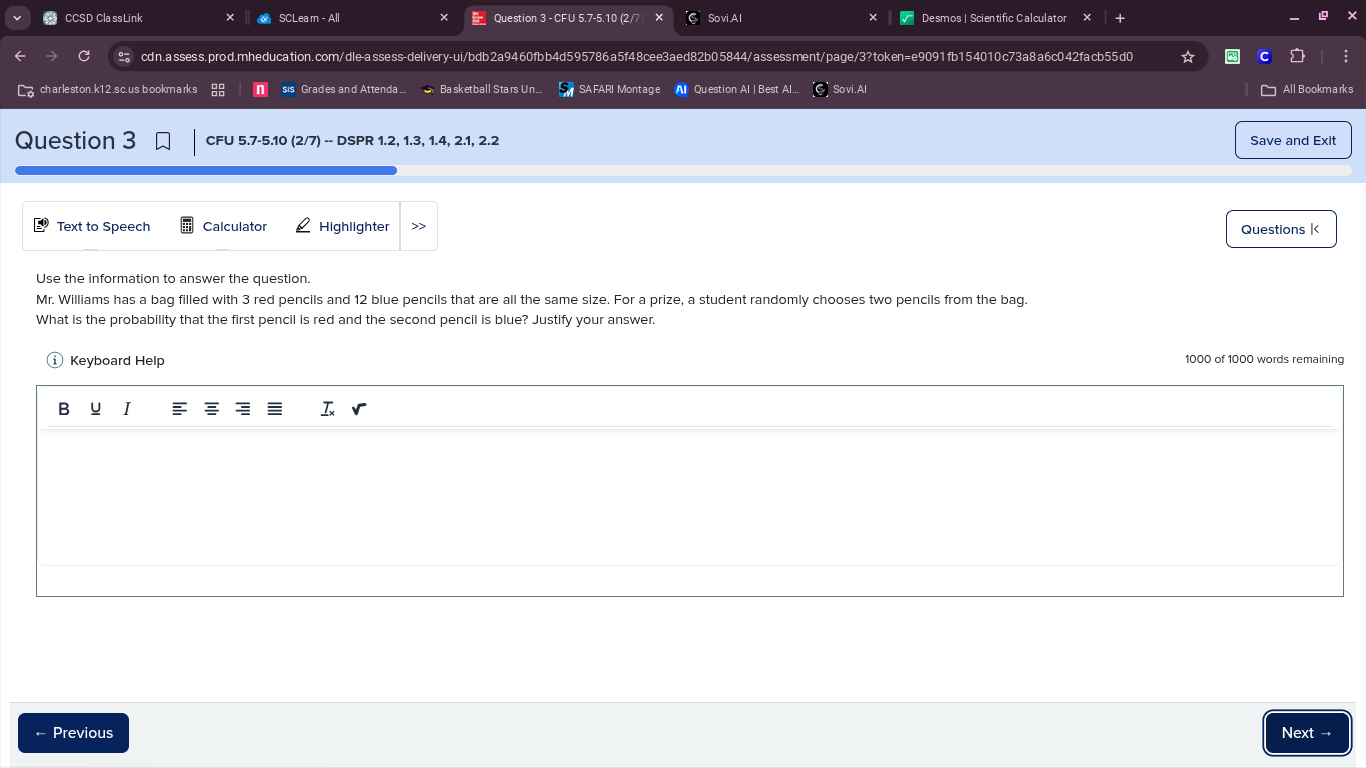
use the information to answer the question. mr. williams has a bag filled with 3 red pencils and 12 blue pencils that are all the same size. for a prize, a student randomly chooses two pencils from the bag. what is the probability that the first pencil is red and the second pencil is blue? justify your answer.
Step1: Find total number of pencils
First, calculate the total number of pencils in the bag. There are 3 red and 12 blue pencils, so total is \( 3 + 12 = 15 \) pencils.
Step2: Probability first pencil is red
The probability that the first pencil chosen is red is the number of red pencils divided by total pencils. So that's \( \frac{3}{15} \), which simplifies to \( \frac{1}{5} \).
Step3: Probability second pencil is blue (after first red)
After removing one red pencil, there are now \( 15 - 1 = 14 \) pencils left, and still 12 blue pencils. So the probability the second pencil is blue is \( \frac{12}{14} \), which simplifies to \( \frac{6}{7} \).
Step4: Multiply the two probabilities
To find the probability of both events happening (first red, then blue), we multiply the two probabilities. So \( \frac{1}{5} \times \frac{6}{7} = \frac{6}{35} \).

Snap & solve any problem in the app
Get step-by-step solutions on Sovi AI
Photo-based solutions with guided steps
Explore more problems and detailed explanations
The probability that the first pencil is red and the second pencil is blue is \(\frac{6}{35}\). To justify, we first find the total number of pencils (\(3 + 12 = 15\)). The probability the first is red is \(\frac{3}{15}=\frac{1}{5}\). After removing one red pencil, there are 14 pencils left with 12 blue, so the probability the second is blue is \(\frac{12}{14}=\frac{6}{7}\). Multiplying these probabilities (\(\frac{1}{5} \times \frac{6}{7}\)) gives \(\frac{6}{35}\).