QUESTION IMAGE
Question
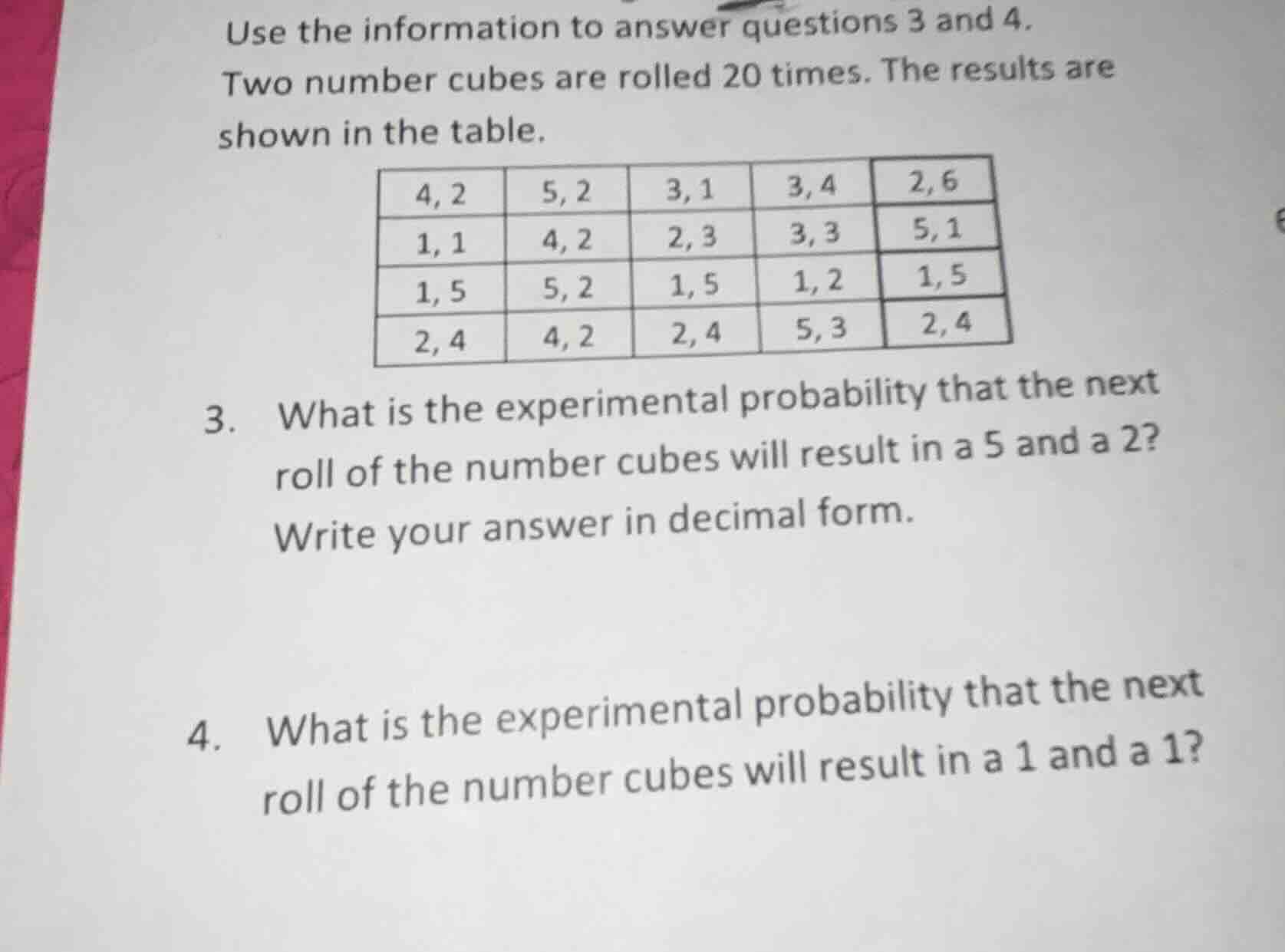
use the information to answer questions 3 and 4.
two number cubes are rolled 20 times. the results are shown in the table.
4, 2 5, 2 3, 1 3, 4 2, 6
1, 1 4, 2 2, 3 3, 3 5, 1
1, 5 5, 2 1, 5 1, 2 1, 5
2, 4 4, 2 2, 4 5, 3 2, 4
- what is the experimental probability that the next roll of the number cubes will result in a 5 and a 2? write your answer in decimal form.
- what is the experimental probability that the next roll of the number cubes will result in a 1 and a 1?
Step1: Count total trials
Total number of rolls = 20
Step2: Count (5,2) occurrences
Number of times (5,2) appears = 3
Step3: Calculate Q3 probability
Experimental probability = $\frac{\text{Number of favorable outcomes}}{\text{Total number of trials}} = \frac{3}{20} = 0.15$
Step4: Count (1,1) occurrences
Number of times (1,1) appears = 1
Step5: Calculate Q4 probability
Experimental probability = $\frac{\text{Number of favorable outcomes}}{\text{Total number of trials}} = \frac{1}{20} = 0.05$

Snap & solve any problem in the app
Get step-by-step solutions on Sovi AI
Photo-based solutions with guided steps
Explore more problems and detailed explanations
- $0.15$
- $0.05$