QUESTION IMAGE
Question
use the information and table to answer the following question.
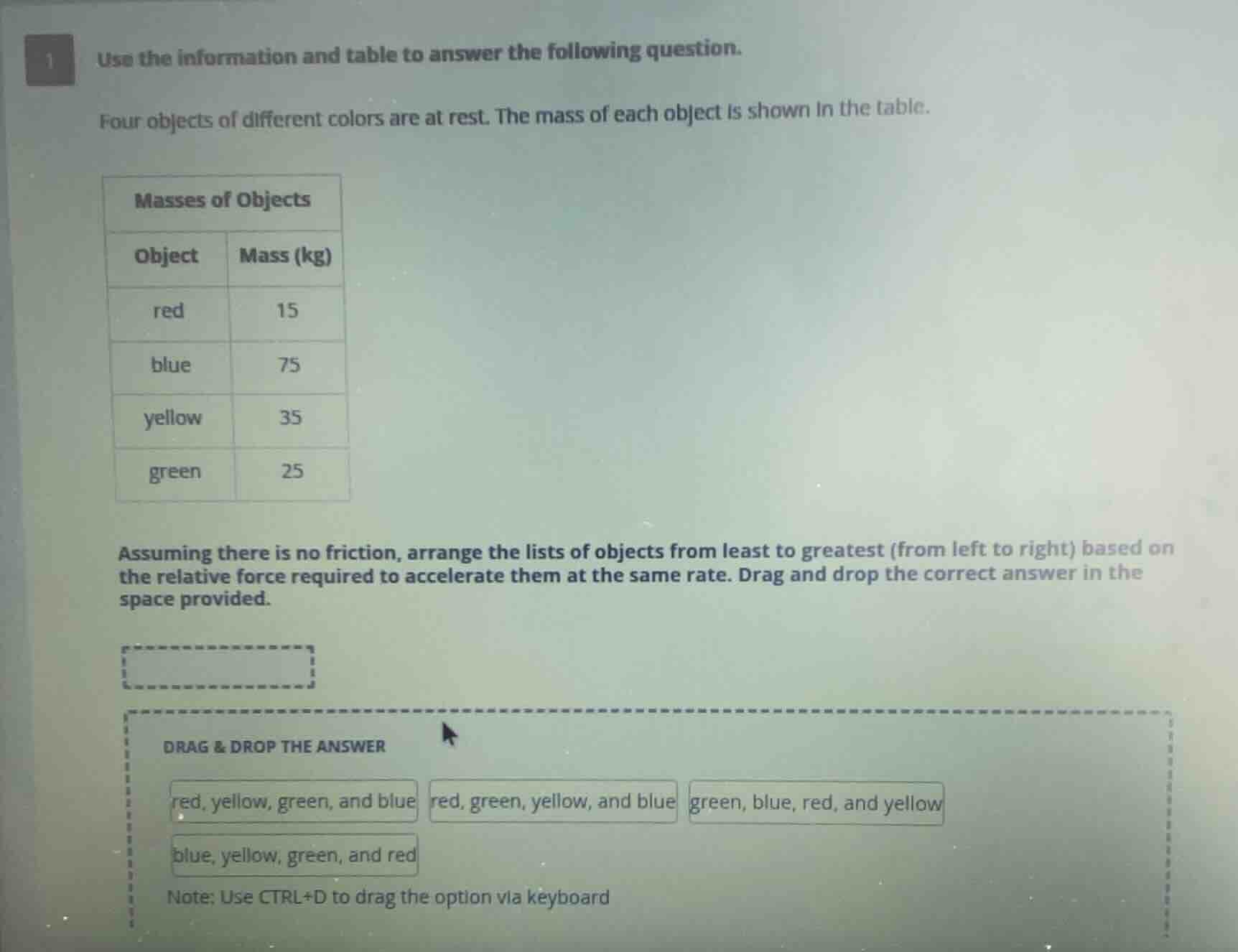
four objects of different colors are at rest. the mass of each object is shown in the table.
masses of objects
object | mass (kg)
red | 15
blue | 75
yellow | 35
green | 25
assuming there is no friction, arrange the lists of objects from least to greatest (from left to right) based on the relative force required to accelerate them at the same rate. drag and drop the correct answer in the space provided.
drag & drop the answer
red, yellow, green, and blue | red, green, yellow, and blue | green, blue, red, and yellow
blue, yellow, green, and red
note: use ctrl+d to drag the option via keyboard
Step1: Recall Newton's Second Law
Newton's second law states that \( F = ma \), where \( F \) is force, \( m \) is mass, and \( a \) is acceleration. If the acceleration \( a \) is the same for all objects, then the force \( F \) is directly proportional to the mass \( m \) (i.e., \( F \propto m \) when \( a \) is constant). So, we need to arrange the objects by their mass from least to greatest, as the force required will follow the same order.
Step2: List the masses of each object
- Red: \( 15 \, \text{kg} \)
- Blue: \( 75 \, \text{kg} \)
- Yellow: \( 35 \, \text{kg} \)
- Green: \( 25 \, \text{kg} \)
Step3: Order the masses from least to greatest
Comparing the masses: \( 15 < 25 < 35 < 75 \). Corresponding to the objects: red (15 kg), green (25 kg), yellow (35 kg), blue (75 kg).

Snap & solve any problem in the app
Get step-by-step solutions on Sovi AI
Photo-based solutions with guided steps
Explore more problems and detailed explanations
red, green, yellow, and blue