QUESTION IMAGE
Question
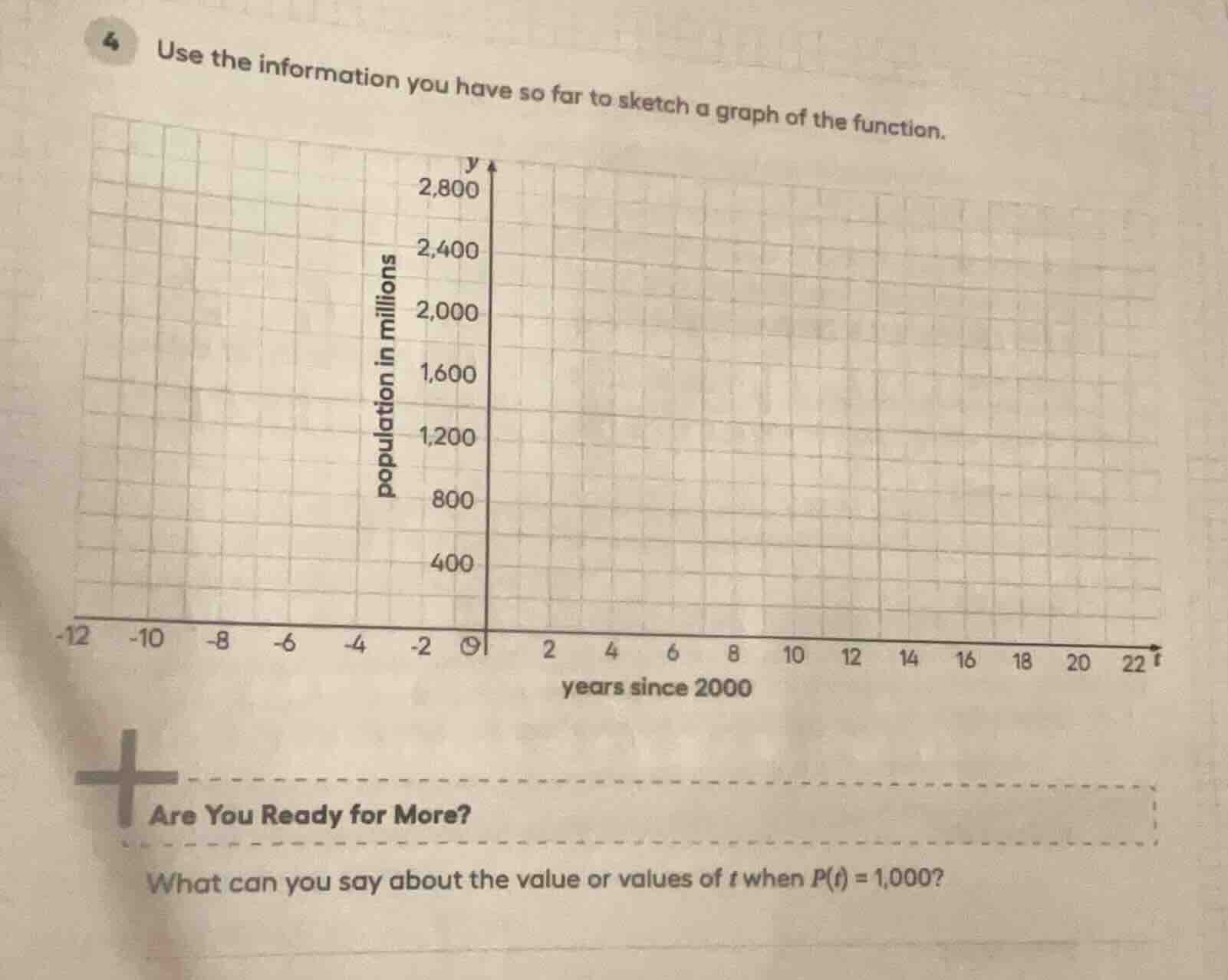
4 use the information you have so far to sketch a graph of the function.
are you ready for more?
what can you say about the value or values of t when p(t) = 1,000?
Step1: Understand the Problem
We need to analyze the function \( P(t) \) where \( P(t) \) represents population in millions and \( t \) is years since 2000. We are asked about the value(s) of \( t \) when \( P(t) = 1000 \). This involves understanding the graph of the function (even though we need to sketch it, for the "Are You Ready for More?" part, we can infer based on typical population growth or the context).
Step2: Analyze the Graph Context
Assuming the function \( P(t) \) is a population function, often population functions (like exponential growth or linear growth) are monotonic (either always increasing or decreasing). If we consider typical population models, population usually increases over time (so \( P(t) \) is an increasing function).
Step3: Determine the Number of Solutions
For an increasing function, the equation \( P(t)=1000 \) will have at most one solution. Because if \( P(t) \) is increasing, as \( t \) increases, \( P(t) \) increases. So there will be exactly one value of \( t \) (a specific number of years since 2000) where \( P(t) = 1000 \). If the function were non - monotonic, there could be more, but population functions are generally monotonic (increasing) over time.

Snap & solve any problem in the app
Get step-by-step solutions on Sovi AI
Photo-based solutions with guided steps
Explore more problems and detailed explanations
The equation \( P(t) = 1000 \) has exactly one solution for \( t \) (assuming \( P(t) \) is a monotonic (e.g., increasing) population function, which is typical for population models). This is because a monotonic function (like an increasing population function) will cross the horizontal line \( y = 1000 \) at most once. So there is one value of \( t \) (number of years since 2000) such that \( P(t)=1000 \).