QUESTION IMAGE
Question
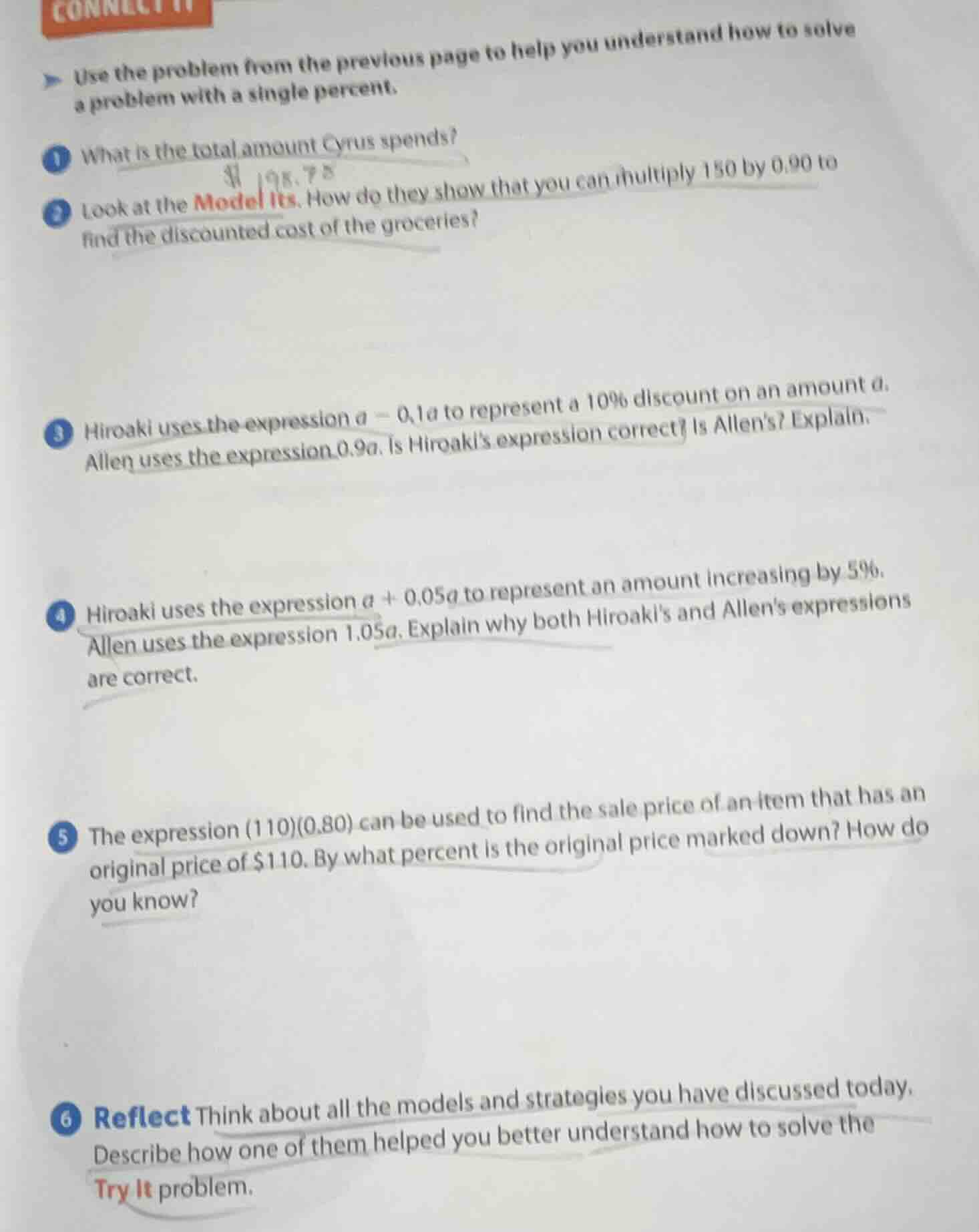
use the problem from the previous page to help you understand how to solve a problem with a single percent. 1 what is the total amount cyrus spends? 2 look at the model its. how do they show that you can multiply 150 by 0.90 to find the discounted cost of the groceries? 3 hiroaki uses the expression ( a - 0.1a ) to represent a 10% discount on an amount ( a ). allen uses the expression ( 0.9a ). is hiroakis expression correct? is allens? explain. 4 hiroaki uses the expression ( a + 0.05a ) to represent an amount increasing by 5%. allen uses the expression ( 1.05a ). explain why both hiroakis and allens expressions are correct. 5 the expression ( (110)(0.80) ) can be used to find the sale price of an item that has an original price of $110. by what percent is the original price marked down? how do you know? 6 reflect think about all the models and strategies you have discussed today. describe how one of them helped you better understand how to solve the try it problem.
Question 5 Solution:
Step 1: Recall the discount formula
The formula for the sale price after a discount is \( \text{Sale Price} = \text{Original Price} \times (1 - \text{Discount Rate}) \). Here, the original price is \( \$110 \) and the sale price is calculated as \( (110)(0.80) \).
Step 2: Compare with the formula
Let the discount rate be \( r \). Then the sale price formula becomes \( 110\times(1 - r)=110\times0.80 \). Divide both sides by 110: \( 1 - r = 0.80 \).
Step 3: Solve for the discount rate
Subtract 0.80 from 1: \( r=1 - 0.80 = 0.20 \). To convert this to a percentage, multiply by 100: \( 0.20\times100 = 20\% \). We know this because the coefficient \( 0.80 \) in the expression \( (110)(0.80) \) represents the fraction of the original price that is paid (since \( 1 - 0.20 = 0.80 \)), so the discount is \( 20\% \).

Snap & solve any problem in the app
Get step-by-step solutions on Sovi AI
Photo-based solutions with guided steps
Explore more problems and detailed explanations
The original price is marked down by \( 20\% \). We know this because the expression \( (110)(0.80) \) implies that we are paying \( 80\% \) of the original price (since \( 0.80=\frac{80}{100} \)), so the discount percentage is \( 100\% - 80\% = 20\% \).