QUESTION IMAGE
Question
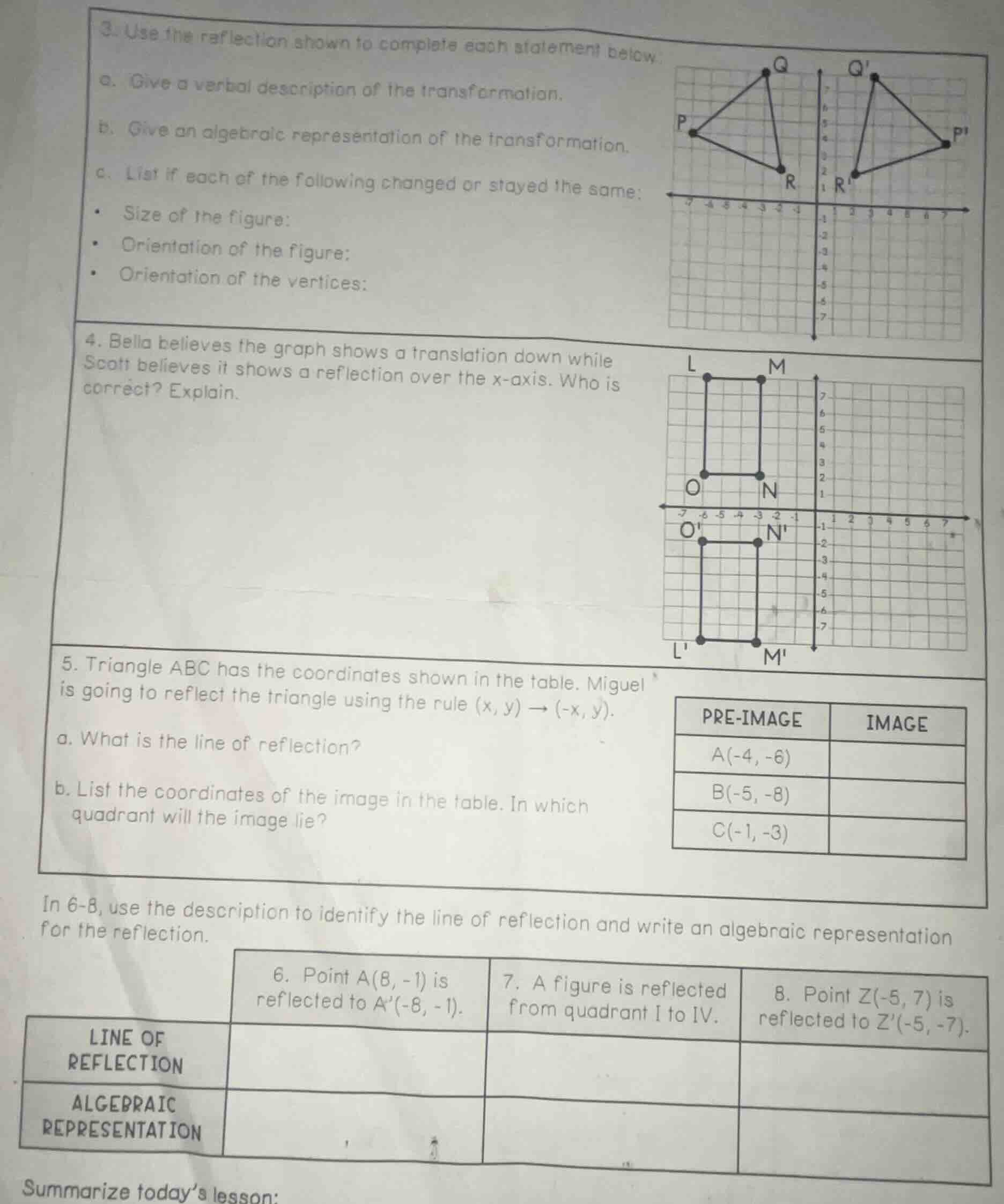
- use the reflection shown to complete each statement below:
a. give a verbal description of the transformation.
b. give an algebraic representation of the transformation.
c. list if each of the following changed or stayed the same:
- size of the figure:
- orientation of the figure:
- orientation of the vertices:
- bella believes the graph shows a translation down while scott believes it shows a reflection over the x - axis. who is correct? explain.
- triangle abc has the coordinates shown in the table. miguel is going to reflect the triangle using the rule ((x, y) \to (-x, y)).
a. what is the line of reflection?
b. list the coordinates of the image in the table. in which quadrant will the image lie?
in 6 - 8, use the description to identify the line of reflection and write an algebraic representation for the reflection.
- point (a(8, -1)) is reflected to (a(-8, -1)).
- a figure is reflected from quadrant i to iv.
- point (z(-5, 7)) is reflected to (z(-5, -7)).
summarize today’s lesson:
Problem 3
Step1: Identify reflection axis
Original triangle $P(-6,4)$, $Q(-2,7)$, $R(-2,2)$; image $P'(6,4)$, $Q'(2,7)$, $R'(2,2)$. The $y$-coordinates stay same, $x$-coordinates flip sign.
Step2: Write algebraic rule
For any point $(x,y)$, the transformation flips the $x$-value.
Step3: Analyze figure properties
Reflections preserve size; reverse vertex/orientation order.
A translation down would shift all points straight down, keeping their $x$-coordinates identical and subtracting the same value from all $y$-coordinates. A reflection over the $x$-axis flips the sign of the $y$-coordinate: $(x,y)\to(x,-y)$. For the original vertices $L(-5,7)$, $M(-2,7)$, $N(-2,2)$, $O(-5,2)$, the image vertices are $L'(-5,-7)$, $M'(-2,-7)$, $N'(-2,-2)$, $O'(-5,-2)$, which matches the reflection rule, not a translation.
Step1: Identify reflection line
Rule $(x,y)\to(-x,y)$ flips $x$-coordinate sign, which is the $y$-axis definition.
Step2: Calculate image coordinates
Apply $(-x,y)$ to each pre-image point:
- $A(-4,-6)\to(4,-6)$
- $B(-5,-8)\to(5,-8)$
- $C(-1,-3)\to(1,-3)$
Step3: Identify quadrant
Points with positive $x$, negative $y$ lie in Quadrant IV.

Snap & solve any problem in the app
Get step-by-step solutions on Sovi AI
Photo-based solutions with guided steps
Explore more problems and detailed explanations
a. Reflection over the $y$-axis (vertical axis)
b. $(x,y)\to(-x,y)$
c.
- Size of the figure: Stayed the same
- Orientation of the figure: Changed
- Orientation of the vertices: Changed
---