QUESTION IMAGE
Question
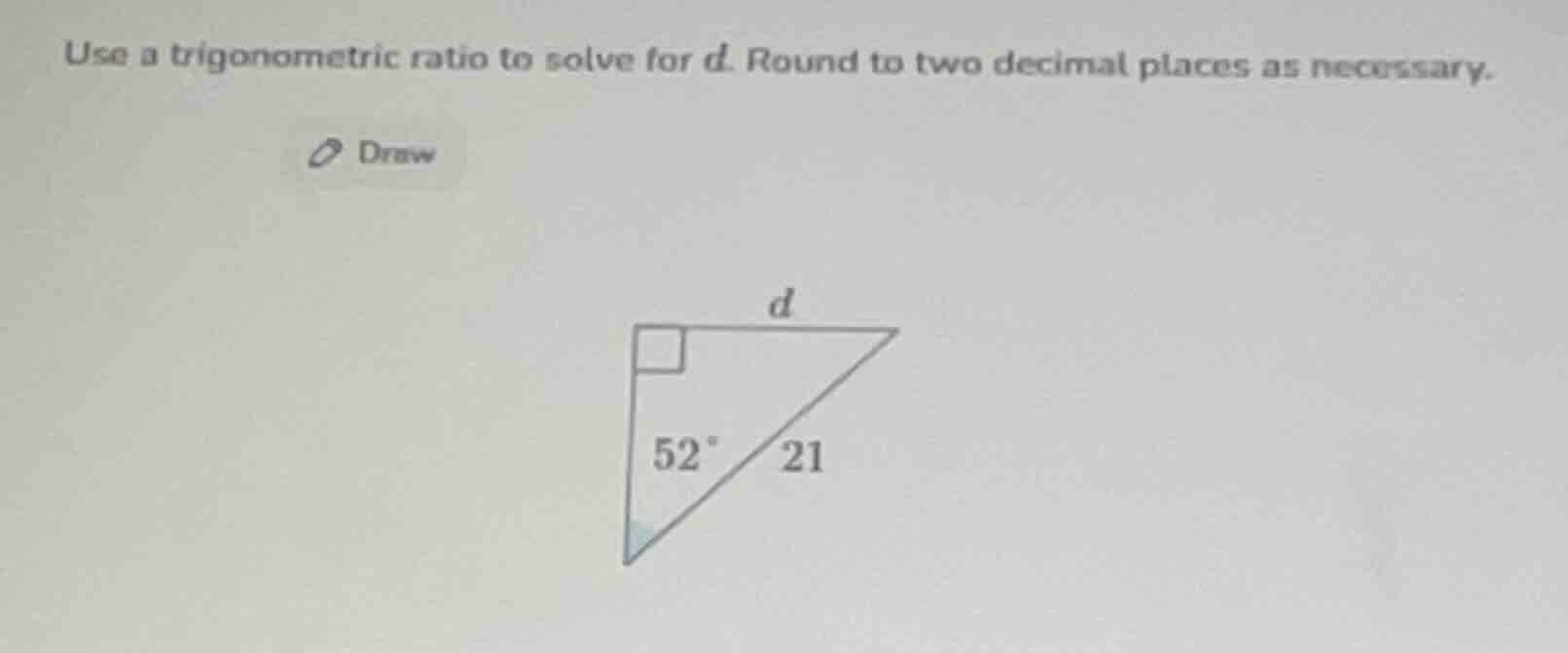
use a trigonometric ratio to solve for d. round to two decimal places as necessary.
Step1: Identify trigonometric ratio
In a right triangle, we can use the sine, cosine, or tangent ratios. Here, we have the hypotenuse (21) and we need to find the side opposite the 52° angle? Wait, no, wait. Wait, the right angle is at the left, so the angle at the bottom is 52°, the hypotenuse is 21, and \( d \) is the side adjacent to the 52° angle? Wait, no, let's label the triangle. Let's call the right angle \( C \), the bottom angle \( A = 52^\circ \), the hypotenuse \( AB = 21 \), and the side \( BC = d \) (adjacent to angle \( A \)), and the other leg \( AC \) (opposite to angle \( A \)). Wait, no, in the diagram, the right angle is at the top left, so the horizontal side is \( d \) (adjacent to the 52° angle at the bottom), the hypotenuse is 21, and the vertical leg is opposite? Wait, no, cosine of an angle in a right triangle is adjacent over hypotenuse. So angle 52°, adjacent side is \( d \), hypotenuse is 21. So \( \cos(52^\circ) = \frac{d}{21} \).
Step2: Solve for \( d \)
Multiply both sides by 21: \( d = 21 \times \cos(52^\circ) \). Calculate \( \cos(52^\circ) \approx 0.6157 \). Then \( d \approx 21 \times 0.6157 \approx 12.93 \).

Snap & solve any problem in the app
Get step-by-step solutions on Sovi AI
Photo-based solutions with guided steps
Explore more problems and detailed explanations
\( d \approx 12.93 \)