QUESTION IMAGE
Question
b) use words to describe the transformations
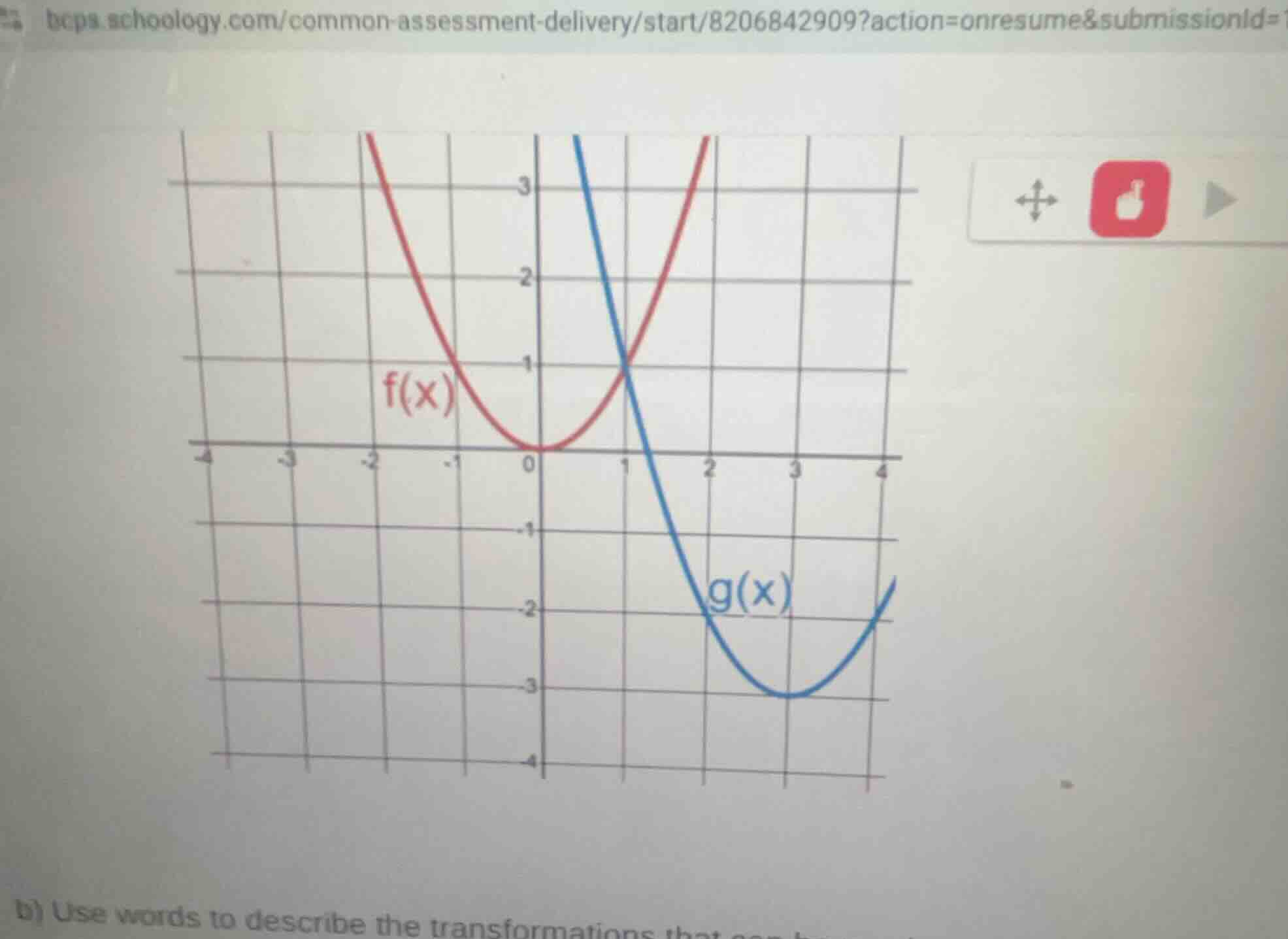
To solve this, we analyze the graphs of \( f(x) \) (red) and \( g(x) \) (blue):
Step 1: Identify the parent function of \( f(x) \)
The red graph \( f(x) \) is a parabola with vertex at \( (0, 0) \), so it represents the parent function \( f(x) = x^2 \) (standard parabola opening upwards).
Step 2: Analyze the vertex of \( g(x) \)
The blue graph \( g(x) \) has its vertex at \( (3, -3) \). To transform \( f(x) = x^2 \) into \( g(x) \):
- Horizontal shift: The vertex of \( f(x) \) is at \( x = 0 \), and the vertex of \( g(x) \) is at \( x = 3 \). This means \( f(x) \) is shifted \( 3 \) units to the right (since the \( x \)-coordinate increases by \( 3 \)).
- Vertical shift: The vertex of \( f(x) \) is at \( y = 0 \), and the vertex of \( g(x) \) is at \( y = -3 \). This means \( f(x) \) is shifted \( 3 \) units down (since the \( y \)-coordinate decreases by \( 3 \)).
Step 3: Confirm the shape (stretch/compression)
Both parabolas open upwards with the same "width" (no vertical stretch/compression, as the coefficient of \( x^2 \) remains \( 1 \) in terms of shape).

Snap & solve any problem in the app
Get step-by-step solutions on Sovi AI
Photo-based solutions with guided steps
Explore more problems and detailed explanations
To transform \( f(x) = x^2 \) into \( g(x) \), we apply a horizontal shift 3 units to the right and a vertical shift 3 units down.