QUESTION IMAGE
Question
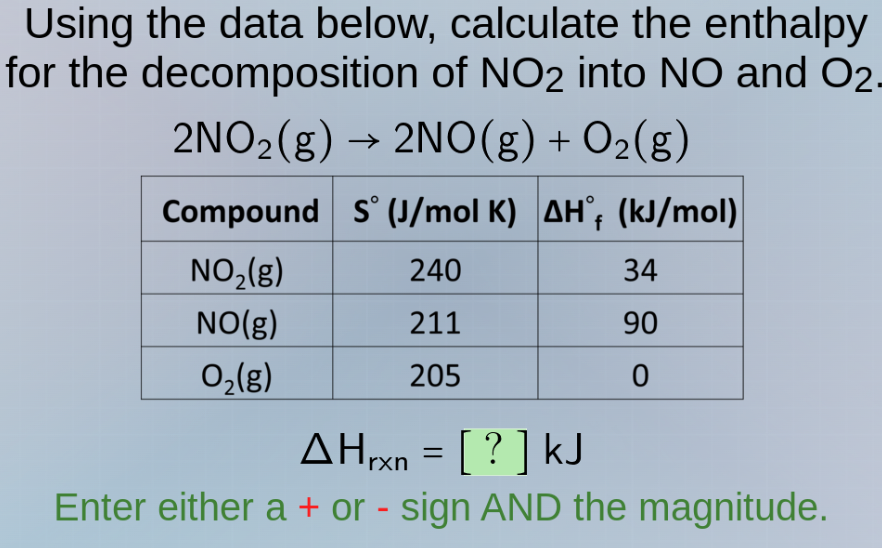
using the data below, calculate the enthalpy for the decomposition of no₂ into no and o₂. 2no₂(g) → 2no(g) + o₂(g) \
| compound | s° (j/mol k) | δh°f (kj/mol) | \ |
| --- | --- | --- | \ |
| no₂(g) | 240 | 34 | \ |
| no(g) | 211 | 90 | \ |
| o₂(g) | 205 | 0 | \ |
δhᵣₓₙ = ? kj \
enter either a + or - sign and the magnitude.
Step1: Recall the formula for enthalpy of reaction
The formula for the enthalpy of a reaction (\(\Delta H_{rxn}\)) is \(\Delta H_{rxn}=\sum n\Delta H_f^{\circ}(\text{products})-\sum m\Delta H_f^{\circ}(\text{reactants})\), where \(n\) and \(m\) are the stoichiometric coefficients of products and reactants respectively.
Step2: Identify products and reactants with coefficients
For the reaction \(2NO_2(g)
ightarrow 2NO(g)+O_2(g)\), the products are \(2\) moles of \(NO(g)\) and \(1\) mole of \(O_2(g)\), and the reactant is \(2\) moles of \(NO_2(g)\).
Step3: Calculate \(\sum n\Delta H_f^{\circ}(\text{products})\)
For \(NO(g)\): \(n = 2\), \(\Delta H_f^{\circ}=90\space kJ/mol\), so contribution is \(2\times90 = 180\space kJ\).
For \(O_2(g)\): \(n = 1\), \(\Delta H_f^{\circ}=0\space kJ/mol\), so contribution is \(1\times0 = 0\space kJ\).
Sum of products: \(180 + 0=180\space kJ\).
Step4: Calculate \(\sum m\Delta H_f^{\circ}(\text{reactants})\)
For \(NO_2(g)\): \(m = 2\), \(\Delta H_f^{\circ}=34\space kJ/mol\), so contribution is \(2\times34 = 68\space kJ\).
Step5: Calculate \(\Delta H_{rxn}\)
Using the formula \(\Delta H_{rxn}=\sum n\Delta H_f^{\circ}(\text{products})-\sum m\Delta H_f^{\circ}(\text{reactants})\)
\(\Delta H_{rxn}=180 - 68=112\space kJ\)

Snap & solve any problem in the app
Get step-by-step solutions on Sovi AI
Photo-based solutions with guided steps
Explore more problems and detailed explanations
\(+112\)