QUESTION IMAGE
Question
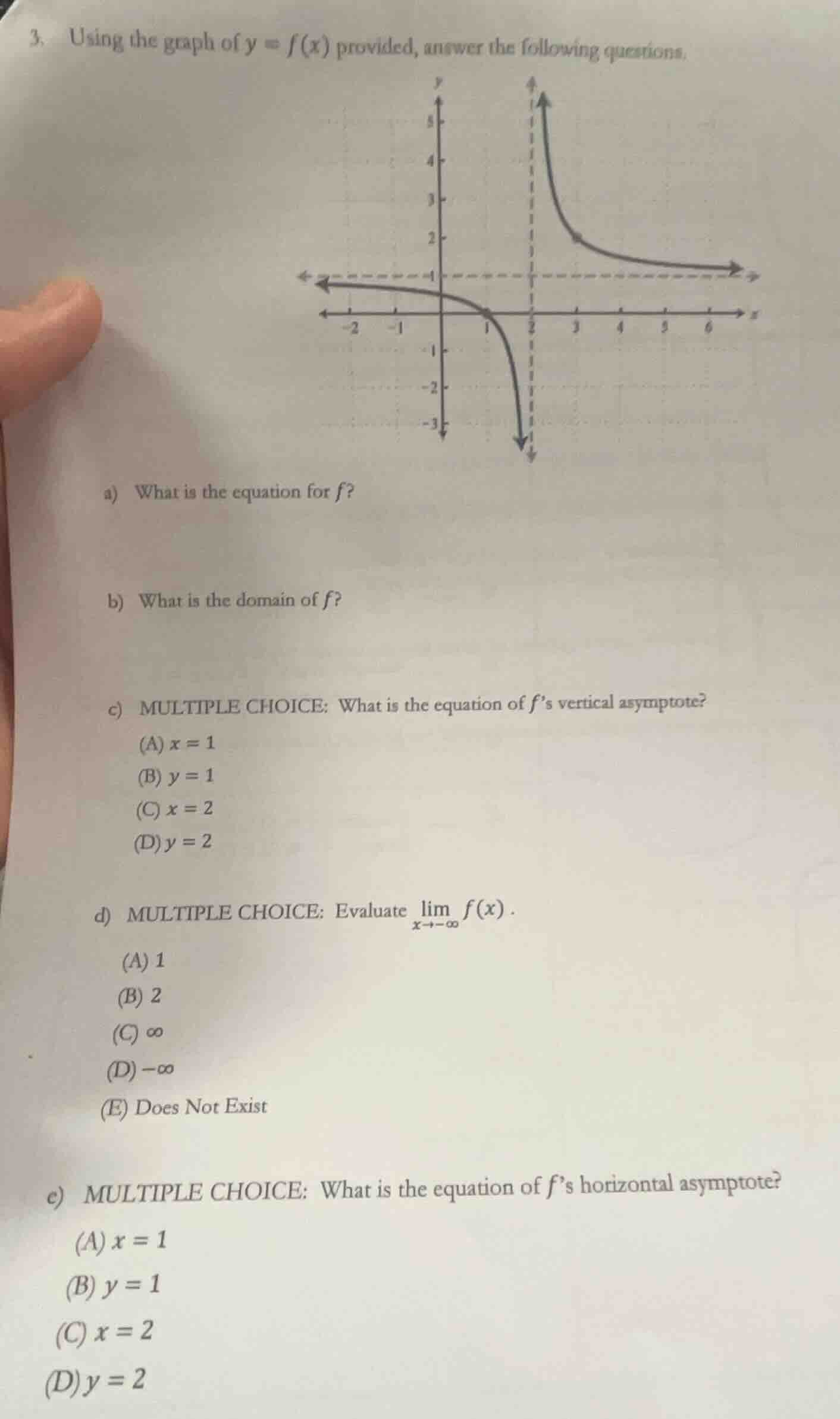
- using the graph of ( y = f(x) ) provided, answer the following questions.
a) what is the equation for ( f )?
b) what is the domain of ( f )?
c) multiple choice: what is the equation of ( f )’s vertical asymptote?
(a) ( x = 1 )
(b) ( y = 1 )
(c) ( x = 2 )
(d) ( y = 2 )
d) multiple choice: evaluate ( lim_{x \to -infty} f(x) ).
(a) 1
(b) 2
(c) ( infty )
(d) ( -infty )
(e) does not exist
e) multiple choice: what is the equation of ( f )’s horizontal asymptote?
(a) ( x = 1 )
(b) ( y = 1 )
(c) ( x = 2 )
(d) ( y = 2 )
Part (a)
Step1: Identify the type of function
The graph has a vertical asymptote and horizontal asymptote, and passes through (1,0). It looks like a rational function. Let's assume it's a transformation of \( y = \frac{1}{x} \). The vertical asymptote is at \( x = 2 \), so the denominator has a factor of \( (x - 2) \). The x - intercept is at \( x = 1 \), so the numerator has a factor of \( (x - 1) \). Let's check the horizontal asymptote. For a rational function \( f(x)=\frac{a(x)}{b(x)} \), if the degrees of \( a(x) \) and \( b(x) \) are equal, the horizontal asymptote is \( y=\frac{\text{leading coefficient of }a(x)}{\text{leading coefficient of }b(x)} \). Here, when \( x
ightarrow\pm\infty \), the function approaches \( y = 0 \)? Wait, no, looking at the left - hand side, as \( x
ightarrow-\infty \), the function approaches \( y = 0 \)? Wait, no, the left - hand part of the graph approaches \( y = 0 \)? Wait, no, the graph on the left has a horizontal asymptote? Wait, no, let's re - examine. The graph has a vertical asymptote at \( x = 2 \), x - intercept at \( x = 1 \), and when \( x>2 \), the function is in the first quadrant, decreasing towards \( y = 0 \), and when \( x<2 \), the function is in the fourth and second quadrants, with a root at \( x = 1 \) and approaching \( y = 0 \) as \( x
ightarrow-\infty \). Let's assume the function is \( f(x)=\frac{x - 1}{x - 2} \). Let's check: when \( x = 1 \), \( f(1)=\frac{1 - 1}{1 - 2}=0 \), which matches the x - intercept. The vertical asymptote is at \( x = 2 \) (since the denominator is zero at \( x = 2 \)). When \( x
ightarrow2^{+} \), \( x - 1>0 \), \( x - 2>0 \), so \( f(x)
ightarrow+\infty \), and when \( x
ightarrow2^{-} \), \( x - 1<0 \), \( x - 2<0 \), so \( f(x)
ightarrow-\infty \), which matches the graph. As \( x
ightarrow\pm\infty \), \( f(x)=\frac{x - 1}{x - 2}=\frac{1-\frac{1}{x}}{1 - \frac{2}{x}}
ightarrow1 \)? Wait, no, my mistake earlier. Wait, the left - hand side of the graph ( \( x<2 \)): when \( x
ightarrow-\infty \), \( f(x)=\frac{x - 1}{x - 2}=\frac{1-\frac{1}{x}}{1-\frac{2}{x}}
ightarrow1 \)? But the graph on the left - hand side ( \( x<2 \)) seems to approach \( y = 0 \)? Wait, no, maybe the function is \( f(x)=\frac{x - 1}{x - 2} \). Wait, let's check the value at \( x = 0 \): \( f(0)=\frac{0 - 1}{0 - 2}=\frac{1}{2} \), but the graph passes through the origin? Wait, no, the graph passes through (1,0) and the origin? Wait, the graph intersects the x - axis at \( x = 1 \) and maybe at \( x = 0 \)? Wait, the graph crosses the x - axis at \( x = 1 \) (since when \( x = 1 \), \( y = 0 \)) and maybe at \( x = 0 \)? Wait, the graph passes through the origin? Let's re - evaluate. Let's suppose the function is a rational function with vertical asymptote \( x = 2 \), x - intercepts at \( x = 0 \) and \( x = 1 \)? No, the graph crosses the x - axis at \( x = 1 \) (the point (1,0)). Let's try \( f(x)=\frac{x - 1}{x - 2} \). When \( x = 0 \), \( f(0)=\frac{-1}{-2}=\frac{1}{2} \), but the graph at \( x = 0 \) is at \( y = 0 \)? Wait, maybe the function is \( f(x)=\frac{x(x - 1)}{x - 2} \)? No, that would have a root at \( x = 0 \) and \( x = 1 \). Wait, the graph on the left ( \( x<2 \)): as \( x
ightarrow-\infty \), the function approaches \( y = 0 \)? No, the left - hand part of the graph ( \( x<2 \)) is a curve that approaches a horizontal line? Wait, no, the left - hand side ( \( x<2 \)) has a horizontal asymptote? Wait, the graph on the left ( \( x<2 \)): when \( x
ightarrow-\infty \), the function approaches \( y = 0 \)? And on the right ( \( x>2 \)), as \( x
ightarrow+\…
Step1: Recall the definition of domain
The domain of a function is the set of all real numbers for which the function is defined. For a rational function \( f(x)=\frac{x - 1}{x - 2} \), the function is undefined when the denominator is zero.
Step2: Find the value that makes the denominator zero
Set the denominator \( x - 2=0 \), which gives \( x = 2 \). So the function is defined for all real numbers except \( x = 2 \).
Step1: Recall the definition of vertical asymptote
A vertical asymptote of a rational function \( f(x)=\frac{a(x)}{b(x)} \) occurs at \( x = c \) where \( b(c)=0 \) and \( a(c)
eq0 \) (or when the function has a non - removable discontinuity at \( x = c \)).
Step2: Identify the vertical asymptote from the graph
From the graph, we can see that the function has a vertical asymptote at \( x = 2 \) (the dashed line at \( x = 2 \) where the function approaches \( \pm\infty \)). Also, from the function \( f(x)=\frac{x - 1}{x - 2} \), the denominator is zero at \( x = 2 \) and the numerator at \( x = 2 \) is \( 2 - 1=1
eq0 \), so the vertical asymptote is \( x = 2 \). Among the options, option (C) is \( x = 2 \).

Snap & solve any problem in the app
Get step-by-step solutions on Sovi AI
Photo-based solutions with guided steps
Explore more problems and detailed explanations
\( f(x)=\frac{x - 1}{x - 2} \) (or \( f(x)=1+\frac{1}{x - 2} \))