QUESTION IMAGE
Question
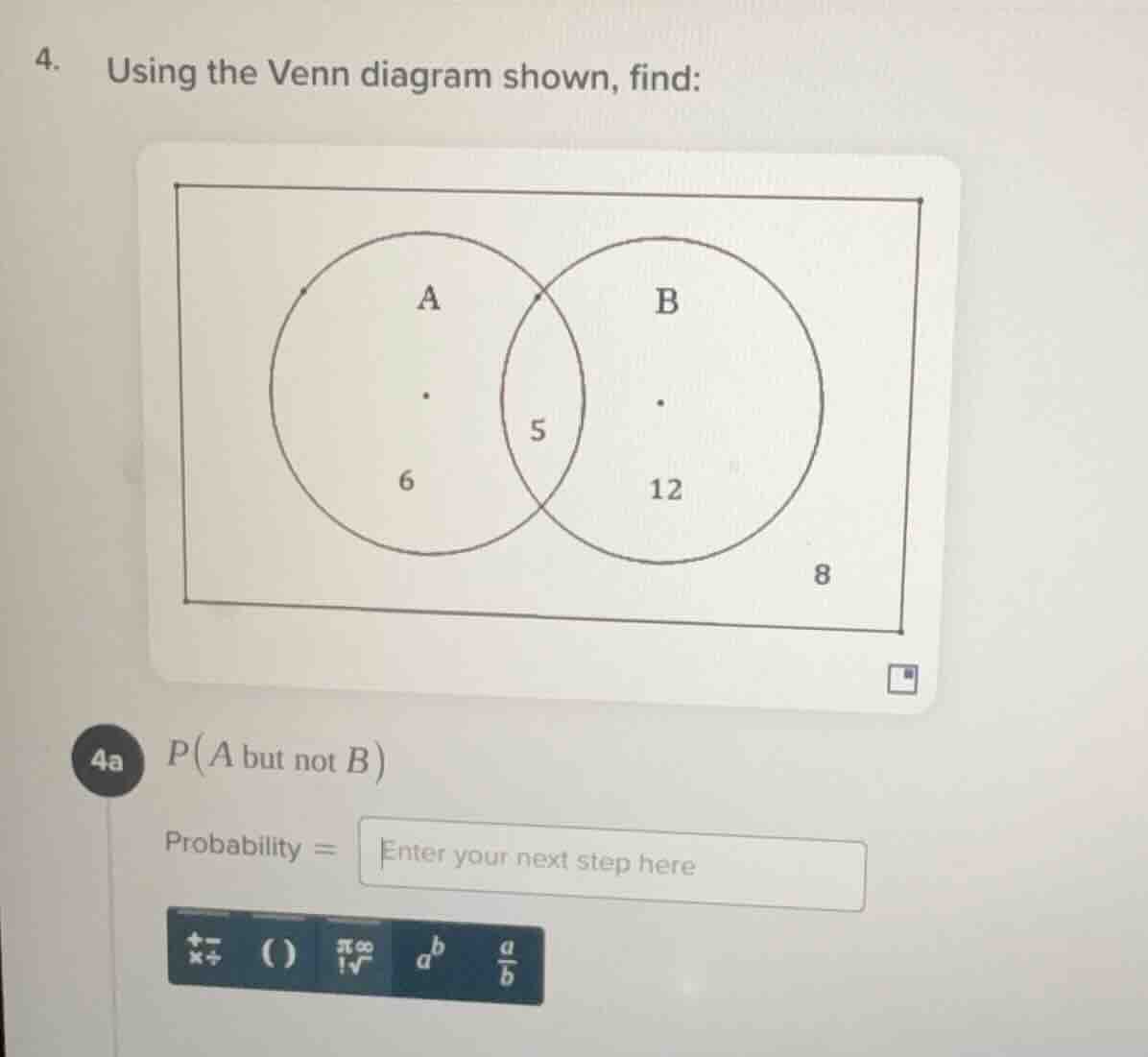
- using the venn diagram shown, find:
4a ( p(a \text{ but not } b) )
probability =
Step1: Find total number of elements
First, we calculate the total number of elements in the universal set. The elements are in set A only (6), set B only (12), the intersection of A and B (5), and outside both sets (8). So total \( N = 6 + 5 + 12 + 8 = 31 \).
Step2: Find number of elements in A but not B
The number of elements in A but not B is the number of elements only in set A, which is 6.
Step3: Calculate the probability
The probability \( P(A \text{ but not } B) \) is the number of elements in A but not B divided by the total number of elements. So \( P(A \text{ but not } B) = \frac{6}{31} \).

Snap & solve any problem in the app
Get step-by-step solutions on Sovi AI
Photo-based solutions with guided steps
Explore more problems and detailed explanations
\(\frac{6}{31}\)