QUESTION IMAGE
Question
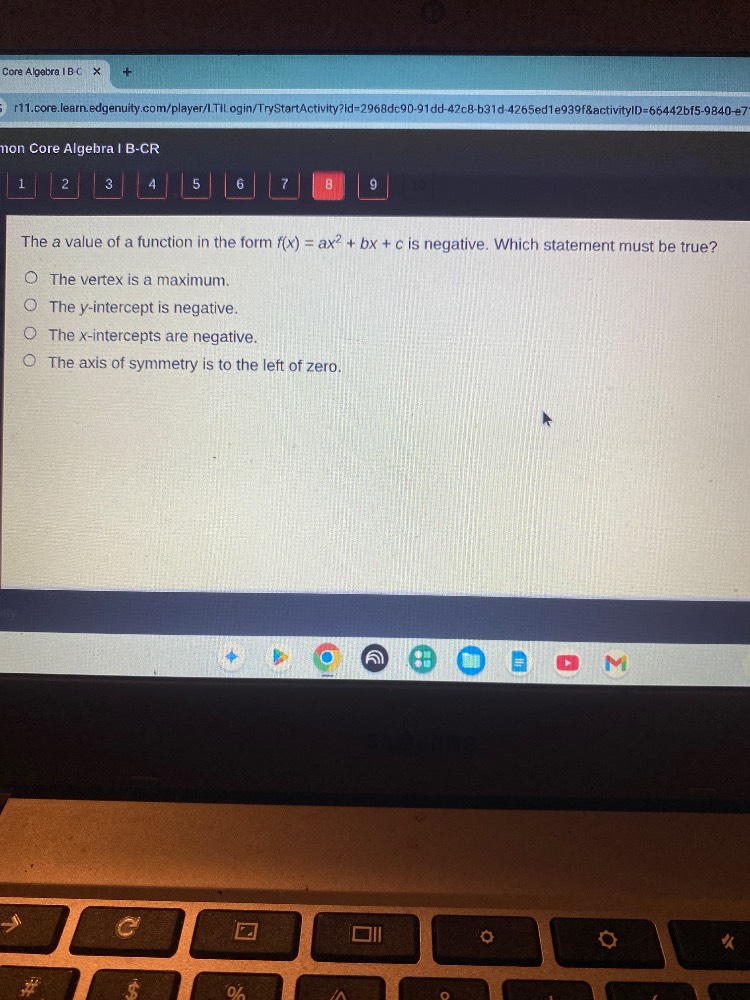
the a value of a function in the form $f(x) = ax^2 + bx + c$ is negative. which statement must be true?
the vertex is a maximum.
the y-intercept is negative.
the x-intercepts are negative.
the axis of symmetry is to the left of zero.
Brief Explanations
For a quadratic function \( f(x) = ax^2 + bx + c \), the coefficient \( a \) determines the direction the parabola opens. If \( a < 0 \), the parabola opens downward. A downward - opening parabola has its vertex as the maximum point (since the parabola opens down, the vertex is the highest point on the graph).
- For the y - intercept: The y - intercept is found by setting \( x = 0 \), so \( f(0)=c \). The value of \( a \) being negative has no direct relation to the sign of \( c \), so we can't say the y - intercept is negative.
- For the x - intercepts: The x - intercepts are found by solving \( ax^2+bx + c = 0 \). The sign of \( a \) doesn't determine the sign of the x - intercepts (they depend on \( b \), \( c \) and the discriminant as well).
- For the axis of symmetry: The axis of symmetry is given by \( x=-\frac{b}{2a} \). The sign of \( a \) (negative) and the sign of \( b \) determine the position of the axis of symmetry, so we can't say it's to the left of zero.

Snap & solve any problem in the app
Get step-by-step solutions on Sovi AI
Photo-based solutions with guided steps
Explore more problems and detailed explanations
A. The vertex is a maximum.