QUESTION IMAGE
Question
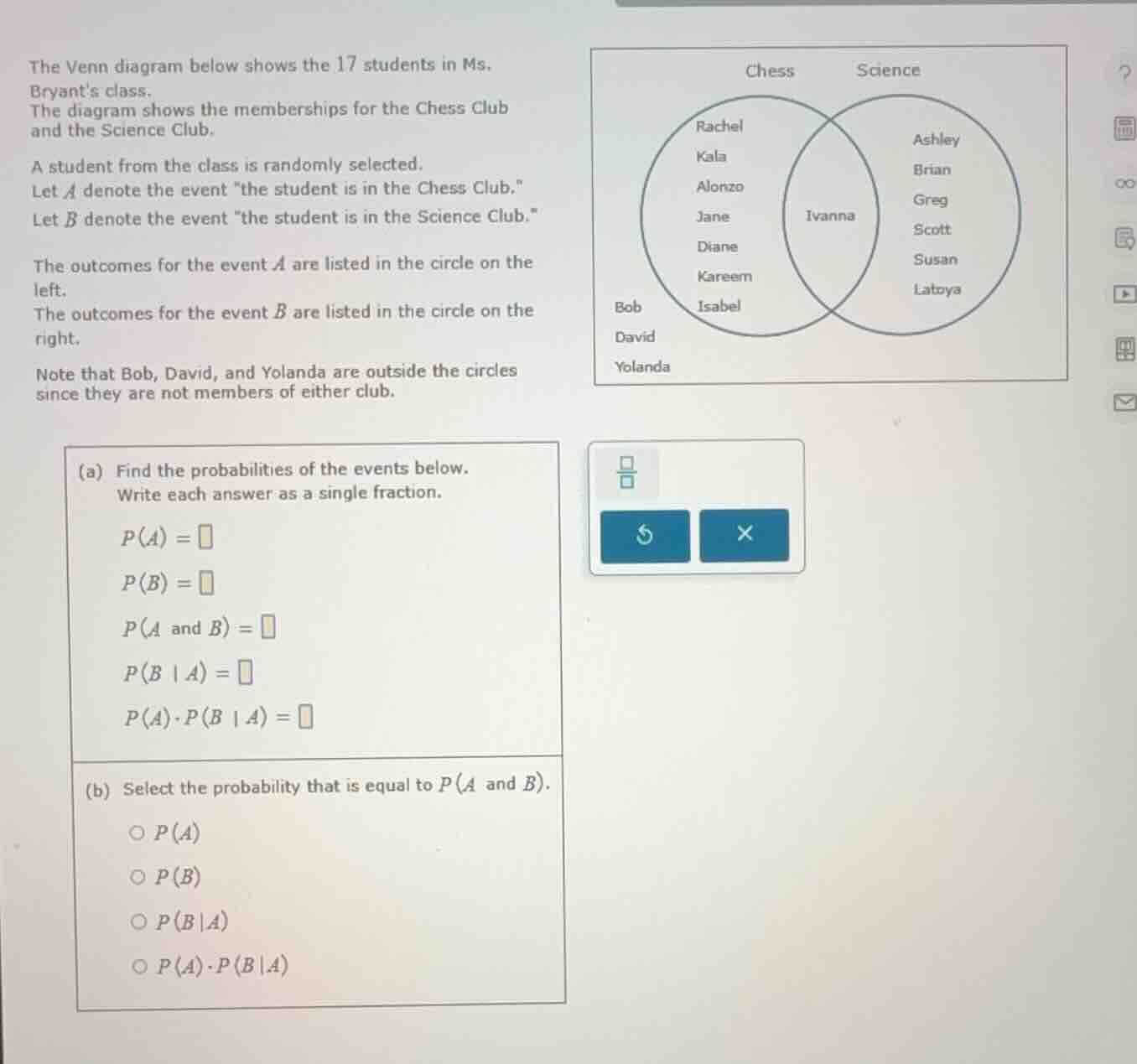
the venn diagram below shows the 17 students in ms. bryants class. the diagram shows the memberships for the chess club and the science club. a student from the class is randomly selected. let ( a ) denote the event \the student is in the chess club.\ let ( b ) denote the event \the student is in the science club.\ the outcomes for the event ( a ) are listed in the circle on the left. the outcomes for the event ( b ) are listed in the circle on the right. note that bob, david, and yolanda are outside the circles since they are not members of either club. (a) find the probabilities of the events below. write each answer as a single fraction. ( p(a) = square ) ( p(b) = square ) ( p(a \text{ and } b) = square ) ( p(b mid a) = square ) ( p(a) cdot p(b mid a) = square ) (b) select the probability that is equal to ( p(a \text{ and } b) ). ( \bigcirc p(a) ) ( \bigcirc p(b) ) ( \bigcirc p(b mid a) ) ( \bigcirc p(a) cdot p(b mid a) )
Part (a)
Step 1: Find \( P(A) \)
- Explanation: Count the number of students in event \( A \) (Chess Club) and divide by total students (17).
- Chess Club (A) members: Rachel, Kala, Alonzo, Jane, Diane, Kareem, Isabel, Ivanna. Wait, wait, let's list all: Left circle (Chess) has Rachel, Kala, Alonzo, Jane, Diane, Kareem, Isabel, and the overlap (Ivanna). Wait, no: Left circle (Chess) includes the non-overlap and overlap. Wait, the Venn diagram: Chess circle (left) has Rachel, Kala, Alonzo, Jane, Diane, Kareem, Isabel (non-overlap) and Ivanna (overlap). Then Bob, David, Yolanda are outside. Wait, let's count:
- Chess Club (A) members: Rachel, Kala, Alonzo, Jane, Diane, Kareem, Isabel, Ivanna. Wait, no: Wait the left circle (Chess) has Rachel, Kala, Alonzo, Jane, Diane, Kareem, Isabel (7) and Ivanna (1) – total 8? Wait no, let's check the diagram:
- Chess circle: Rachel, Kala, Alonzo, Jane, Diane, Kareem, Isabel (7) + Ivanna (1) = 8? Wait no, the outside are Bob, David, Yolanda (3). Total students: 8 (Chess) + 6 (Science non-overlap: Ashley, Brian, Greg, Scott, Susan, Latoya) + 1 (Ivanna) + 3 (outside) = 8+6+1+3=18? Wait no, the problem says 17 students. Wait, maybe I miscounted. Let's re-express:
Wait the problem says "17 students in Ms. Bryant’s class". Let's list all:
- Chess only: Rachel, Kala, Alonzo, Jane, Diane, Kareem, Isabel (7)
- Overlap (A and B): Ivanna (1)
- Science only: Ashley, Brian, Greg, Scott, Susan, Latoya (6)
- Outside: Bob, David, Yolanda (3)
Total: 7 + 1 + 6 + 3 = 17. Yes! So:
- Event \( A \) (Chess Club): Chess only (7) + overlap (1) = 8 students.
- Event \( B \) (Science Club): Science only (6) + overlap (1) = 7 students.
- Event \( A \) and \( B \): overlap (Ivanna) = 1 student.
So:
- \( P(A) = \frac{\text{Number in } A}{\text{Total}} = \frac{8}{17} \)
Step 2: Find \( P(B) \)
- Explanation: Count number in \( B \) (Science Club) and divide by 17.
- Number in \( B \): Science only (6) + overlap (1) = 7. So \( P(B) = \frac{7}{17} \)
Step 3: Find \( P(A \text{ and } B) \)
- Explanation: Number in both \( A \) and \( B \) (overlap) divided by 17.
- Overlap: Ivanna (1). So \( P(A \text{ and } B) = \frac{1}{17} \)
Step 4: Find \( P(B | A) \)
- Explanation: Conditional probability: \( P(B | A) = \frac{P(A \text{ and } B)}{P(A)} \)
- \( P(A \text{ and } B) = \frac{1}{17} \), \( P(A) = \frac{8}{17} \). So \( P(B | A) = \frac{\frac{1}{17}}{\frac{8}{17}} = \frac{1}{8} \)
Step 5: Find \( P(A) \cdot P(B | A) \)
- Explanation: Multiply \( P(A) \) and \( P(B | A) \)
- \( P(A) = \frac{8}{17} \), \( P(B | A) = \frac{1}{8} \). So \( \frac{8}{17} \cdot \frac{1}{8} = \frac{1}{17} \)
Part (b)
By the definition of conditional probability, \( P(A \text{ and } B) = P(A) \cdot P(B | A) \). This is the multiplication rule for probability: \( P(A \cap B) = P(A) \cdot P(B | A) \) (when \( P(A) > 0 \)).
Final Answers
(a)
- \( P(A) = \boldsymbol{\frac{8}{17}} \)
- \( P(B) = \boldsymbol{\frac{7}{17}} \)
- \( P(A \text{ and } B) = \boldsymbol{\frac{1}{17}} \)
- \( P(B | A) = \boldsymbol{\frac{1}{8}} \)
- \( P(A) \cdot P(B | A) = \boldsymbol{\frac{1}{17}} \)
(b)
The correct option is \( \boldsymbol{P(A) \cdot P(B | A)} \) (the fourth option).

Snap & solve any problem in the app
Get step-by-step solutions on Sovi AI
Photo-based solutions with guided steps
Explore more problems and detailed explanations
By the definition of conditional probability, \( P(A \text{ and } B) = P(A) \cdot P(B | A) \). This is the multiplication rule for probability: \( P(A \cap B) = P(A) \cdot P(B | A) \) (when \( P(A) > 0 \)).
Final Answers
(a)
- \( P(A) = \boldsymbol{\frac{8}{17}} \)
- \( P(B) = \boldsymbol{\frac{7}{17}} \)
- \( P(A \text{ and } B) = \boldsymbol{\frac{1}{17}} \)
- \( P(B | A) = \boldsymbol{\frac{1}{8}} \)
- \( P(A) \cdot P(B | A) = \boldsymbol{\frac{1}{17}} \)
(b)
The correct option is \( \boldsymbol{P(A) \cdot P(B | A)} \) (the fourth option).