QUESTION IMAGE
Question
video link: https://www.youtube.com/watch?v=jsdxw63qak0
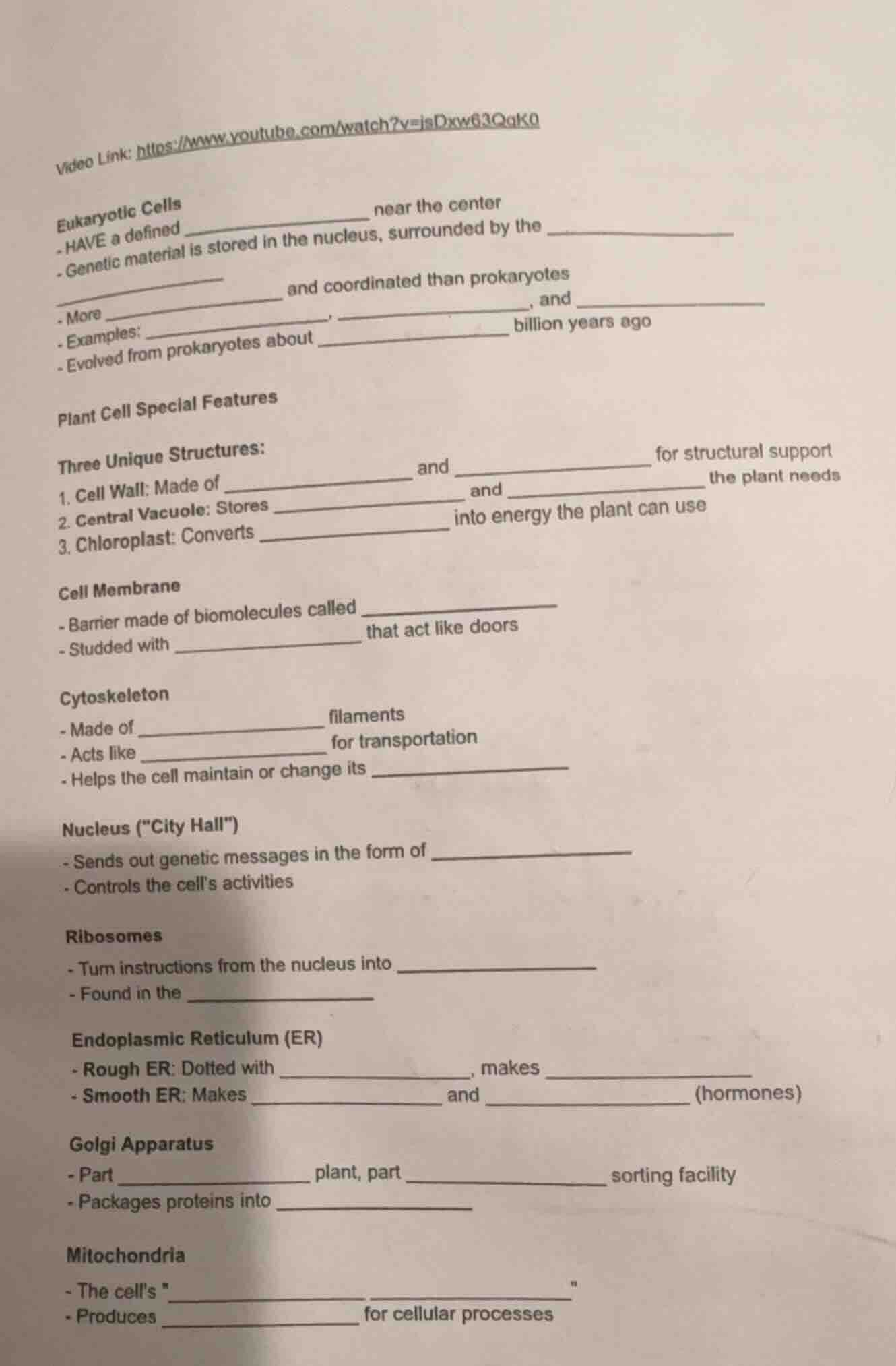
eukaryotic cells
- have a defined ____________ near the center
- genetic material is stored in the nucleus, surrounded by the ____________
- more ____________ and coordinated than prokaryotes
- examples: __________, ________, and __________
- evolved from prokaryotes about ____________ billion years ago
plant cell special features
three unique structures:
- cell wall: made of __________ and __________ for structural support
- central vacuole: stores __________ and __________ the plant needs
- chloroplast: converts ____________ into energy the plant can use
cell membrane
- barrier made of biomolecules called ____________
- studded with ____________ that act like doors
cytoskeleton
- made of ____________ filaments
- acts like ____________ for transportation
- helps the cell maintain or change its ____________
nucleus (\city hall\)
- sends out genetic messages in the form of ____________
- controls the cell’s activities
ribosomes
- turn instructions from the nucleus into ____________
- found in the ____________
endoplasmic reticulum (er)
- rough er: dotted with __________, makes __________
- smooth er: makes __________ and __________ (hormones)
golgi apparatus
- part __________ plant, part __________ sorting facility
- packages proteins into ____________
mitochondria
- the cell’s \__________ __________\
- produces ____________ for cellular processes
Brief Explanations
This worksheet is about eukaryotic cells and their structures, which falls under the subfield of Biology (Natural Science). To fill in the blanks, we use knowledge of cell biology:
Eukaryotic Cells
- HAVE a defined nucleus near the center (eukaryotic cells have a true nucleus).
- Genetic material is stored in the nucleus, surrounded by the nuclear envelope (a double - membrane structure around the nucleus).
- More complex and coordinated than prokaryotes (eukaryotic cells have more organelles and a more complex organization).
- Examples: Animals, Plants, and Fungi (these are common groups of eukaryotic organisms).
- Evolved from prokaryotes about 1.5 billion years ago (approximate time of eukaryotic evolution from prokaryotic ancestors).
Plant Cell Special Features - Three Unique Structures:
- Cell Wall: Made of cellulose and lignin for structural support (cellulose is the main component, lignin adds rigidity in some cells).
- Central Vacuole: Stores water and nutrients the plant needs (vacuoles store various substances for the plant's use).
- Chloroplast: Converts sunlight into energy the plant can use (chloroplasts perform photosynthesis, using light energy).
Cell Membrane
- Barrier made of biomolecules called phospholipids (cell membranes are mainly composed of phospholipid bilayers).
- Studded with proteins that act like doors (membrane proteins facilitate transport across the membrane).
Cytoskeleton
- Made of protein filaments (cytoskeleton is composed of different types of protein - based filaments like actin and microtubules).
- Acts like tracks for transportation (cytoskeleton filaments provide a pathway for organelle movement).
- Helps the cell maintain or change its shape (cytoskeleton is involved in cell shape maintenance and change during processes like cell division or movement).
Nucleus ("City Hall")
- Sends out genetic messages in the form of RNA (nucleus transcribes DNA into RNA to send out genetic instructions).
- Controls the cell’s activities (nucleus is the control center of the cell).
Ribosomes
- Turn instructions from the nucleus into proteins (ribosomes are the site of protein synthesis, translating mRNA into proteins).
- Found in the cytoplasm (free ribosomes) and on the rough ER (bound ribosomes, but also present in the cytoplasm).
Endoplasmic Reticulum (ER)
- Rough ER: Dotted with ribosomes, makes proteins (ribosomes on rough ER synthesize proteins).
- Smooth ER: Makes lipids and steroids (hormones) (smooth ER is involved in lipid and steroid hormone synthesis).
Golgi Apparatus
- Part post - office plant, part sorting facility (analogy: Golgi modifies, sorts, and packages molecules like a post - office).
- Packages proteins into vesicles (Golgi packages proteins into vesicles for transport to other parts of the cell or for secretion).
Mitochondria
- The cell’s "powerhouse" (mitochondria produce energy, so they are called the powerhouses of the cell).
- Produces ATP for cellular processes (mitochondria generate ATP, the energy currency of the cell, through cellular respiration).

Snap & solve any problem in the app
Get step-by-step solutions on Sovi AI
Photo-based solutions with guided steps
Explore more problems and detailed explanations
Eukaryotic Cells
- HAVE a defined \(\boldsymbol{\text{nucleus}}\) near the center
- Genetic material is stored in the nucleus, surrounded by the \(\boldsymbol{\text{nuclear envelope}}\)
- More \(\boldsymbol{\text{complex}}\) and coordinated than prokaryotes
- Examples: \(\boldsymbol{\text{Animals}}\), \(\boldsymbol{\text{Plants}}\), and \(\boldsymbol{\text{Fungi}}\)
- Evolved from prokaryotes about \(\boldsymbol{1.5}\) billion years ago
Plant Cell Special Features - Three Unique Structures:
- Cell Wall: Made of \(\boldsymbol{\text{cellulose}}\) and \(\boldsymbol{\text{lignin}}\) for structural support
- Central Vacuole: Stores \(\boldsymbol{\text{water}}\) and \(\boldsymbol{\text{nutrients}}\) the plant needs
- Chloroplast: Converts \(\boldsymbol{\text{sunlight}}\) into energy the plant can use
Cell Membrane
- Barrier made of biomolecules called \(\boldsymbol{\text{phospholipids}}\)
- Studded with \(\boldsymbol{\text{proteins}}\) that act like doors
Cytoskeleton
- Made of \(\boldsymbol{\text{protein}}\) filaments
- Acts like \(\boldsymbol{\text{tracks}}\) for transportation
- Helps the cell maintain or change its \(\boldsymbol{\text{shape}}\)
Nucleus ("City Hall")
- Sends out genetic messages in the form of \(\boldsymbol{\text{RNA}}\)
- Controls the cell’s activities
Ribosomes
- Turn instructions from the nucleus into \(\boldsymbol{\text{proteins}}\)
- Found in the \(\boldsymbol{\text{cytoplasm}}\)
Endoplasmic Reticulum (ER)
- Rough ER: Dotted with \(\boldsymbol{\text{ribosomes}}\), makes \(\boldsymbol{\text{proteins}}\)
- Smooth ER: Makes \(\boldsymbol{\text{lipids}}\) and \(\boldsymbol{\text{steroids}}\) (hormones)
Golgi Apparatus
- Part \(\boldsymbol{\text{post - office}}\) plant, part \(\boldsymbol{\text{sorting}}\) facility
- Packages proteins into \(\boldsymbol{\text{vesicles}}\)
Mitochondria
- The cell’s "\(\boldsymbol{\text{powerhouse}}\)"
- Produces \(\boldsymbol{\text{ATP}}\) for cellular processes