QUESTION IMAGE
Question
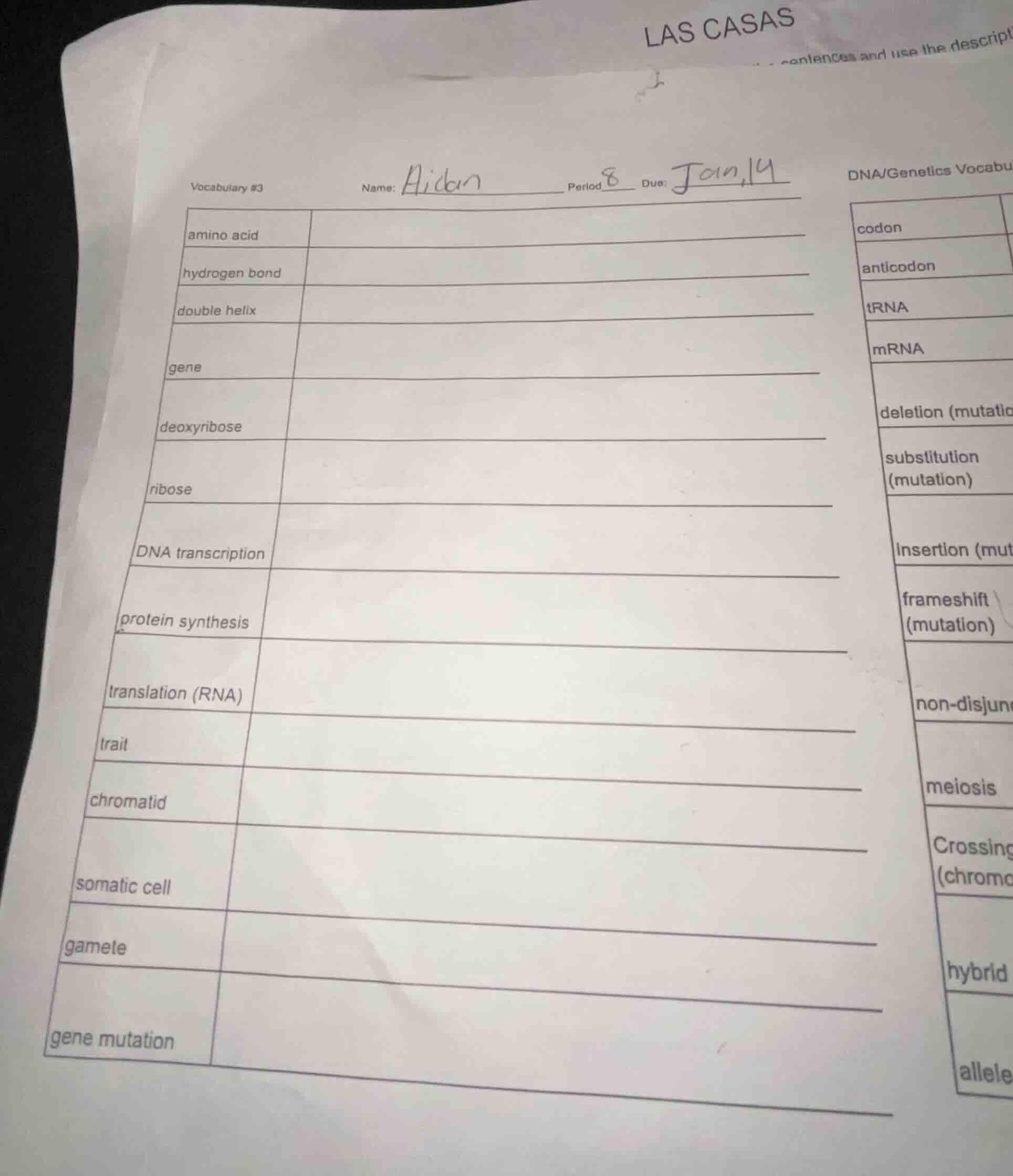
vocabulary #3
name: aiden
period 8
due: jan,14
dna/genetics vocabu
amino acid
hydrogen bond
double helix
gene
deoxyribose
ribose
dna transcription
protein synthesis
translation (rna)
trait
chromatid
somatic cell
gamete
gene mutation
codon
anticodon
trna
mrna
deletion (mutatio
substitution (mutation)
insertion (mut
frameshift (mutation)
non-disjun
meiosis
crossing (chromo
hybrid
allele
Response
To solve this, we'll define each term related to DNA/Genetics:
1. Amino Acid
- Explanation: Building blocks of proteins, with an amino group, carboxyl group, and unique R - group.
- Definition: Organic molecules containing an amino group ($-NH_2$), a carboxyl group ($-COOH$), and a specific side chain (R - group); used in protein synthesis.
2. Hydrogen Bond
- Explanation: Weak attraction between a hydrogen atom (covalently bonded to an electronegative atom like O or N) and another electronegative atom. In DNA, holds base pairs together.
- Definition: A weak intermolecular force where a hydrogen atom, bonded to a highly electronegative atom (e.g., O, N), is attracted to another electronegative atom; stabilizes DNA’s double helix (between complementary bases).
3. Double Helix
- Explanation: The three - dimensional structure of DNA, two strands twisted like a spiral staircase.
- Definition: The structural model of DNA, consisting of two polynucleotide strands coiled around a central axis, forming a spiral (staircase - like) shape; the strands are held together by hydrogen bonds between complementary nucleotide bases.
4. Gene
- Explanation: A segment of DNA that codes for a functional product (usually a protein or RNA).
- Definition: A specific sequence of DNA nucleotides that contains the information to produce a functional molecule (e.g., a protein or a non - coding RNA); the basic unit of heredity.
5. Deoxyribose
- Explanation: A 5 - carbon sugar (pentose) that is part of DNA’s nucleotide structure.
- Definition: A pentose (5 - carbon) sugar molecule; a component of DNA nucleotides (along with a phosphate group and a nitrogenous base), differing from ribose by the absence of an oxygen atom on the 2’ carbon.
6. Ribose
- Explanation: A 5 - carbon sugar, a component of RNA nucleotides.
- Definition: A pentose (5 - carbon) sugar molecule; a component of RNA nucleotides (along with a phosphate group and a nitrogenous base), with an oxygen atom on the 2’ carbon (distinguishing it from deoxyribose).
7. DNA Transcription
- Explanation: The process of making mRNA from a DNA template.
- Definition: The cellular process where the information in a DNA gene is copied into a complementary mRNA (messenger RNA) molecule; occurs in the nucleus (in eukaryotes) and is catalyzed by RNA polymerase.
8. Protein Synthesis
- Explanation: The overall process of making proteins, including transcription and translation.
- Definition: The biological process that produces proteins, consisting of two main stages: transcription (DNA $\to$ mRNA) and translation (mRNA $\to$ protein); involves ribosomes, tRNA, mRNA, and amino acids.
9. Translation (RNA)
- Explanation: The process of using mRNA to assemble amino acids into a protein, occurs at ribosomes.
- Definition: The cellular process where the sequence of mRNA codons is used to assemble a specific sequence of amino acids into a polypeptide (protein); takes place at ribosomes and involves tRNA (transfer RNA) carrying amino acids.
10. Trait
- Explanation: A characteristic of an organism, can be physical (e.g., eye color) or physiological, determined by genes (and environment, in some cases).
- Definition: A specific characteristic of an organism (e.g., height, hair color, enzyme activity); can be inherited (genetic) or influenced by the environment, and is determined by the expression of genes.
11. Chromatid
- Explanation: One of the two identical parts of a duplicated chromosome,…

Snap & solve any problem in the app
Get step-by-step solutions on Sovi AI
Photo-based solutions with guided steps
Explore more problems and detailed explanations
To solve this, we'll define each term related to DNA/Genetics:
1. Amino Acid
- Explanation: Building blocks of proteins, with an amino group, carboxyl group, and unique R - group.
- Definition: Organic molecules containing an amino group ($-NH_2$), a carboxyl group ($-COOH$), and a specific side chain (R - group); used in protein synthesis.
2. Hydrogen Bond
- Explanation: Weak attraction between a hydrogen atom (covalently bonded to an electronegative atom like O or N) and another electronegative atom. In DNA, holds base pairs together.
- Definition: A weak intermolecular force where a hydrogen atom, bonded to a highly electronegative atom (e.g., O, N), is attracted to another electronegative atom; stabilizes DNA’s double helix (between complementary bases).
3. Double Helix
- Explanation: The three - dimensional structure of DNA, two strands twisted like a spiral staircase.
- Definition: The structural model of DNA, consisting of two polynucleotide strands coiled around a central axis, forming a spiral (staircase - like) shape; the strands are held together by hydrogen bonds between complementary nucleotide bases.
4. Gene
- Explanation: A segment of DNA that codes for a functional product (usually a protein or RNA).
- Definition: A specific sequence of DNA nucleotides that contains the information to produce a functional molecule (e.g., a protein or a non - coding RNA); the basic unit of heredity.
5. Deoxyribose
- Explanation: A 5 - carbon sugar (pentose) that is part of DNA’s nucleotide structure.
- Definition: A pentose (5 - carbon) sugar molecule; a component of DNA nucleotides (along with a phosphate group and a nitrogenous base), differing from ribose by the absence of an oxygen atom on the 2’ carbon.
6. Ribose
- Explanation: A 5 - carbon sugar, a component of RNA nucleotides.
- Definition: A pentose (5 - carbon) sugar molecule; a component of RNA nucleotides (along with a phosphate group and a nitrogenous base), with an oxygen atom on the 2’ carbon (distinguishing it from deoxyribose).
7. DNA Transcription
- Explanation: The process of making mRNA from a DNA template.
- Definition: The cellular process where the information in a DNA gene is copied into a complementary mRNA (messenger RNA) molecule; occurs in the nucleus (in eukaryotes) and is catalyzed by RNA polymerase.
8. Protein Synthesis
- Explanation: The overall process of making proteins, including transcription and translation.
- Definition: The biological process that produces proteins, consisting of two main stages: transcription (DNA $\to$ mRNA) and translation (mRNA $\to$ protein); involves ribosomes, tRNA, mRNA, and amino acids.
9. Translation (RNA)
- Explanation: The process of using mRNA to assemble amino acids into a protein, occurs at ribosomes.
- Definition: The cellular process where the sequence of mRNA codons is used to assemble a specific sequence of amino acids into a polypeptide (protein); takes place at ribosomes and involves tRNA (transfer RNA) carrying amino acids.
10. Trait
- Explanation: A characteristic of an organism, can be physical (e.g., eye color) or physiological, determined by genes (and environment, in some cases).
- Definition: A specific characteristic of an organism (e.g., height, hair color, enzyme activity); can be inherited (genetic) or influenced by the environment, and is determined by the expression of genes.
11. Chromatid
- Explanation: One of the two identical parts of a duplicated chromosome, joined at the centromere.
- Definition: One of the two identical copies of a chromosome, formed during DNA replication (in the S - phase of the cell cycle); the two chromatids (sister chromatids) are joined at the centromere and separate during cell division (mitosis/meiosis II).
12. Somatic Cell
- Explanation: A body cell (not a sex cell), has a diploid number of chromosomes.
- Definition: Any cell of an organism except the reproductive (gamete - producing) cells; somatic cells are diploid (contain two sets of chromosomes, one from each parent) and undergo mitosis for growth, repair, and asexual reproduction.
13. Gamete
- Explanation: A sex cell (sperm or egg), has a haploid number of chromosomes.
- Definition: A reproductive cell (sperm in males, egg in females) that contains a haploid (n) number of chromosomes; when two gametes fuse (fertilization), a diploid zygote is formed.
14. Gene Mutation
- Explanation: A change in the DNA sequence of a gene.
- Definition: A permanent alteration in the DNA sequence of a gene; can be caused by errors in DNA replication, mutagens (e.g., radiation, chemicals), or viral infections; may affect the gene’s product (protein) and the organism’s phenotype.
15. Codon
- Explanation: A three - nucleotide sequence on mRNA that codes for an amino acid or a stop signal.
- Definition: A sequence of three adjacent nucleotides in mRNA that specifies a particular amino acid (or a start/stop signal) during protein translation; the basic unit of the genetic code.
16. Anticodon
- Explanation: A three - nucleotide sequence on tRNA that is complementary to a mRNA codon.
- Definition: A sequence of three nucleotides in tRNA (transfer RNA) that is complementary to a specific mRNA codon; allows tRNA to bind to the correct codon during translation and deliver the corresponding amino acid.
17. tRNA (Transfer RNA)
- Explanation: A type of RNA that carries amino acids to the ribosome during translation, has an anticodon.
- Definition: A small RNA molecule that functions in protein synthesis by transporting a specific amino acid to the ribosome; contains an anticodon that base - pairs with a complementary mRNA codon, ensuring the correct amino acid is added to the growing polypeptide chain.
18. mRNA (Messenger RNA)
- Explanation: A type of RNA that carries the genetic code from DNA to the ribosome.
- Definition: A single - stranded RNA molecule that is transcribed from a DNA gene; carries the genetic information (in the form of codons) from the nucleus (in eukaryotes) to the ribosome, where it is used as a template for protein synthesis.
19. Deletion (Mutation)
- Explanation: A mutation where one or more nucleotides are removed from the DNA sequence.
- Definition: A type of gene mutation (or chromosomal mutation) where one or more nucleotide bases are removed from a DNA sequence; can cause a frameshift (if the number of deleted bases is not a multiple of three) or alter the amino acid sequence of the encoded protein.
20. Substitution (Mutation)
- Explanation: A mutation where one nucleotide is replaced by another.
- Definition: A type of gene mutation where one nucleotide base in a DNA sequence is replaced by a different nucleotide; may change a single codon, potentially altering the corresponding amino acid (missense), producing a stop codon (nonsense), or having no effect (silent).
21. Insertion (Mutation)
- Explanation: A mutation where one or more nucleotides are added to the DNA sequence.
- Definition: A type of gene mutation (or chromosomal mutation) where one or more nucleotide bases are inserted into a DNA sequence; can cause a frameshift (if the number of inserted bases is not a multiple of three) and significantly alter the amino acid sequence of the encoded protein.
22. Frameshift (Mutation)
- Explanation: A mutation (insertion or deletion) that shifts the reading frame of the genetic code.
- Definition: A type of gene mutation caused by insertions or deletions of nucleotide bases that are not multiples of three; this shifts the “reading frame” of the genetic code, leading to a completely different sequence of amino acids (and often a non - functional protein) downstream of the mutation site.
23. Non - disjunction
- Explanation: An error in meiosis where chromosomes fail to separate properly.
- Definition: A chromosomal abnormality that occurs during meiosis (or mitosis) when homologous chromosomes (in meiosis I) or sister chromatids (in meiosis II or mitosis) fail to separate correctly; results in gametes (or cells) with an abnormal number of chromosomes (aneuploidy), e.g., trisomy (extra chromosome) or monosomy (missing chromosome).
24. Meiosis
- Explanation: A type of cell division that produces gametes, reduces chromosome number by half.
- Definition: A specialized form of cell division that occurs in reproductive cells (germ cells) to produce gametes (sperm and egg); consists of two consecutive divisions (meiosis I and meiosis II), resulting in four haploid daughter cells (gametes) with half the number of chromosomes of the parent cell.
25. Crossing Over
- Explanation: The exchange of genetic material between homologous chromosomes during meiosis I.
- Definition: A process that occurs during prophase I of meiosis, where homologous chromosomes pair up (synapsis) and exchange segments of their chromatids; increases genetic variation by creating new combinations of alleles on the chromosomes.
26. Hybrid
- Explanation: An organism produced by the crossbreeding of two different species or varieties.
- Definition: An organism (or offspring) resulting from the mating of two genetically distinct individuals (e.g., different species, breeds, or varieties); can exhibit a combination of traits from both parents and may be used in agriculture or research to study genetic interactions.
27. Allele
- Explanation: Different forms of a gene, located at the same locus on homologous chromosomes.
- Definition: One of two or more alternative forms of a gene that occupy the same position (locus) on homologous chromosomes; alleles can be dominant or recessive and contribute to the variation of traits within a population (e.g., alleles for blue eyes vs. brown eyes).
These definitions clarify the key concepts in DNA and Genetics, helping to complete the vocabulary worksheet.