QUESTION IMAGE
Question
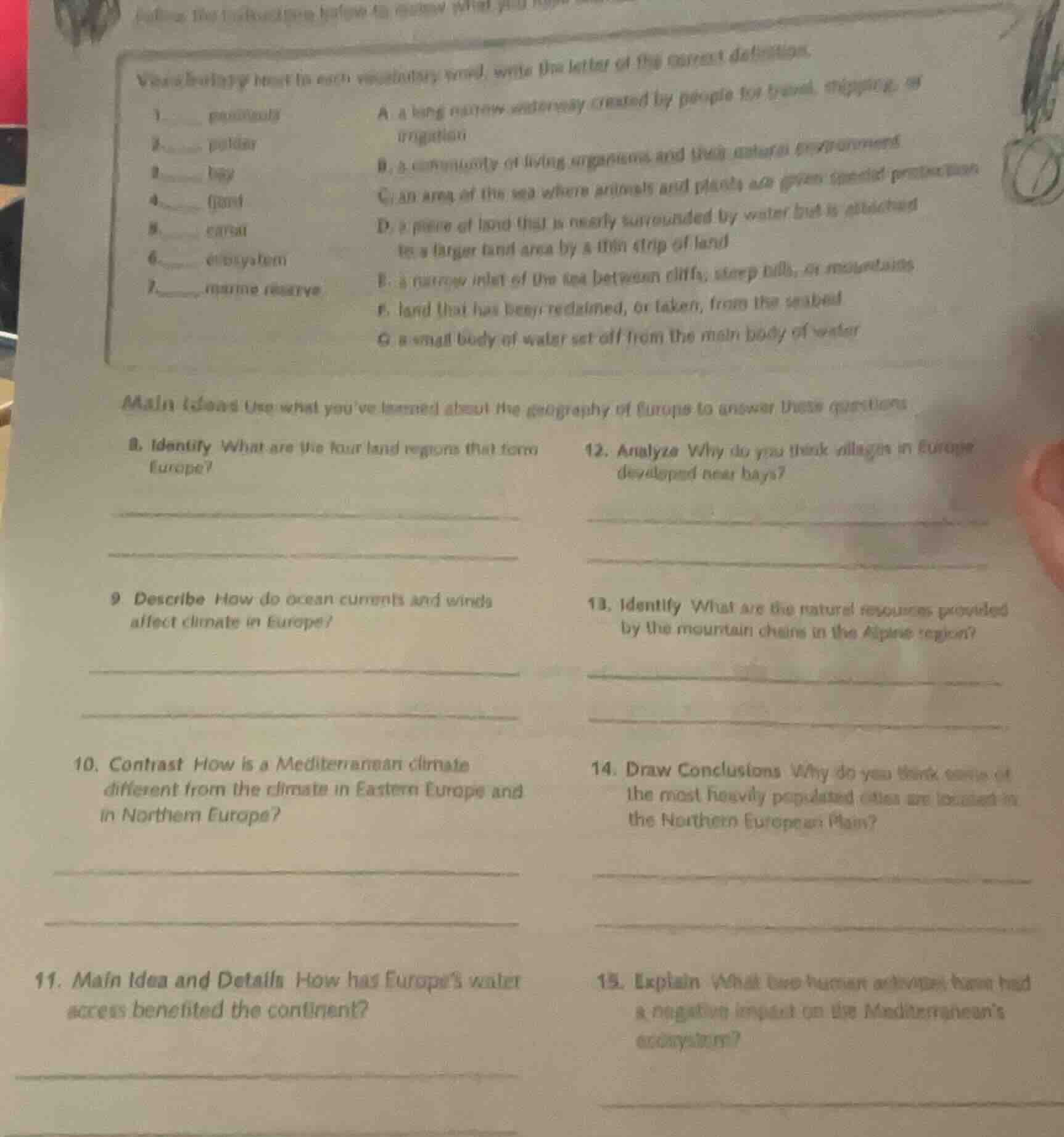
vocabulary: next to each vocabulary word, write the letter of the correct definition.
- ______ peninsula a. a long narrow waterway created by people for travel, shipping, or irrigation
- ______ polder b. a community of living organisms and their natural environment
- ______ bay c. an area of the sea where animals and plants are given special protection
- ______ fjord d. a piece of land that is nearly surrounded by water but is attached to a larger land area by a thin strip of land
- ______ canal e. a narrow inlet of the sea between cliffs, steep hills, or mountains
- ______ ecosystem f. land that has been reclaimed, or taken, from the seabed
- ______ marine reserve g. a small body of water set off from the main body of water
main ideas: use what you’ve learned about the geography of europe to answer these questions.
- identify what are the four land regions that form europe?
_________________________________________
_________________________________________
- describe how do ocean currents and winds affect climate in europe?
_________________________________________
_________________________________________
- contrast how is a mediterranean climate different from the climate in eastern europe and in northern europe?
_________________________________________
_________________________________________
- main idea and details how has europe’s water access benefited the continent?
_________________________________________
_________________________________________
- analyze why do you think villages in europe developed near bays?
_________________________________________
_________________________________________
- identify what are the natural resources provided by the mountain chains in the alpine region?
_________________________________________
_________________________________________
- draw conclusions why do you think some of the most heavily populated cities are located in the northern european plain?
_________________________________________
_________________________________________
- explain what two human activities have had a negative impact on the mediterranean’s ecosystem?
Vocabulary Match:
- peninsula - D (a piece of land that is nearly surrounded by water but is attached to a larger land area by a thin strip of land)
- polder - F (land that has been reclaimed, or taken, from the seabed)
- bay - G (a small body of water set off from the main body of water)
- fjord - E (a narrow inlet of the sea between cliffs, steep hills, or mountains)
- canal - A (a long narrow waterway created by people for travel, shipping, or irrigation)
- ecosystem - B (a community of living organisms and their natural environment)
- marine reserve - C (an area of the sea where animals and plants are given special protection)
Main Ideas (Sample Answers):
- The four land regions that form Europe are the Western Uplands, the North European Plain, the Central Uplands, and the Alpine Mountains.
- Ocean currents like the North Atlantic Drift and prevailing westerly winds bring warm, moist air to Europe, moderating temperatures (making winters milder and summers cooler) and increasing precipitation, especially in western areas.
- Mediterranean climate: hot, dry summers and mild, wet winters (found in southern Europe). Eastern Europe: continental climate with cold winters and warm summers, more temperature extremes. Northern Europe: marine or subarctic, cool temperatures, high precipitation (milder than subarctic due to currents), with tundra in far north.
- Europe’s water access (rivers, canals, seas, bays) has benefited it by enabling trade (easy transportation of goods), supporting agriculture (irrigation), providing hydroelectric power, facilitating tourism (waterways, coastal areas), and enabling fishing/aquaculture.
- Villages in Europe developed near bays for access to fishing (food source), easy maritime trade/transportation (bays as natural harbors), and access to fresh water (proximity to rivers or groundwater near coasts), plus flat land for settlement/agriculture near some bays.
- Alpine mountain chains provide natural resources like timber (forests), minerals (e.g., iron, copper), hydroelectric power (from mountain streams/rivers), and tourism (skiing, hiking), plus water sources (glaciers, rivers) for downstream regions.
- The Northern European Plain is densely populated because it has fertile soil (good for agriculture), flat terrain (easy for building cities, transportation), access to waterways (trade, irrigation), and a moderate climate (more hospitable than mountainous or arctic regions).
- Two human activities harming the Mediterranean ecosystem: Overfishing (depleting fish populations, disrupting food chains) and coastal development (housing, tourism) leading to habitat destruction (mangroves, seagrass beds), pollution (sewage, runoff), and increased erosion.

Snap & solve any problem in the app
Get step-by-step solutions on Sovi AI
Photo-based solutions with guided steps
Explore more problems and detailed explanations
Vocabulary Match:
- peninsula - D (a piece of land that is nearly surrounded by water but is attached to a larger land area by a thin strip of land)
- polder - F (land that has been reclaimed, or taken, from the seabed)
- bay - G (a small body of water set off from the main body of water)
- fjord - E (a narrow inlet of the sea between cliffs, steep hills, or mountains)
- canal - A (a long narrow waterway created by people for travel, shipping, or irrigation)
- ecosystem - B (a community of living organisms and their natural environment)
- marine reserve - C (an area of the sea where animals and plants are given special protection)
Main Ideas (Sample Answers):
- The four land regions that form Europe are the Western Uplands, the North European Plain, the Central Uplands, and the Alpine Mountains.
- Ocean currents like the North Atlantic Drift and prevailing westerly winds bring warm, moist air to Europe, moderating temperatures (making winters milder and summers cooler) and increasing precipitation, especially in western areas.
- Mediterranean climate: hot, dry summers and mild, wet winters (found in southern Europe). Eastern Europe: continental climate with cold winters and warm summers, more temperature extremes. Northern Europe: marine or subarctic, cool temperatures, high precipitation (milder than subarctic due to currents), with tundra in far north.
- Europe’s water access (rivers, canals, seas, bays) has benefited it by enabling trade (easy transportation of goods), supporting agriculture (irrigation), providing hydroelectric power, facilitating tourism (waterways, coastal areas), and enabling fishing/aquaculture.
- Villages in Europe developed near bays for access to fishing (food source), easy maritime trade/transportation (bays as natural harbors), and access to fresh water (proximity to rivers or groundwater near coasts), plus flat land for settlement/agriculture near some bays.
- Alpine mountain chains provide natural resources like timber (forests), minerals (e.g., iron, copper), hydroelectric power (from mountain streams/rivers), and tourism (skiing, hiking), plus water sources (glaciers, rivers) for downstream regions.
- The Northern European Plain is densely populated because it has fertile soil (good for agriculture), flat terrain (easy for building cities, transportation), access to waterways (trade, irrigation), and a moderate climate (more hospitable than mountainous or arctic regions).
- Two human activities harming the Mediterranean ecosystem: Overfishing (depleting fish populations, disrupting food chains) and coastal development (housing, tourism) leading to habitat destruction (mangroves, seagrass beds), pollution (sewage, runoff), and increased erosion.