QUESTION IMAGE
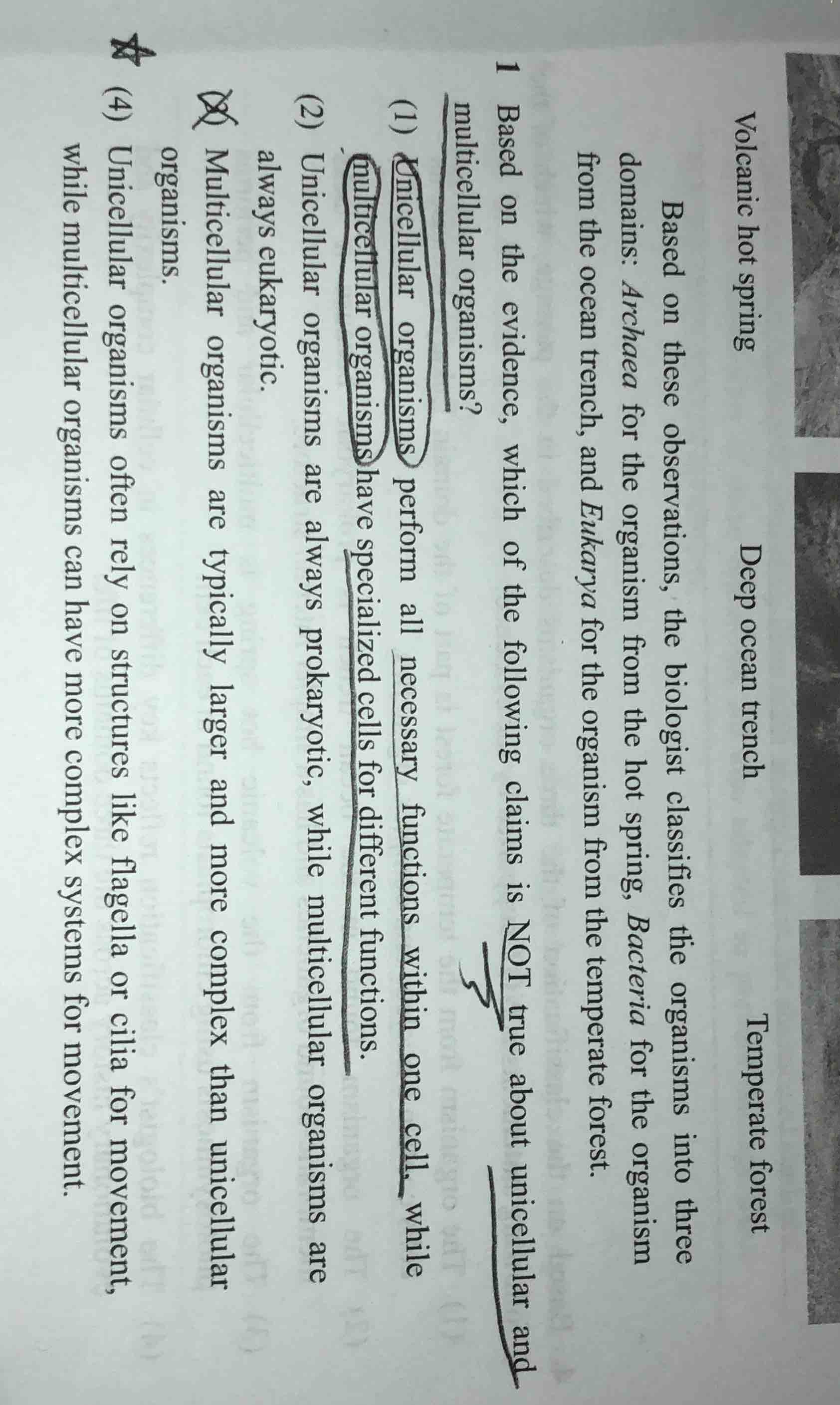
Question
volcanic hot spring
deep ocean trench
temperate forest
based on these observations, the biologist classifies the organisms into three domains: archaea for the organism from the hot spring, bacteria for the organism from the ocean trench, and eukarya for the organism from the temperate forest.
1 based on the evidence, which of the following claims is not true about unicellular and multicellular organisms?
(1) unicellular organisms perform all necessary functions within one cell, while multicellular organisms have specialized cells for different functions.
(2) unicellular organisms are always prokaryotic, while multicellular organisms are always eukaryotic.
(3) multicellular organisms are typically larger and more complex than unicellular organisms.
(4) unicellular organisms often rely on structures like flagella or cilia for movement, while multicellular organisms can have more complex systems for movement.
To determine the incorrect claim, we analyze each option:
- Option (1): Unicellular organisms (like bacteria) can perform all necessary functions within one cell, and multicellular organisms have specialized cells (e.g., muscle, nerve cells) for different functions. This is true.
- Option (2): Unicellular organisms can be prokaryotic (e.g., bacteria) or eukaryotic (e.g., some protists). Multicellular organisms are typically eukaryotic (e.g., plants, animals), but not all unicellular organisms are prokaryotic. So this claim is false.
- Option (3): Multicellular organisms are generally larger and more complex (with tissues, organs) than unicellular organisms (single - celled, simpler structure). This is true.
- Option (4): Unicellular organisms often use flagella/cilia for movement (e.g., paramecium with cilia), and multicellular organisms have more complex movement systems (e.g., muscular - skeletal system in animals). This is true.

Snap & solve any problem in the app
Get step-by-step solutions on Sovi AI
Photo-based solutions with guided steps
Explore more problems and detailed explanations
(2) Unicellular organisms are always prokaryotic, while multicellular organisms are always eukaryotic.