QUESTION IMAGE
Question
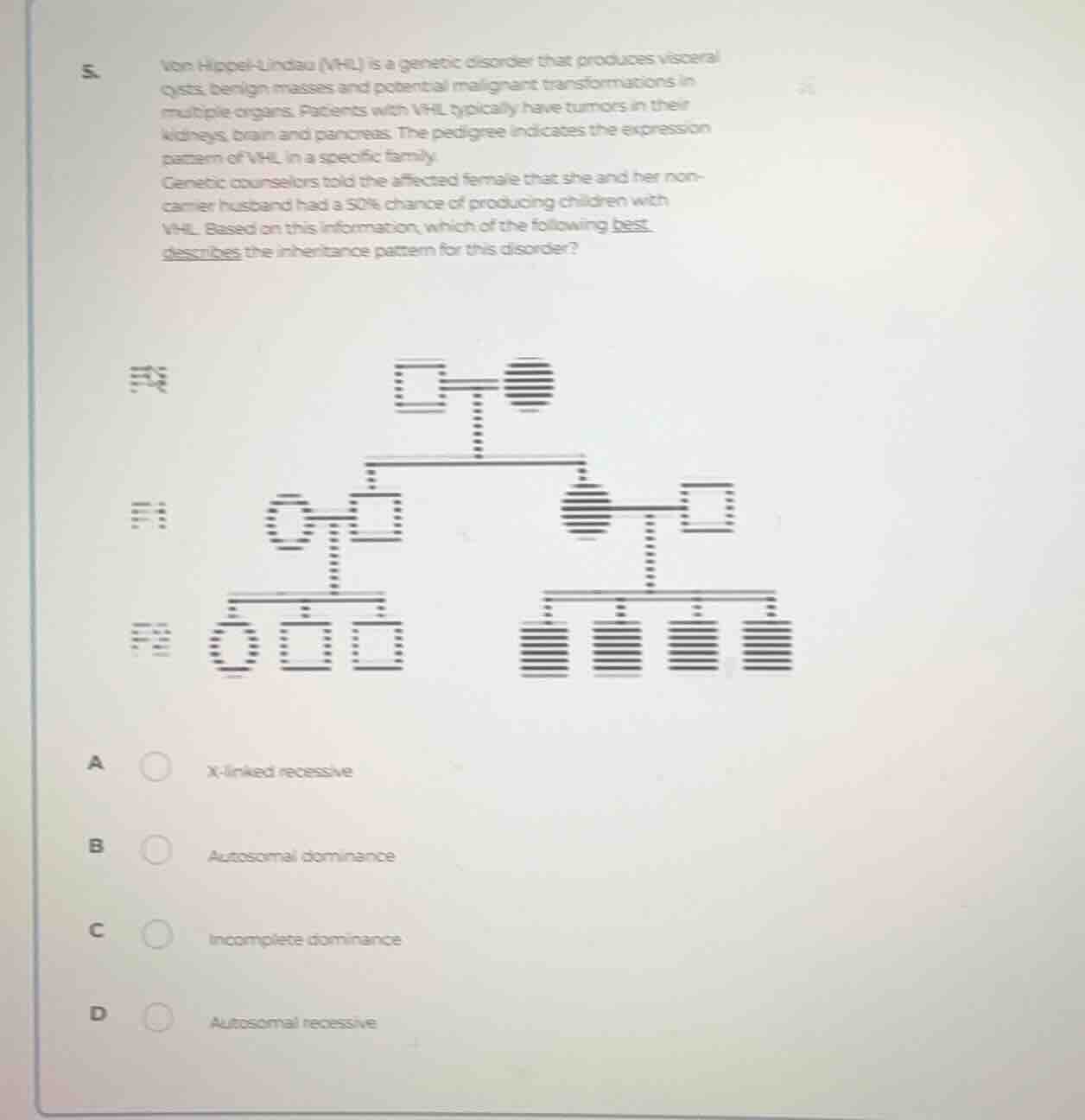
- von hippel-lindau (vhl) is a genetic disorder that produces visceral cysts, benign masses and potential malignant transformations in multiple organs. patients with vhl typically have tumors in their kidneys, brain and pancreas. the pedigree indicates the expression pattern of vhl in a specific family.genetic counselors told the affected female that she and her non-carrier husband had a 50% chance of producing children with vhl. based on this information, which of the following best describes the inheritance pattern for this disorder?a x-linked recessiveb autosomal dominancec incomplete dominanced autosomal recessive
Brief Explanations
- Key clue from genetics counseling: An affected female and non-carrier male have a 50% chance of having affected children. For an autosomal dominant disorder, an affected individual is typically heterozygous (let genotype be $Aa$) and a non-carrier is homozygous recessive ($aa$). The cross $Aa \times aa$ results in 50% $Aa$ (affected) and 50% $aa$ (unaffected) offspring, matching the given risk.
- Pedigree clues: The affected female in generation 2 has an affected mother (generation 1) and passes the trait to all 4 of her children. Autosomal dominant traits do not skip generations, and affected individuals have at least one affected parent, which aligns with the pedigree.
- Eliminating other options:
- X-linked recessive: Affected females would have affected fathers, which is not the case here, and the inheritance risk pattern does not match.
- Incomplete dominance: Would produce intermediate phenotypes, which is not described for VHL.
- Autosomal recessive: An affected individual would need two carrier parents, and the risk for children of an affected person and non-carrier would be 0% (if affected is homozygous recessive) or 50% carrier but not affected, which does not match the 50% affected risk given.

Snap & solve any problem in the app
Get step-by-step solutions on Sovi AI
Photo-based solutions with guided steps
Explore more problems and detailed explanations
B. Autosomal dominance