QUESTION IMAGE
Question
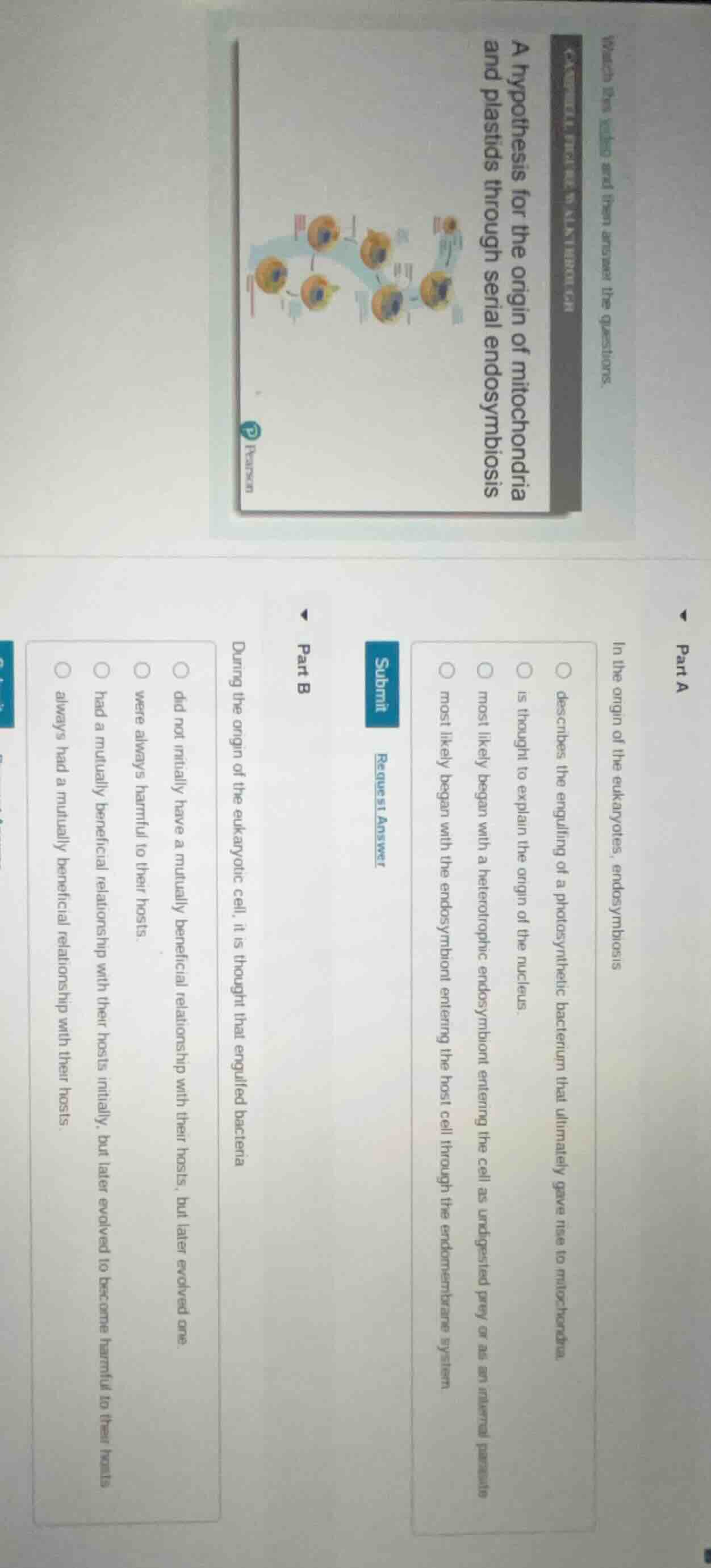
watch the video and then answer the questions. a hypothesis for the origin of mitochondria and plastids through serial endosymbiosis part a in the origin of the eukaryotes, endosymbiosis
describes the engulfing of a photosynthetic bacterium that ultimately gave rise to mitochondria.
is thought to explain the origin of the nucleus.
most likely began with a heterotrophic endosymbiont entering the cell as undigested prey or as an internal parasite
most likely began with the endosymbiont entering the host cell through the endomembrane system
submit request answer part b during the origin of the eukaryotic cell, it is thought that engulfed bacteria
did not initially have a mutually beneficial relationship with their hosts, but later evolved one.
were always harmful to their hosts.
had a mutually beneficial relationship with their hosts initially, but later evolved to become harmful to their hosts
always had a mutually beneficial relationship with their hosts.
Part A
To solve Part A, we analyze each option:
- Option 1: Describes the origin of chloroplasts (from photosynthetic bacteria), not mitochondria. Eliminate.
- Option 2: The nucleus origin is explained by other theories (e.g., invagination), not endosymbiosis. Eliminate.
- Option 3: Mitochondria likely originated from a heterotrophic endosymbiont (like an undigested prey or internal parasite) entering the cell. This matches the endosymbiotic theory for mitochondria.
- Option 4: Mitochondria's endosymbiont entry is not via the endomembrane system (that's for nuclear origin/other organelles). Eliminate.
For Part B, we analyze the endosymbiotic relationship evolution:
- Option 1: Bacteria (future mitochondria) initially had no mutual benefit (e.g., host provided protection, bacteria provided energy later). Over time, mutualism evolved. This matches.
- Option 2: If they were always harmful, the host would not retain them. Eliminate.
- Option 3: Mutualism later turning harmful is unlikely (mitochondria are essential). Eliminate.
- Option 4: "Always" mutual is incorrect; the relationship evolved to mutualism. Eliminate.

Snap & solve any problem in the app
Get step-by-step solutions on Sovi AI
Photo-based solutions with guided steps
Explore more problems and detailed explanations
C. most likely began with a heterotrophic endosymbiont entering the cell as undigested prey or as an internal parasite (assuming the option labels were A, B, C, D with this as the third option; if labels were different, adjust, but based on content, this is the correct one)