QUESTION IMAGE
Question
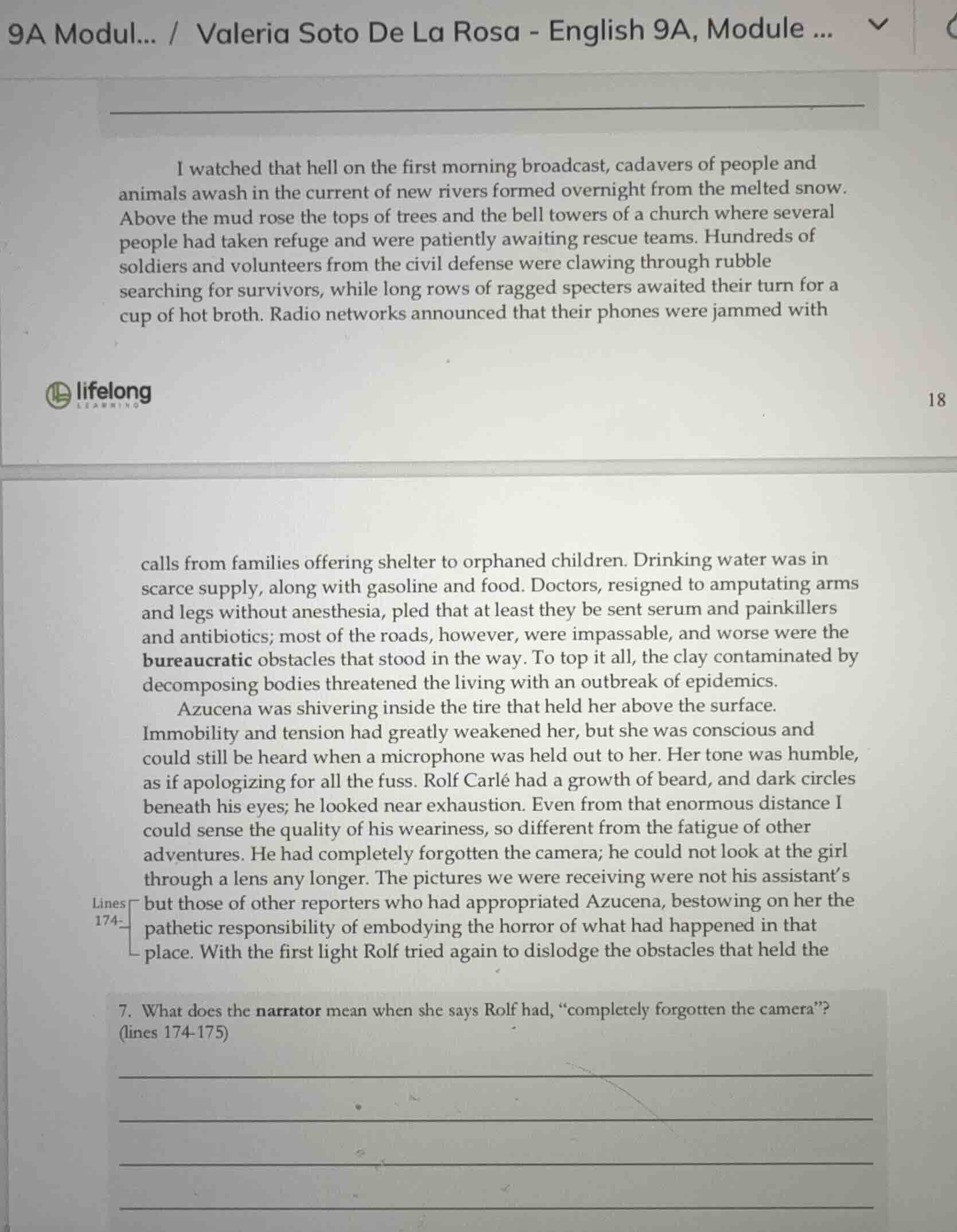
i watched that hell on the first morning broadcast, cadavers of people and animals awash in the current of new rivers formed overnight from the melted snow. above the mud rose the tops of trees and the bell towers of a church where several people had taken refuge and were patiently awaiting rescue teams. hundreds of soldiers and volunteers from the civil defense were clawing through rubble searching for survivors, while long rows of ragged specters awaited their turn for a cup of hot broth. radio networks announced that their phones were jammed with calls from families offering shelter to orphaned children. drinking water was in scarce supply, along with gasoline and food. doctors, resigned to amputating arms and legs without anesthesia, pled that at least they be sent serum and painkillers and antibiotics; most of the roads, however, were impassable, and worse were the bureaucratic obstacles that stood in the way. to top it all, the clay contaminated by decomposing bodies threatened the living with an outbreak of epidemics.
azucena was shivering inside the tire that held her above the surface. immobility and tension had greatly weakened her, but she was conscious and could still be heard when a microphone was held out to her. her tone was humble, as if apologizing for all the fuss. rolf carlé had a growth of beard, and dark circles beneath his eyes; he looked near exhaustion. even from that enormous distance i could sense the quality of his weariness, so different from the fatigue of other adventures. he had completely forgotten the camera; he could not look at the girl through a lens any longer. the pictures we were receiving were not his assistant’s but those of other reporters who had appropriated azucena, bestowing on her the pathetic responsibility of embodying the horror of what had happened in that place. with the first light rolf tried again to dislodge the obstacles that held the
- what does the narrator mean when she says rolf had, “completely forgotten the camera”? (lines 174 - 175)
The narrator means Rolf has stopped viewing Azucena as a news story to report on. Instead of fulfilling his role as a detached journalist documenting the disaster, he has become emotionally invested in her well-being, prioritizing helping her over capturing footage for broadcast. His exhaustion and focus on her plight have shifted his perspective from professional observer to someone personally connected to her suffering.

Snap & solve any problem in the app
Get step-by-step solutions on Sovi AI
Photo-based solutions with guided steps
Explore more problems and detailed explanations
Rolf has abandoned his journalistic role and become emotionally invested in Azucena, prioritizing helping her over documenting the disaster for the media. He can no longer view her as a subject to film, seeing her instead as a person in need rather than part of a news story.