QUESTION IMAGE
Question
water: all three states of matter
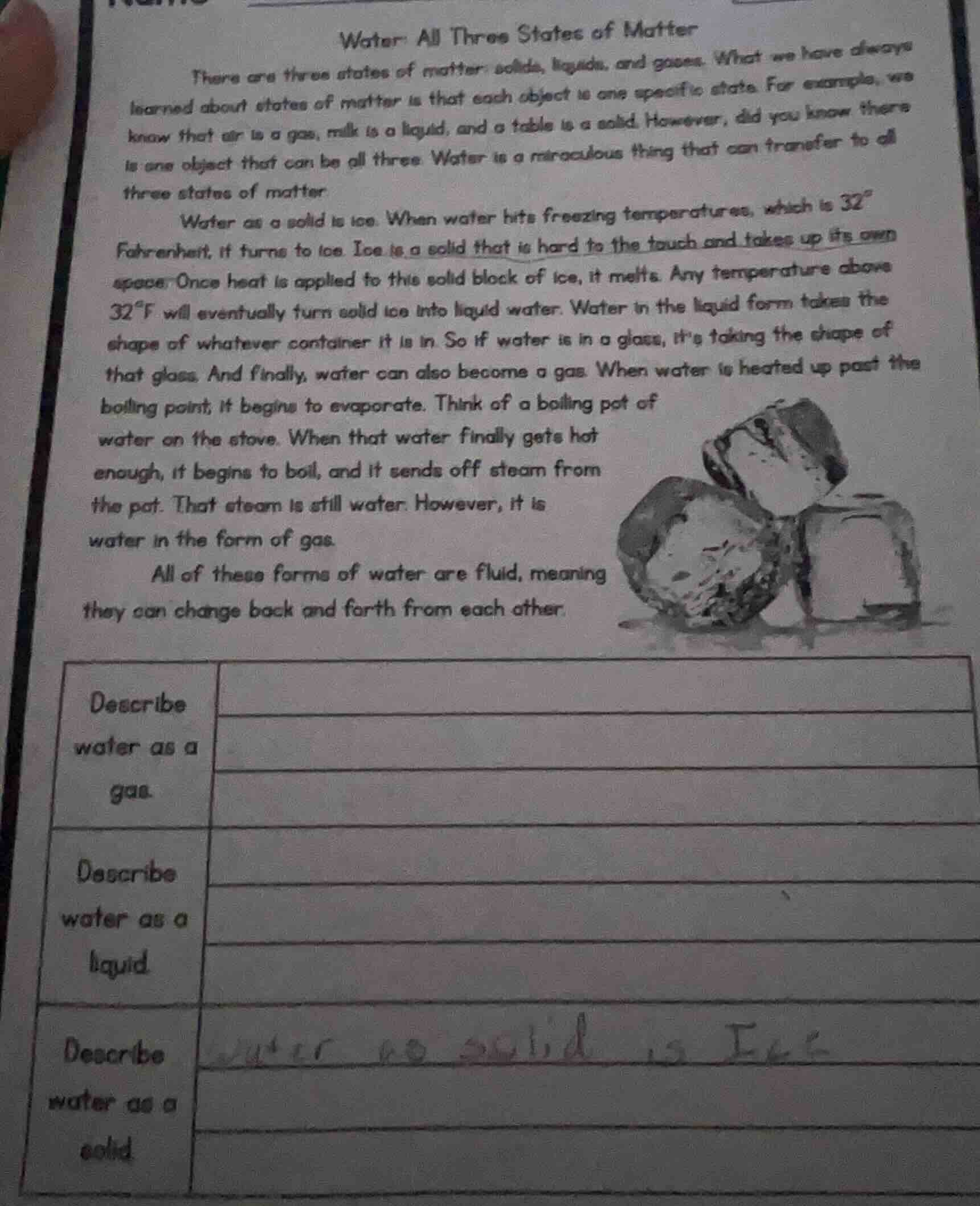
there are three states of matter: solids, liquids, and gases. what we have always learned about states of matter is that each object is one specific state. for example, we know that air is a gas, milk is a liquid, and a table is a solid. however, did you know there is one object that can be all three. water is a miraculous thing that can transfer to all three states of matter.
water as a solid is ice. when water hits freezing temperatures, which is 32° fahrenheit, it turns to ice. ice is a solid that is hard to the touch and takes up its own space. once heat is applied to this solid block of ice, it melts. any temperature above 32°f will eventually turn solid ice into liquid water. water in the liquid form takes the shape of whatever container it is in. so if water is in a glass, its taking the shape of that glass. and finally, water can also become a gas. when water is heated up past the boiling point, it begins to evaporate. think of a boiling pot of
water on the stove. when that water finally gets hot
enough, it begins to boil, and it sends off steam from
the pot. that steam is still water. however, it is
water in the form of gas.
all of these forms of water are fluid, meaning
they can change back and forth from each other.
describe
water as a
gas.
describe
water as a
liquid.
describe
water as a
solid.
Each description is derived directly from the provided text about water's three states:
- For gas: The text states boiling water produces steam, which is water as a gas.
- For liquid: The text notes liquid water matches its container's shape and forms when ice melts above 32°F.
- For solid: The text defines solid water as ice, which is hard, has a fixed volume/shape, and forms at 32°F.

Snap & solve any problem in the app
Get step-by-step solutions on Sovi AI
Photo-based solutions with guided steps
Explore more problems and detailed explanations
- As a gas: It is steam, formed when water is heated past its boiling point; it is water in gaseous form.
- As a liquid: It takes the shape of its container, and forms when ice is heated above 32°F.
- As a solid: It is ice, hard to the touch, takes up its own space, and forms when water reaches 32°F (freezing temperature).