QUESTION IMAGE
Question
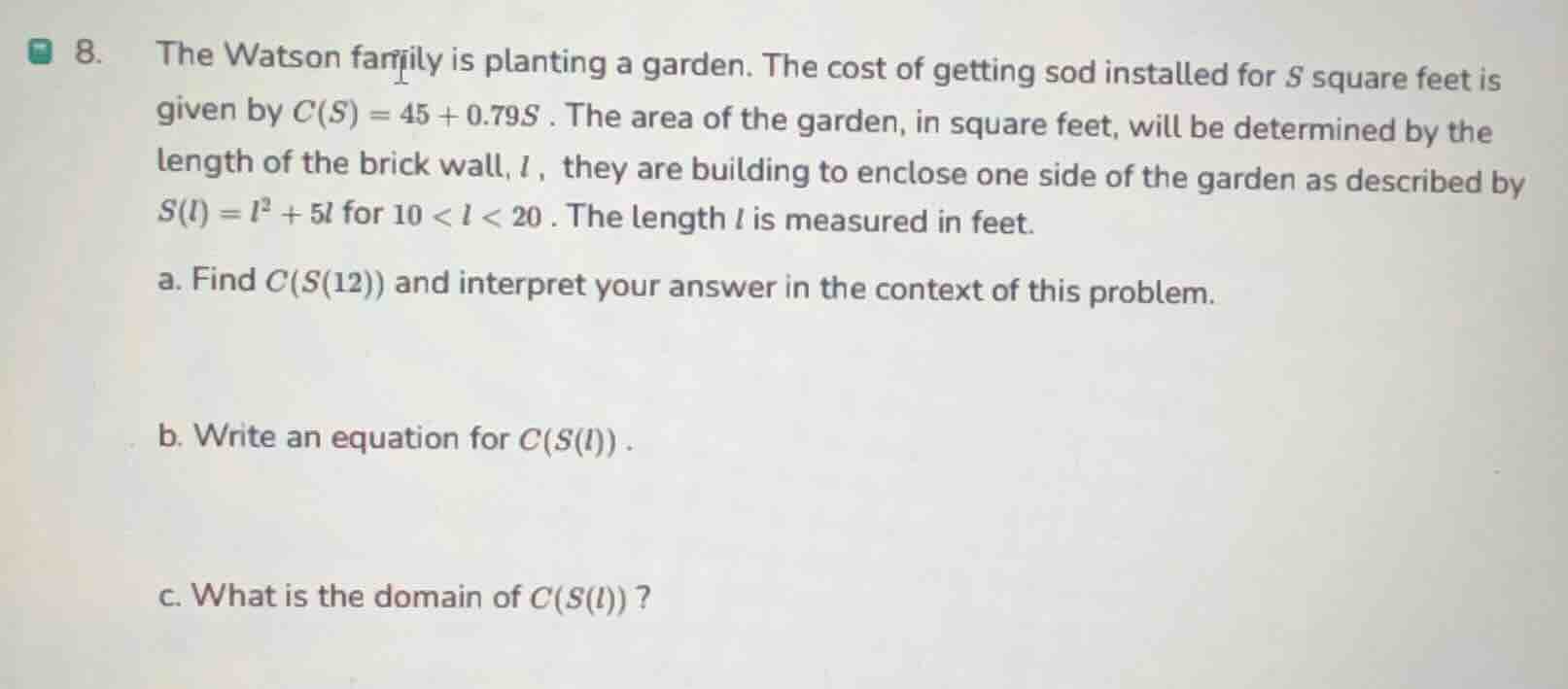
- the watson family is planting a garden. the cost of getting sod installed for ( s ) square feet is given by ( c(s) = 45 + 0.79s ). the area of the garden, in square feet, will be determined by the length of the brick wall, ( l ), they are building to enclose one side of the garden as described by ( s(l) = l^2 + 5l ) for ( 10 < l < 20 ). the length ( l ) is measured in feet.
a. find ( c(s(12)) ) and interpret your answer in the context of this problem.
b. write an equation for ( c(s(l)) ).
c. what is the domain of ( c(s(l)) )?
Part a
Step 1: Find \( S(12) \)
We are given the function \( S(l) = l^2 + 5l \). To find \( S(12) \), we substitute \( l = 12 \) into this function.
\( S(12)=12^{2}+5\times12 \)
\( S(12)=144 + 60 \)
\( S(12)=204 \)
Step 2: Find \( C(S(12)) \)
Now that we know \( S(12)=204 \), we substitute this value into the cost function \( C(S)=45 + 0.79S \).
\( C(204)=45+0.79\times204 \)
First, calculate \( 0.79\times204 \): \( 0.79\times204 = 0.79\times(200 + 4)=0.79\times200+0.79\times4 = 158+3.16 = 161.16 \)
Then, \( C(204)=45 + 161.16=206.16 \)
Interpretation:
\( C(S(12)) = 206.16 \) means that when the length of the brick wall \( l \) is 12 feet, the cost of getting sod installed for the area of the garden (determined by this length of the wall) is \$206.16.
To find \( C(S(l)) \), we need to compose the functions \( C(S) \) and \( S(l) \). We know that \( C(S)=45 + 0.79S \) and \( S(l)=l^{2}+5l \). We substitute \( S = l^{2}+5l \) into the function \( C(S) \).
\( C(S(l))=45+0.79\times(l^{2}+5l) \)
Expand the expression:
\( C(S(l))=45 + 0.79l^{2}+3.95l \)
Or, we can write it as \( C(S(l))=0.79l^{2}+3.95l + 45 \)
The domain of a composite function \( C(S(l)) \) is determined by the domain of the inner function \( S(l) \) that results in valid inputs for the outer function \( C(S) \).
We are given that the domain of \( S(l) \) is \( 10 < l < 20 \) (since \( S(l)=l^{2}+5l \) is defined for \( 10 < l < 20 \) and the cost function \( C(S) \) is a linear function that is defined for all real numbers \( S\geq0 \). Since \( l\in(10,20) \), we can check the range of \( S(l) \) to ensure that \( S(l) \) is valid for \( C(S) \).
For \( l\in(10,20) \), let's analyze \( S(l)=l^{2}+5l \). The function \( S(l) \) is a quadratic function with a positive leading coefficient, so it is increasing on the interval \( (10,20) \) (because the vertex of \( y = l^{2}+5l \) is at \( l=-\frac{5}{2} \), and for \( l>-\frac{5}{2} \), the function is increasing).
When \( l = 10 \), \( S(10)=10^{2}+5\times10=100 + 50=150 \)
When \( l = 20 \), \( S(20)=20^{2}+5\times20=400+100 = 500 \)
Since \( S(l) \) is increasing on \( (10,20) \), \( S(l)\in(150,500) \) for \( l\in(10,20) \), and \( C(S) \) is defined for all non - negative real numbers, and \( S(l)>0 \) for \( l\in(10,20) \), the domain of \( C(S(l)) \) is the same as the domain of \( S(l) \) which is \( 10 < l < 20 \) (or in interval notation \( (10,20) \))

Snap & solve any problem in the app
Get step-by-step solutions on Sovi AI
Photo-based solutions with guided steps
Explore more problems and detailed explanations
(for part a):
\( C(S(12))=\boxed{206.16} \)