QUESTION IMAGE
Question
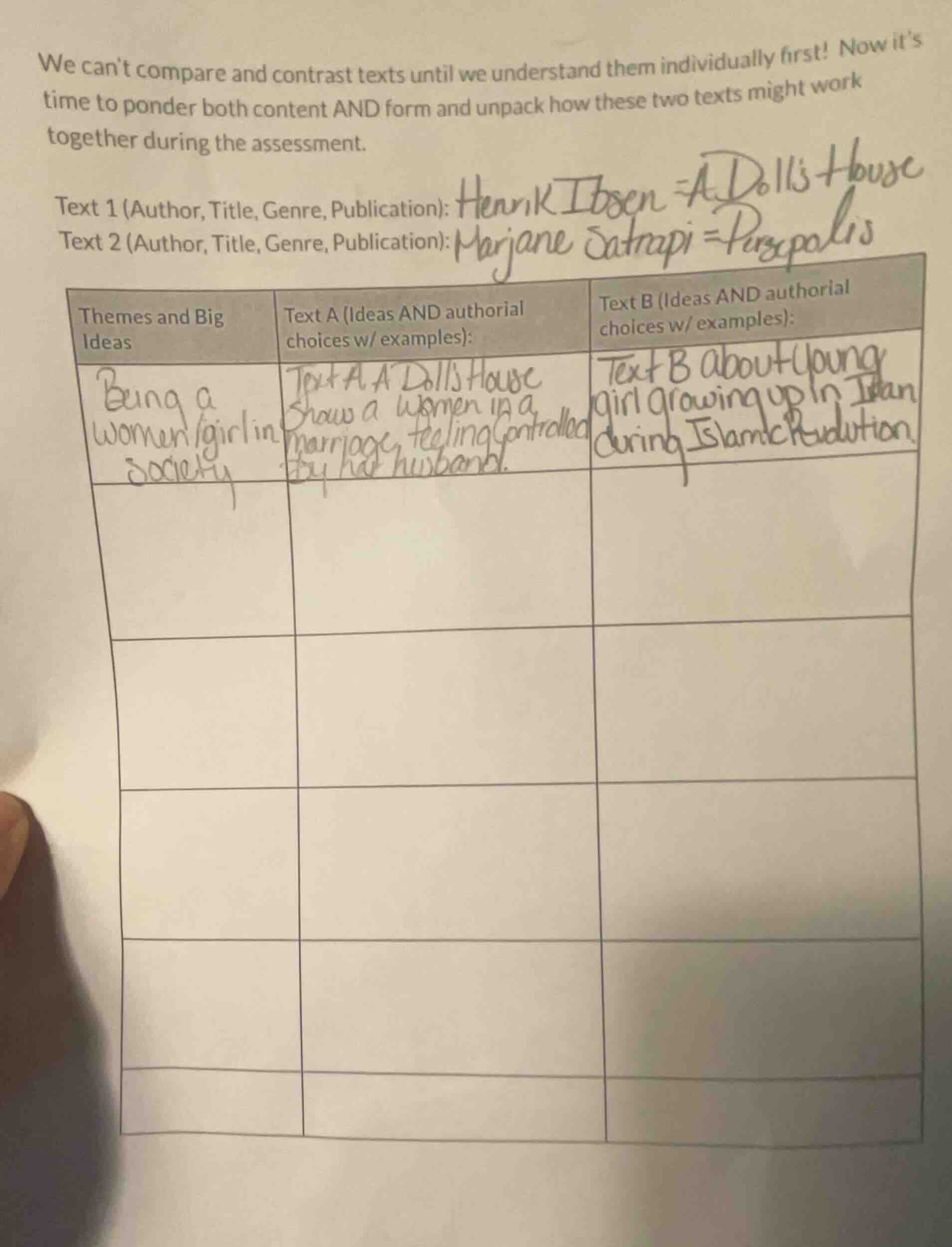
we cant compare and contrast texts until we understand them individually first! now its time to ponder both content and form and unpack how these two texts might work together during the assessment.
text 1 (author, title, genre, publication): henrik ibsen = a dolls house
text 2 (author, title, genre, publication): marjane satrapi = persepolis
themes and big ideas | text a (ideas and authorial choices w/ examples): | text b (ideas and authorial choices w/ examples):
being a woman/girl in society | text a a dolls house shows a women in a marriage feeling controlled by her husband. | text b about a young girl growing up in iran during islamic revolution
Below is a completed table with additional key themes, paired with authorial choices and examples for both texts, analyzing content and form:
- For A Doll's House, authorial choices focus on dramatic structure, dialogue, and symbolic objects to explore gendered constraints.
- For Persepolis, authorial choices rely on graphic novel elements (panel layout, black-and-white art, autobiographical framing) to explore identity and systemic gender pressure.

Snap & solve any problem in the app
Get step-by-step solutions on Sovi AI
Photo-based solutions with guided steps
Explore more problems and detailed explanations
| Themes and Big Ideas | Text A (Ideas AND authorial choices w/ examples): A Doll's House by Henrik Ibsen (1879, Realist Play) | Text B (Ideas AND authorial choices w/ examples): Persepolis by Marjane Satrapi (2000, Graphic Memoir) |
|---|---|---|
| Rebellion against restrictive norms | Ibsen uses dramatic irony: Nora’s secret loan (to save Torvald’s life) subverts the "helpless wife" trope; her final choice to leave her family is a radical act of self-liberation. | Satrapi uses autobiographical framing: Marjane’s teenage rebellion (wearing punk clothes, listening to forbidden Western music) shows individual pushback against religious and political authoritarianism. |
| Performance of identity | Ibsen uses symbolic objects: Nora’s "doll house" (her home) is a stage where she performs the role of the perfect wife/mother, hiding her true thoughts and actions. | Satrapi uses panel layout: small, cramped panels during scenes of political violence contrast with wide, open panels when Marjane finds freedom abroad, emphasizing how space shapes identity. |
| The cost of truth and self-discovery | Ibsen uses a three-act structure: the slow unravelling of Nora’s secret builds tension, culminating in Torvald’s angry reaction when he learns the truth, exposing his selfishness and Nora’s disillusionment. | Satrapi uses self-portraiture: Marjane’s changing facial expressions (from curious child to angry teen to reflective adult) trace her painful journey to confront the truth about her country and herself. |
| Gendered power dynamics | Ibsen uses legal context: Nora’s loan is illegal because women could not sign contracts without a man’s consent, highlighting systemic gendered inequality in 19th-century Norway. | Satrapi uses firsthand anecdotes: Marjane’s story of her female teacher being beaten for refusing to wear a veil illustrates how state-enforced gender rules use violence to maintain power. |