QUESTION IMAGE
Question
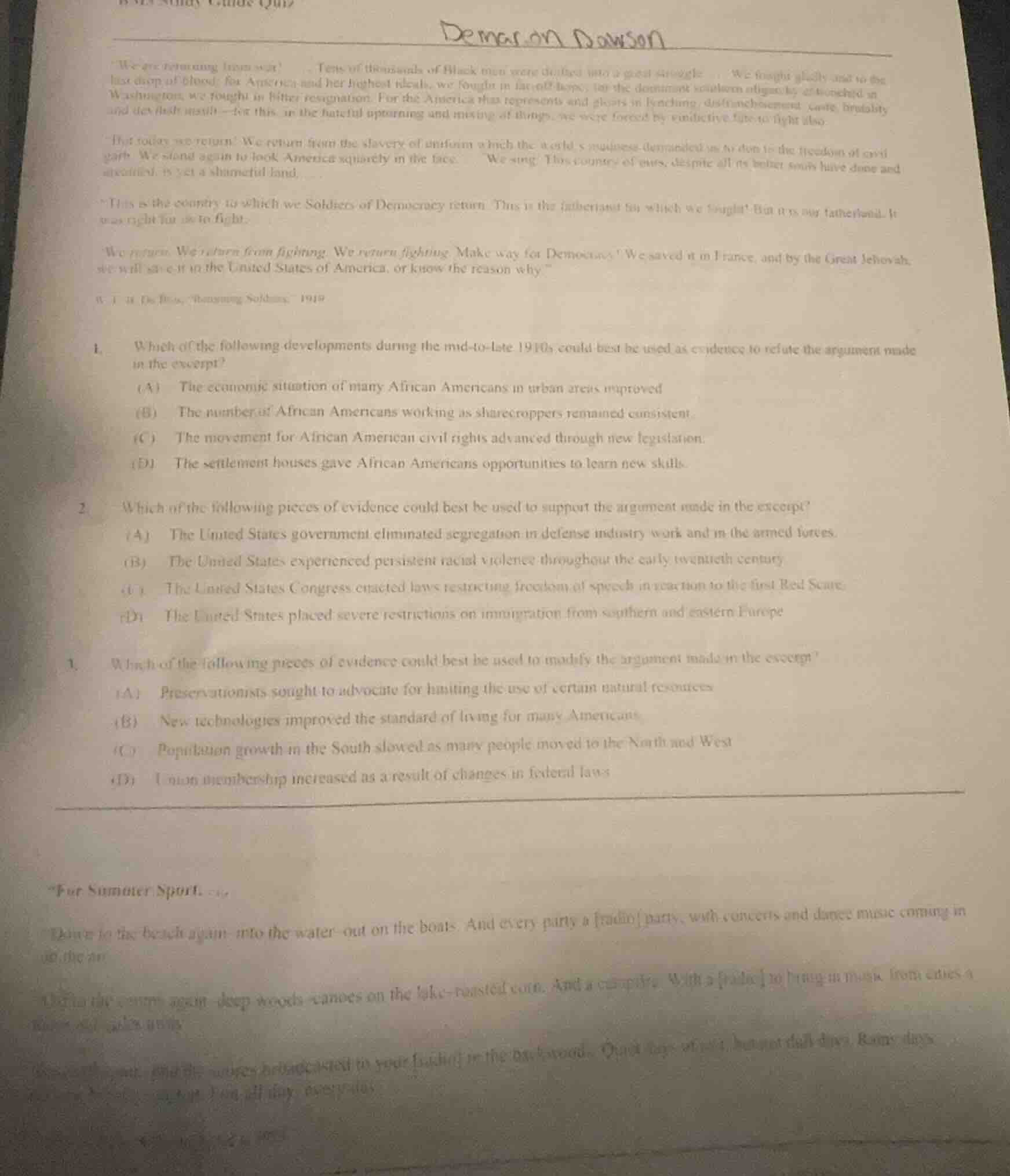
“we are returning from war!... tens of thousands of black men were drafted into a great struggle... we fought gladly and to the last drop of blood for america and her highest ideals, we fought in far-off hope, for the dominant southern oligarchy attended in washington, we fought in bitter resignation. for the america that represents and gloats in lynching, disfranchisement, caste, brutality and devilish insult—for this, in the hateful uproaring and meeting of things, we were forced by vindictive fate to fight also.
‘but today we return. we return from the slavery of uniform which the world’s madness demanded as a due to the freedom of civil garb. we stand again to look america squarely in the face... we sing: this country of ours, despite all its better souls have done and dreamed, is yet a shameful land....
‘this is the country to which we soldiers of democracy return. this is the fatherland for which we fought! but it is our fatherland. it was right for us to fight.
‘we return. we return from fighting. we return fighting. make way for democracy! we saved it in france, and by the great jehovah, we will save it in the united states of america, or know the reason why.’
—w. e. b. du bois, “returning soldiers,” 1919
- which of the following developments during the mid-to-late 1910s could best be used as evidence to refute the argument made in the excerpt?
(a) the economic situation of many african americans in urban areas improved
(b) the number of african americans working as sharecroppers remained consistent.
(c) the movement for african american civil rights advanced through new legislation.
(d) the settlement houses gave african americans opportunities to learn new skills.
- which of the following pieces of evidence could best be used to support the argument made in the excerpt?
(a) the united states government eliminated segregation in defense industry work and in the armed forces.
(b) the united states experienced persistent racial violence throughout the early twentieth century.
(c) the united states congress enacted laws restricting freedom of speech in reaction to the first red scare.
(d) the united states placed severe restrictions on immigration from southern and eastern europe
- which of the following pieces of evidence could best be used to modify the argument made in the excerpt?
(a) preservationists sought to advocate for limiting the use of certain natural resources
(b) new technologies improved the standard of living for many americans
(c) population growth in the south slowed as many people moved to the north and west
(d) union membership increased as a result of changes in federal laws
Question 1
The excerpt reflects the struggles and continued fight for democracy and civil rights by Black soldiers returning from WWI. To refute the argument (implying ongoing struggle against racial injustice), we need evidence that shows little progress or continued oppression. Option B: Sharecropping was a system of near - slavery for African Americans in the South. If the number of African Americans as sharecroppers remained consistent in the mid - to - late 1910s, it shows that their economic and social status (marked by exploitation) didn't improve, which would refute the idea of progress towards democracy and civil rights for them. Option A shows improvement, C shows legal progress (supports the need for fight but not refute), D is about settlement houses (providing opportunities, not refuting struggle).
The excerpt's argument is about the need to fight for democracy in the US as Black soldiers return, implying racial injustice and the need to combat it. Option B: Persistent racial violence in the early 20th century (including the 1910s) supports the idea that there was a need to fight for democracy (since racial violence is a sign of undemocratic, unjust treatment of African Americans). Option A is about later desegregation (not 1910s), C is about Red Scare (not related to racial justice for African Americans), D is about immigration restrictions (not related to African American civil rights struggle).
The excerpt is about African American soldiers' fight for democracy. To modify the argument, we need evidence related to African American experience or broader social change. Option C: Population growth in the South slowed as many (including African Americans in the Great Migration) moved to North and West. This migration was a response to racial violence and economic oppression in the South, which modifies the argument by showing a demographic response (migration) to the conditions described in the excerpt, adding another dimension to the African American experience in the 1910s. Option A is about conservation, B is about general standard of living (not specific to African Americans), D is about union membership (not directly related to African American civil rights struggle in the excerpt's context).

Snap & solve any problem in the app
Get step-by-step solutions on Sovi AI
Photo-based solutions with guided steps
Explore more problems and detailed explanations
B. The number of African Americans working as sharecroppers remained consistent.