QUESTION IMAGE
Question
week 6
day 3
american imperialism
explaining the topic
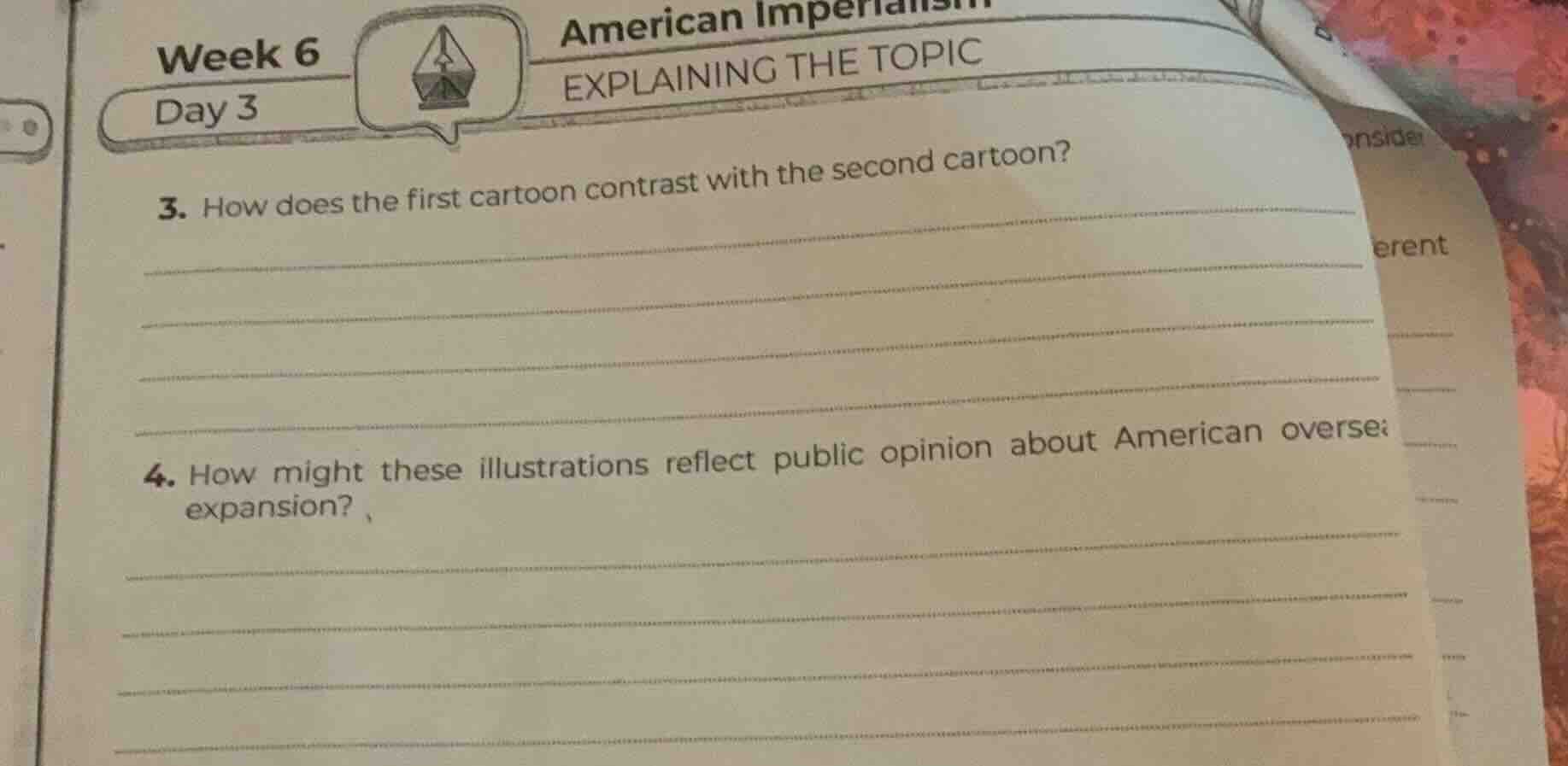
- how does the first cartoon contrast with the second cartoon?
- how might these illustrations reflect public opinion about american overseas expansion?
To answer these questions, we would need to view the cartoons related to American imperialism. Since the cartoons are not provided, here's how you could approach each question once you have the cartoons:
Question 3: How does the first cartoon contrast with the second cartoon?
- Analyze Visual Elements: Look at the symbols, characters, settings, and actions in each cartoon. For example, one might show a positive view of imperialism (e.g., a heroic figure spreading "civilization") while the other shows a negative view (e.g., a greedy figure exploiting a foreign land).
- Analyze Text (if any): Captions or labels can provide context. One cartoon might have text supporting imperialism, and the other criticizing it.
- Identify Themes: Determine the main message of each cartoon. One could emphasize the benefits of American expansion (e.g., bringing progress), and the other could highlight the harms (e.g., oppression of native peoples).
- Compare and Contrast: Note the differences in perspective, tone (positive/negative), and the way they portray American overseas expansion.
Question 4: How might these illustrations reflect public opinion about American overseas expansion?
- Interpret Each Cartoon's Message: If one cartoon is positive, it might reflect support for expansion (e.g., seeing it as a civilizing mission). If the other is negative, it might reflect opposition (e.g., seeing it as exploitation).
- Consider the Time Period: American imperialism was prominent in the late 19th/early 20th century. Public opinion was divided—some supported it for economic/strategic reasons, others opposed it for moral/humanitarian reasons.
- Synthesize the Reflections: The cartoons together might show the divided public opinion, with one representing the "pro" camp and the other the "con" camp. Or they might show a shift in opinion over time (if the cartoons are from different periods).
If you can provide descriptions or images of the cartoons, I can help you with more specific answers!

Snap & solve any problem in the app
Get step-by-step solutions on Sovi AI
Photo-based solutions with guided steps
Explore more problems and detailed explanations
To answer these questions, we would need to view the cartoons related to American imperialism. Since the cartoons are not provided, here's how you could approach each question once you have the cartoons:
Question 3: How does the first cartoon contrast with the second cartoon?
- Analyze Visual Elements: Look at the symbols, characters, settings, and actions in each cartoon. For example, one might show a positive view of imperialism (e.g., a heroic figure spreading "civilization") while the other shows a negative view (e.g., a greedy figure exploiting a foreign land).
- Analyze Text (if any): Captions or labels can provide context. One cartoon might have text supporting imperialism, and the other criticizing it.
- Identify Themes: Determine the main message of each cartoon. One could emphasize the benefits of American expansion (e.g., bringing progress), and the other could highlight the harms (e.g., oppression of native peoples).
- Compare and Contrast: Note the differences in perspective, tone (positive/negative), and the way they portray American overseas expansion.
Question 4: How might these illustrations reflect public opinion about American overseas expansion?
- Interpret Each Cartoon's Message: If one cartoon is positive, it might reflect support for expansion (e.g., seeing it as a civilizing mission). If the other is negative, it might reflect opposition (e.g., seeing it as exploitation).
- Consider the Time Period: American imperialism was prominent in the late 19th/early 20th century. Public opinion was divided—some supported it for economic/strategic reasons, others opposed it for moral/humanitarian reasons.
- Synthesize the Reflections: The cartoons together might show the divided public opinion, with one representing the "pro" camp and the other the "con" camp. Or they might show a shift in opinion over time (if the cartoons are from different periods).
If you can provide descriptions or images of the cartoons, I can help you with more specific answers!