QUESTION IMAGE
Question
wer the questions about each triangle.
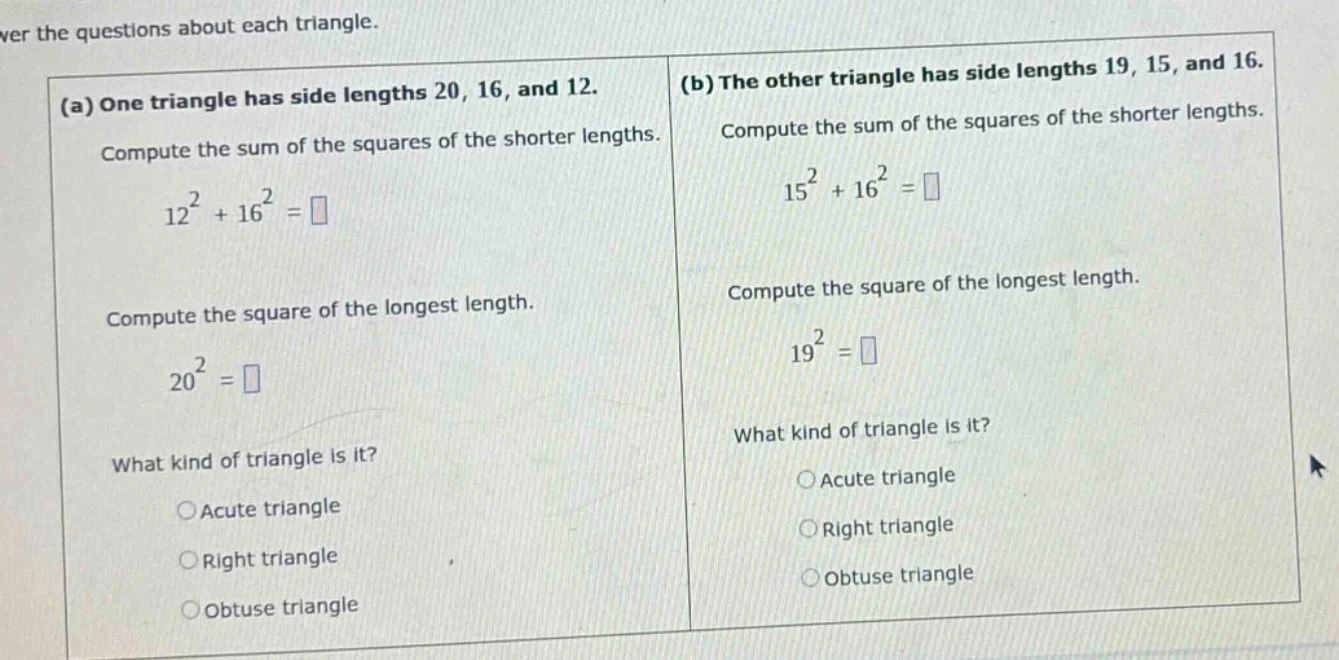
(a) one triangle has side lengths 20, 16, and 12.
compute the sum of the squares of the shorter lengths.
$12^2 + 16^2 = \square$
compute the square of the longest length.
$20^2 = \square$
what kind of triangle is it?
\\(\circ\\) acute triangle
\\(\circ\\) right triangle
\\(\circ\\) obtuse triangle
(b) the other triangle has side lengths 19, 15, and 16.
compute the sum of the squares of the shorter lengths.
$15^2 + 16^2 = \square$
compute the square of the longest length.
$19^2 = \square$
what kind of triangle is it?
\\(\circ\\) acute triangle
\\(\circ\\) right triangle
\\(\circ\\) obtuse triangle
Part (a)
Step 1: Calculate the sum of the squares of the shorter lengths
We need to compute \(12^2 + 16^2\). First, find \(12^2 = 144\) and \(16^2 = 256\). Then add them together: \(144 + 256 = 400\).
Step 2: Calculate the square of the longest length
The longest length is 20, so we compute \(20^2 = 400\).
Step 3: Determine the type of triangle
Since the sum of the squares of the two shorter sides (\(12^2 + 16^2 = 400\)) is equal to the square of the longest side (\(20^2 = 400\)), by the Pythagorean theorem, this is a right triangle.
Part (b)
Step 1: Calculate the sum of the squares of the shorter lengths
We need to compute \(15^2 + 16^2\). First, find \(15^2 = 225\) and \(16^2 = 256\). Then add them together: \(225 + 256 = 481\).
Step 2: Calculate the square of the longest length
The longest length is 19, so we compute \(19^2 = 361\). Wait, no, 19 squared is \(19\times19 = 361\)? Wait, no, 1919: 2019=380, minus 119=19, so 380 - 19 = 361? Wait, no, that's incorrect. Wait, 1919: 1019=190, 919=171, so 190 + 171 = 361? Wait, no, 15^2 + 16^2 is 225 + 256 = 481. Then 19^2: 1919. Let's calculate again: 2020=400, minus 20 + 19 = 39, so 400 - 39 = 361? Wait, no, that's wrong. Wait, 1919: 1910=190, 19*9=171, 190+171=361. But 481 is greater than 361? Wait, no, the longest side is 19? Wait, the side lengths are 19, 15, 16. So 19 is the longest. So \(19^2 = 361\). Then, since the sum of the squares of the two shorter sides (\(15^2 + 16^2 = 481\)) is greater than the square of the longest side (\(19^2 = 361\)), the triangle is acute.
Final Answers
Part (a)
- Sum of squares of shorter lengths: \(12^2 + 16^2 = \boldsymbol{400}\)
- Square of longest length: \(20^2 = \boldsymbol{400}\)
- Type of triangle: \(\boldsymbol{\text{Right triangle}}\)
Part (b)
- Sum of squares of shorter lengths: \(15^2 + 16^2 = \boldsymbol{481}\)
- Square of longest length: \(19^2 = \boldsymbol{361}\)
- Type of triangle: \(\boldsymbol{\text{Acute triangle}}\)

Snap & solve any problem in the app
Get step-by-step solutions on Sovi AI
Photo-based solutions with guided steps
Explore more problems and detailed explanations
Part (a)
Step 1: Calculate the sum of the squares of the shorter lengths
We need to compute \(12^2 + 16^2\). First, find \(12^2 = 144\) and \(16^2 = 256\). Then add them together: \(144 + 256 = 400\).
Step 2: Calculate the square of the longest length
The longest length is 20, so we compute \(20^2 = 400\).
Step 3: Determine the type of triangle
Since the sum of the squares of the two shorter sides (\(12^2 + 16^2 = 400\)) is equal to the square of the longest side (\(20^2 = 400\)), by the Pythagorean theorem, this is a right triangle.
Part (b)
Step 1: Calculate the sum of the squares of the shorter lengths
We need to compute \(15^2 + 16^2\). First, find \(15^2 = 225\) and \(16^2 = 256\). Then add them together: \(225 + 256 = 481\).
Step 2: Calculate the square of the longest length
The longest length is 19, so we compute \(19^2 = 361\). Wait, no, 19 squared is \(19\times19 = 361\)? Wait, no, 1919: 2019=380, minus 119=19, so 380 - 19 = 361? Wait, no, that's incorrect. Wait, 1919: 1019=190, 919=171, so 190 + 171 = 361? Wait, no, 15^2 + 16^2 is 225 + 256 = 481. Then 19^2: 1919. Let's calculate again: 2020=400, minus 20 + 19 = 39, so 400 - 39 = 361? Wait, no, that's wrong. Wait, 1919: 1910=190, 19*9=171, 190+171=361. But 481 is greater than 361? Wait, no, the longest side is 19? Wait, the side lengths are 19, 15, 16. So 19 is the longest. So \(19^2 = 361\). Then, since the sum of the squares of the two shorter sides (\(15^2 + 16^2 = 481\)) is greater than the square of the longest side (\(19^2 = 361\)), the triangle is acute.
Final Answers
Part (a)
- Sum of squares of shorter lengths: \(12^2 + 16^2 = \boldsymbol{400}\)
- Square of longest length: \(20^2 = \boldsymbol{400}\)
- Type of triangle: \(\boldsymbol{\text{Right triangle}}\)
Part (b)
- Sum of squares of shorter lengths: \(15^2 + 16^2 = \boldsymbol{481}\)
- Square of longest length: \(19^2 = \boldsymbol{361}\)
- Type of triangle: \(\boldsymbol{\text{Acute triangle}}\)