QUESTION IMAGE
Question
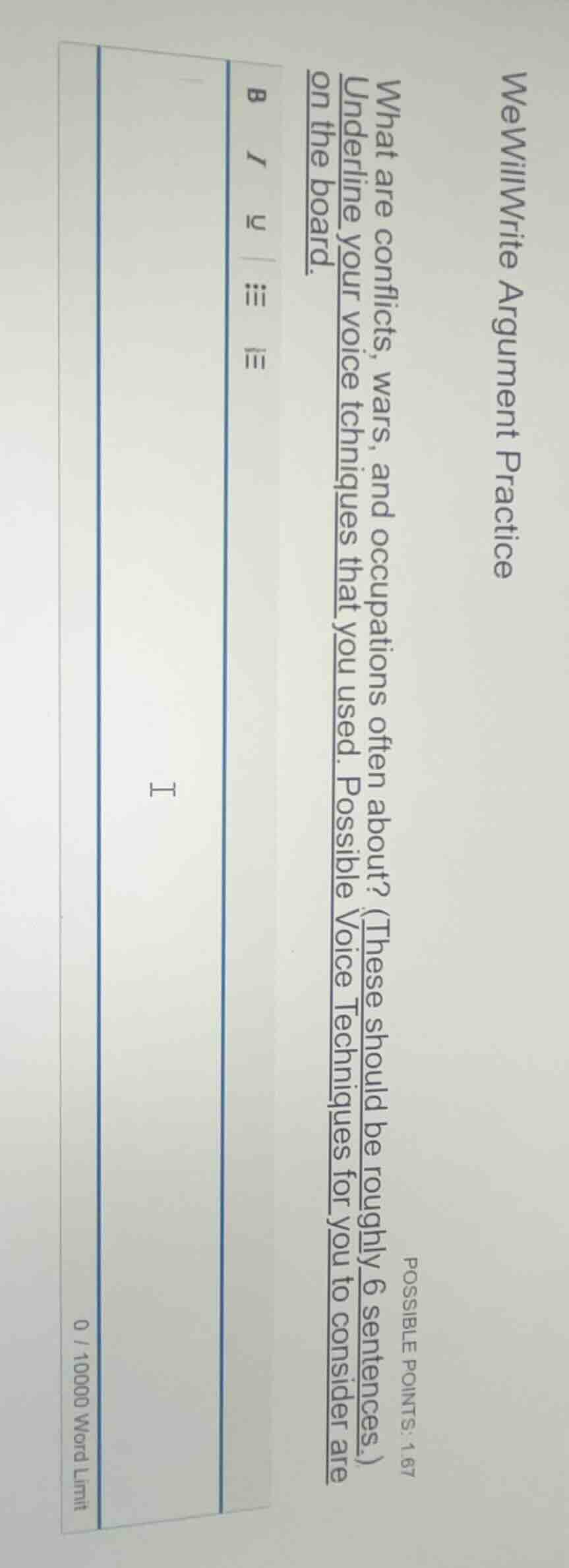
wewillwrite argument practice
possible points: 1.67
what are conflicts, wars, and occupations often about? (these should be roughly 6 sentences.)
underline your voice tchniques that you used. possible voice techniques for you to consider are on the board.
Conflicts, wars, and occupations typically center on competing claims to power, resources, territory, or ideological control. 1. Territorial disputes: Groups fight over land with strategic, cultural, or economic value, like border conflicts between nations. 2. Resource competition: Scarcity of water, oil, or fertile land drives violent clashes, such as disputes over river access in arid regions. 3. Ideological/religious differences: Wars erupt when groups with opposing political, religious, or social beliefs seek to impose their systems, like historical religious wars or modern ideological proxy conflicts. 4. Power struggles: Rival factions fight to control governments or institutions, leading to civil wars or coups. 5. Colonial occupation: Imperial powers seize territories to exploit labor and resources, sparking resistance wars from colonized peoples. 6. Ethnic tensions: Historical marginalization or competition leads to intergroup violence, often escalated into full-scale wars or oppressive occupations of minority groups.
Voice techniques used (underlined): 1. Example-based illustration (citing border/river disputes), 2. Categorical breakdown (organizing conflicts by core cause), 3. Clear definitional framing (linking occupation to exploitation), 4. Historical contextualization (referencing colonial and religious wars), 5. Concise thematic structuring (each sentence focuses on one conflict driver), 6. Specificity in examples (avoiding vague claims with concrete cases).

Snap & solve any problem in the app
Get step-by-step solutions on Sovi AI
Photo-based solutions with guided steps
Explore more problems and detailed explanations
Conflicts, wars, and occupations most commonly revolve around six core drivers:
- Competing claims to strategic or culturally significant territory, such as long-standing border disputes between neighboring nations.
- Scarcity of critical resources like water, oil, or arable land, which pushes groups to fight for access to survival and economic stability.
- Clashing ideological, religious, or political beliefs, where groups seek to impose their systems or suppress opposing worldviews.
- Power struggles between rival factions, political parties, or elites vying to control governing institutions and national resources.
- Colonial or imperial occupation, where outside powers seize territories to exploit labor, resources, or geopolitical advantages, sparking resistance wars.
- Ethnic or communal tensions fueled by historical marginalization, discrimination, or competition for limited social and economic opportunities.
Underlined voice techniques: Example-based illustration, Categorical breakdown, Clear definitional framing, Historical contextualization, Concise thematic structuring, Specificity in examples